How to Play Pickleball: The Basic Rules
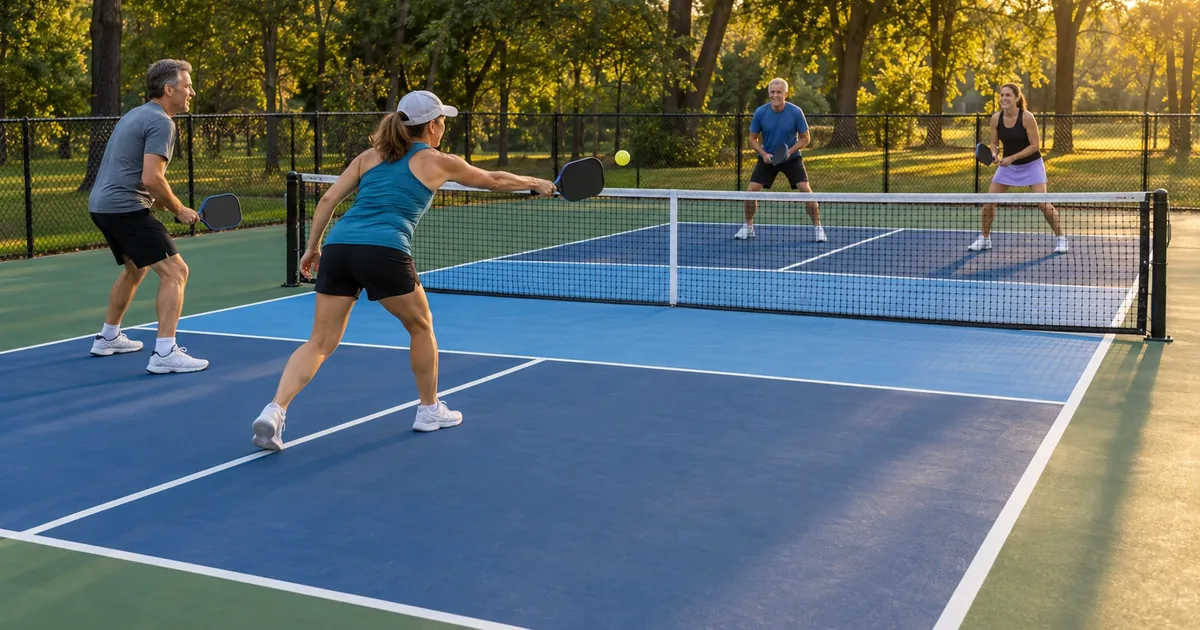
To play pickleball, you serve low and upward into the diagonal box, let the serve and the return bounce once each, stay out of the 7-foot kitchen when you volley, and score points only when you're serving. The first side to 11 points with a two-point lead wins. That's enough to start a game.
Each step has a longer page behind it. This one gives you the order to learn things in, and it's meant to be read once before your first game.
What you need
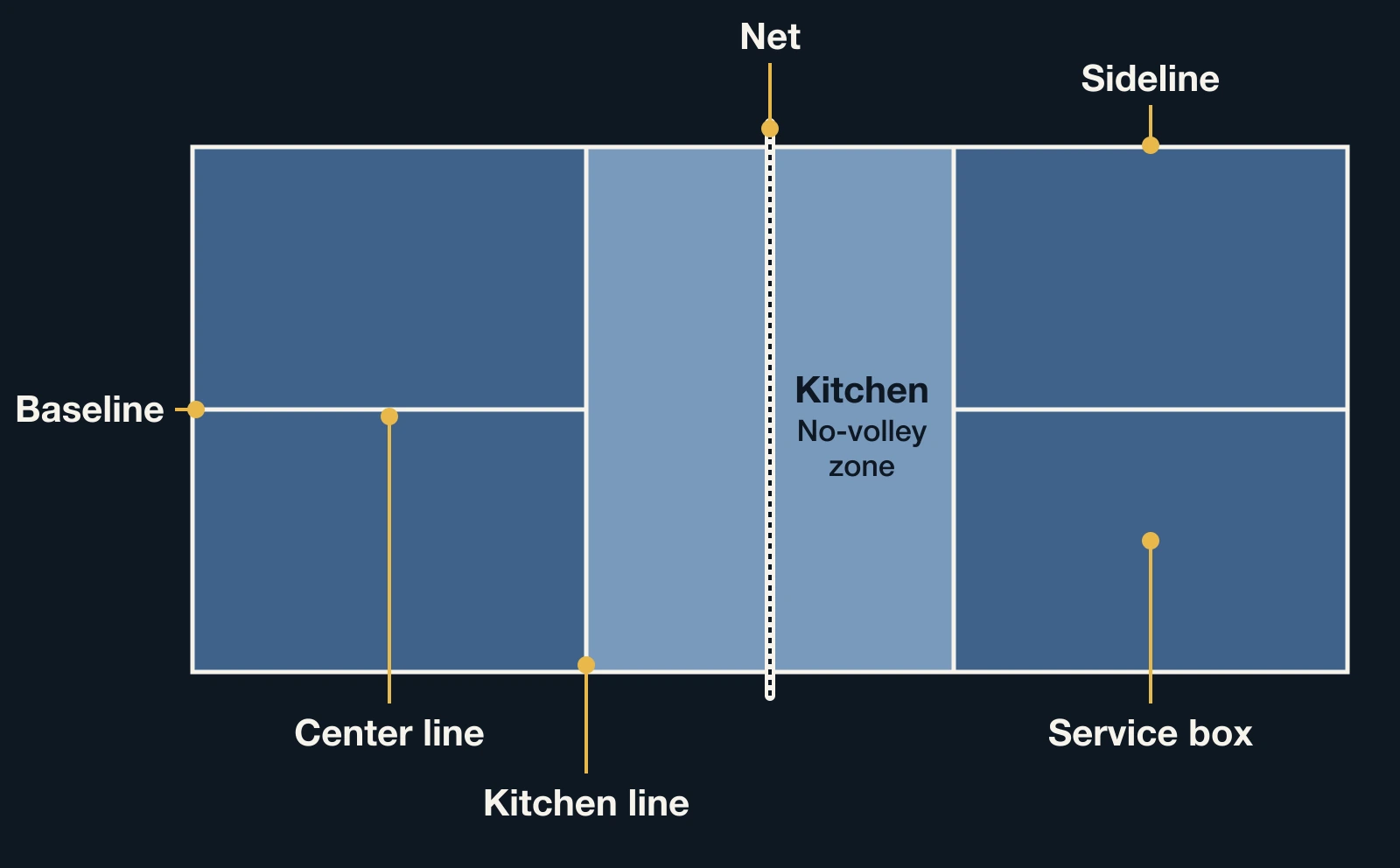
Two players for singles or four for doubles, a paddle each, a perforated plastic ball, and a net on a 20 by 44 foot court. The court dimensions page has every line and measurement, and pickleball vs tennis lines the court and gear up against tennis. The rules don't limit paddle weight, and what a lighter or heavier paddle changes is a separate question. Paddle length and width are limited, though, and the paddle size rules show how to check yours. Indoor and outdoor balls differ mainly in the holes, and what changes between them is short.
What are the basic rules of pickleball?
There are five, and you can learn them in this order.
- Serve. Stand behind the baseline and hit the ball with a low, upward swing, or after a drop, into the box diagonally across the net. It has to clear the kitchen. You get one try. Details are in the serving rules.
- Let it bounce twice. The receiver lets the serve bounce, then the serving team lets the return bounce. After those two bounces, anyone can volley. This is the two-bounce rule.
- Rally. Keep hitting the ball over the net and inside the lines until someone makes a fault. You can hit the ball in the air or after one bounce, but never after two.
- Respect the kitchen. Don't volley while you're standing in the 7-foot zone beside the net, or on its line. You can step in to hit a ball that has bounced. The kitchen rules have the details, including the momentum rule.
- Keep score. Only the serving side scores. Games go to 11 and you win by 2. The scoring guide shows the calls.
What are the common faults in pickleball?
A fault ends the rally. The common ones are:
- hitting the ball out of bounds, or into the net
- letting the ball bounce twice on your side
- volleying in the kitchen, or stepping into it after a volley
- touching the net with your body or paddle while the ball is live
- being hit by the ball (a ball that touches you, other than your paddle or hand holding it, is your fault)
- breaking a serve rule, such as a foot on the baseline
If the serving side faults, the serve passes on. If the receiving side faults, the server scores.
Singles or doubles
Both formats use the same court. In doubles, each team has two players who take turns serving, and the score is called with three numbers. Singles has one player per side and a two-number score. The doubles rules and singles rules explain the differences.
If you're choosing for your first game, doubles lets you share the court with a partner.
Calling the lines
You call balls on your own end of the court. Call a ball out only when you can clearly see space between the ball and the line. If you aren't sure, it's in, and the other team gets the benefit of the doubt (Rules 8.D and 8.E in the 2026 USA Pickleball rulebook). A ball that touches the line is in.
Your first game
Don't try to win with clever shots. Aim to get every ball over the net and inside the lines, and let the other team make the mistakes.
Flip a coin to decide who serves first (Rule 17.C.4). Warm up by hitting gently across the net for a few minutes. For clothes, the rulebook only asks you to avoid the ball's colour, and what to wear covers shoes too. Then play a game to 11. Say the score before every serve, even if you get it wrong at first. You're allowed to ask your opponents for the score before a serve, and they have to answer (Rule 6.E.1).
After the game, pick the one rule that tripped you up the most and read its page. That's a better way to learn than trying to memorize everything at once. For a day-by-day first week, see the seven-day beginner plan.
Try it without a court
If you want to see the rules play out before you go, Pickleball Game is free in your browser, with singles and doubles against the computer. There's more on how the browser game works, and the rules page walks through every rule with diagrams. If you're curious where the game came from, read the history of pickleball and the story of how it got its name.