Pickleball Paddle Weight: What Light and Heavy Change
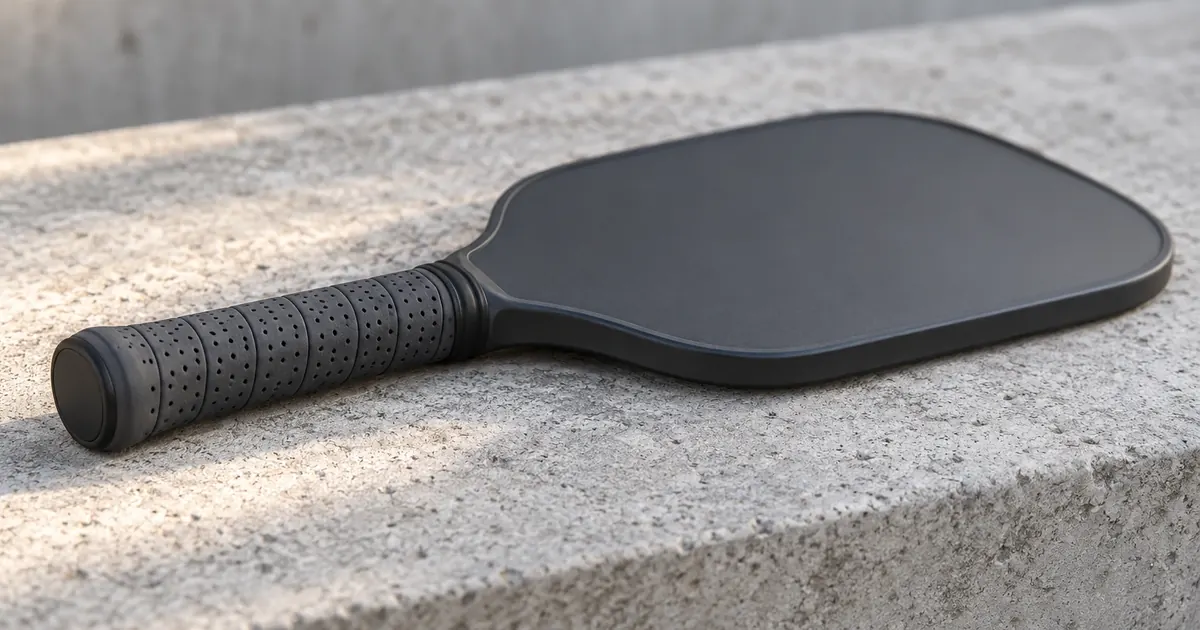
Pickleball paddle weight has no limit: Rule 3.D.3 of the 2026 rulebook says there is no restriction. What weight changes is how the paddle swings, and that depends on where the mass sits as well as how much there is. Light, mid and heavy are shop labels, and the shops draw the lines in different places.
This page sorts three things apart: what the rulebook says, what physics papers found, and what shop habit calls "light" or "heavy". It names no products and gives no buying advice. For everything else a first game needs, see the equipment checklist for beginners. For the basics of the game, see how to play pickleball or pickleball for beginners.
Is there a weight limit on a pickleball paddle?
No. Rule 3.D.3 of the 2026 USA Pickleball rulebook says there is no restriction on paddle weight. The Equipment Standards Manual says the same (2.E.4). The rules page covers the rest of the game.
Size is limited separately. Length plus width can't pass 24 inches, and length can't pass 17 inches (Rule 3.D.2). The paddle size rules page shows how to measure a paddle against both limits.
You can change a paddle's weight only in the ways the rulebook allows. Those are weighted tape (Rule 3.D.6.b) and, on paddles that have one, the maker's own integrated weight system (Rule 3.D.6.c). This page checked the 2026 edition.
What is the standard weight of a pickleball paddle?
There isn't one. The weight bands you see are shop labels, and they disagree.
| Guide | Light | Mid | Heavy |
|---|---|---|---|
| One retailer's guide | below 7.3 oz (207 g) | 7.3 to 8.3 oz | above 8.3 oz (235 g) |
| Another retailer's guide | below 7.2 oz | 7.3 to 8.2 oz | 8.4 oz and up |
| A pickleball facility's guide | about 6.0 to 7.3 oz | about 7.3 to 8.3 oz | about 8.3 oz and up |
The facility's own page calls its bands "industry convention rather than a standard". So is 8.3 ounces heavy? It's the top of mid in the first guide and the start of heavy in the third. The second guide skips it, jumping from 8.2 to 8.4.
What does paddle weight change?
Weight changes how much effort a swing takes, and how much of the paddle meets the ball. Here's what the research says, and how far it goes.
| Effect | What the research says | How far it goes |
|---|---|---|
| Swing speed | Cross and Bower (2006) had four male students swing six rods as hard as they could. Speed fell as swing weight rose. When swing weight stayed the same and mass changed, speed stayed about the same. | Rods, not paddles, and a small group. |
| Power | At the same swing speed, a heavier paddle puts a little more into the ball. About 2 percent from 7.0 to 8.5 oz in the sums below. | An idealized size of effect, not a prediction. |
| Steadiness | Tennis Warehouse University says only the "local" weight at the impact point counts, and it's lowest toward the tip and the edges of the face. | A tennis page. Paddles aren't studied the same way. |
| Arm effort | A heavier paddle has more mass to accelerate on every swing. | Arithmetic, not an injury study. |
If your elbow, wrist or shoulder hurts, stop and ask a doctor or physiotherapist. Weight isn't a treatment.
Swing weight is the key word in the first row. It means how hard a paddle is to swing, and it's a measure of the paddle's resistance to being rotated, not its label weight. Cross and Bower found that swing speed depends more on swing weight than on mass.
The sums behind the power row
The ball weighs between 0.78 and 0.935 oz (Equipment Standards Manual 2.D.4). Take the middle, 0.8575 oz. Treat the paddle as one block hitting the ball head-on at the same swing speed. Then the ball's speed off the paddle is proportional to the paddle mass M divided by M plus the ball mass.
| Paddle | In grams | M / (M + 0.8575) | Against 7.0 oz |
|---|---|---|---|
| 7.0 oz | 198 g | 0.891 | baseline |
| 7.8 oz | 221 g | 0.901 | +1.1 percent |
| 8.5 oz | 241 g | 0.908 | +2.0 percent |
An 8.5 oz paddle is 21 percent heavier than a 7.0 oz one, but the ball leaves only about 2 percent faster. Real paddles are messier. The sums ignore how a paddle turns on impact, where the ball lands on the face and the bounce of the ball. They also assume you swing both paddles equally fast, and a heavier paddle is often swung slower.
Why can two paddles of the same weight feel different?
Because swing weight depends on where the mass is. The label gives the whole paddle's weight and says nothing about balance.
Rod Cross (2001) added a 30 gram weight at different points on tennis rackets. Mass added at the tip raised the racket's power more than mass added anywhere else, and it moved the point of maximum power toward the tip. In plain words, weight toward the head makes a paddle harder to swing and changes where it hits hardest. Weight toward the handle does the reverse. That was tennis, so treat it as the direction of the effect.
Can you add weight to a paddle?
Yes, with weighted tape, inside the limits. Rule 3.D.7 says decals and tape on the paddle face may not extend more than 1.0 inch above the top of the grip, or more than 0.5 inch inside the outer edge of the paddle (or inside the edge guard, if there is one).
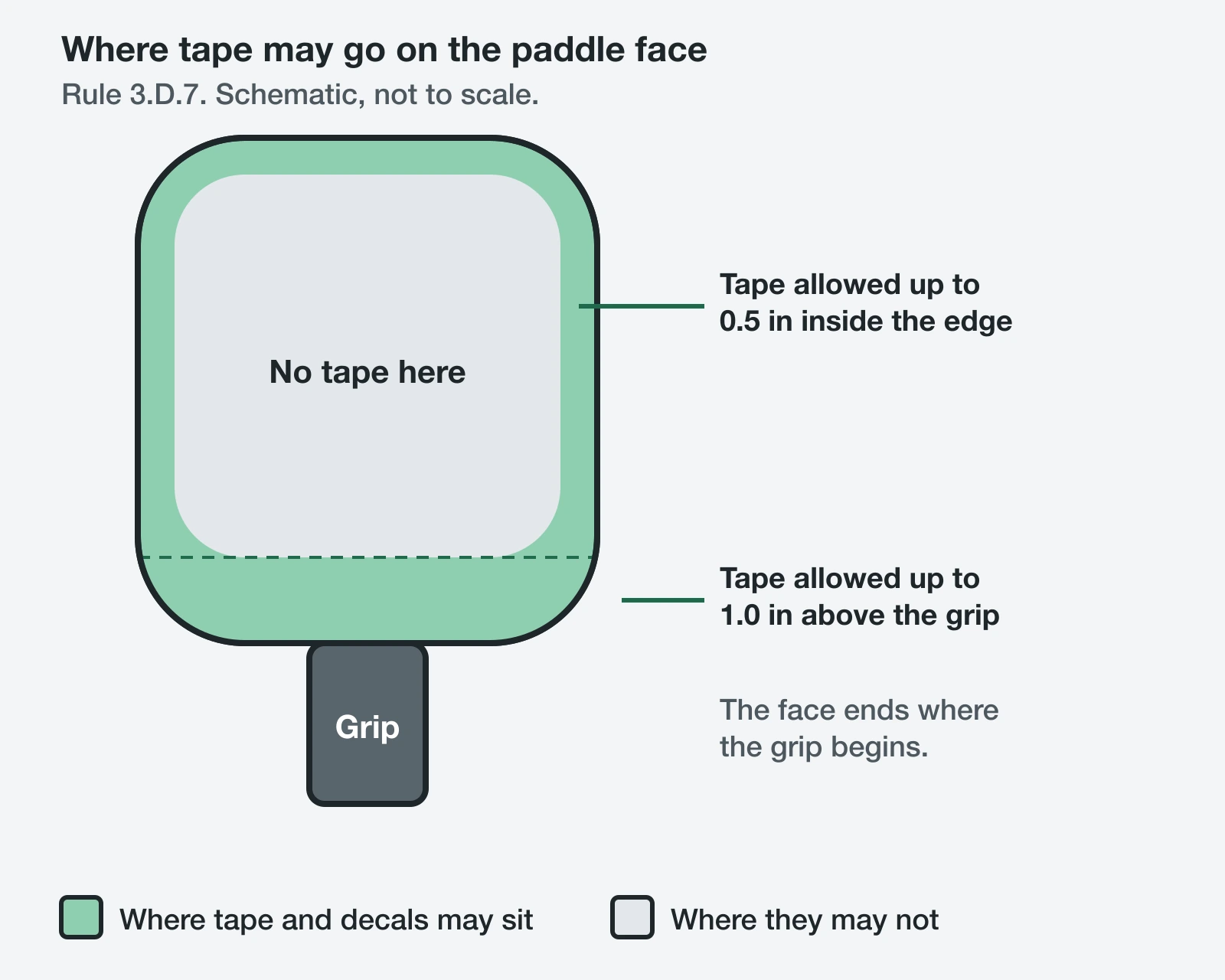
So tape has to stay near a boundary. The middle of the face is off limits. Because where weight sits changes swing weight, a strip near the head changes the feel more than the same strip near the handle.
Five mistakes when judging paddle weight
- Treating the label weight as how the paddle swings. Two paddles at the same weight can have different swing weights.
- Assuming heavier means more power. In the idealized sums it's about 2 percent, and swing speed can fall.
- Calling a paddle light or heavy from one guide. The bands move from shop to shop.
- Judging after one rally. Use a set of 20 shots, and check again after a full game.
- Stacking tape without checking the limits in Rule 3.D.7.
A two-minute test to find your weight
This is our suggestion, not from a study. You need two paddles of different weight, a wall or a partner, a ball and a watch.
- Warm up for a few minutes.
- With paddle A, hit 20 soft shots, dinks or volleys, at the wall or with a partner. Then hit 20 firm forehands.
- Write down how many were mishits. Rate your arm effort from 0 to 10.
- Rest one minute.
- Repeat with paddle B.
- Compare. Pick the paddle with fewer mishits first and lower effort second. If it's a tie, pick the one you'd rather swing for an hour.
Check again after a full game, because tiredness shows later than a drill does. Stop if anything hurts. Weight is one of five checks when you pick a paddle, and how to choose a pickleball paddle covers the other four.
Write the result down at your next session. A game of singles against the computer is a free way to rally when no partner is around.