Pickleball for Beginners: A 7-Day Plan for Your First Week
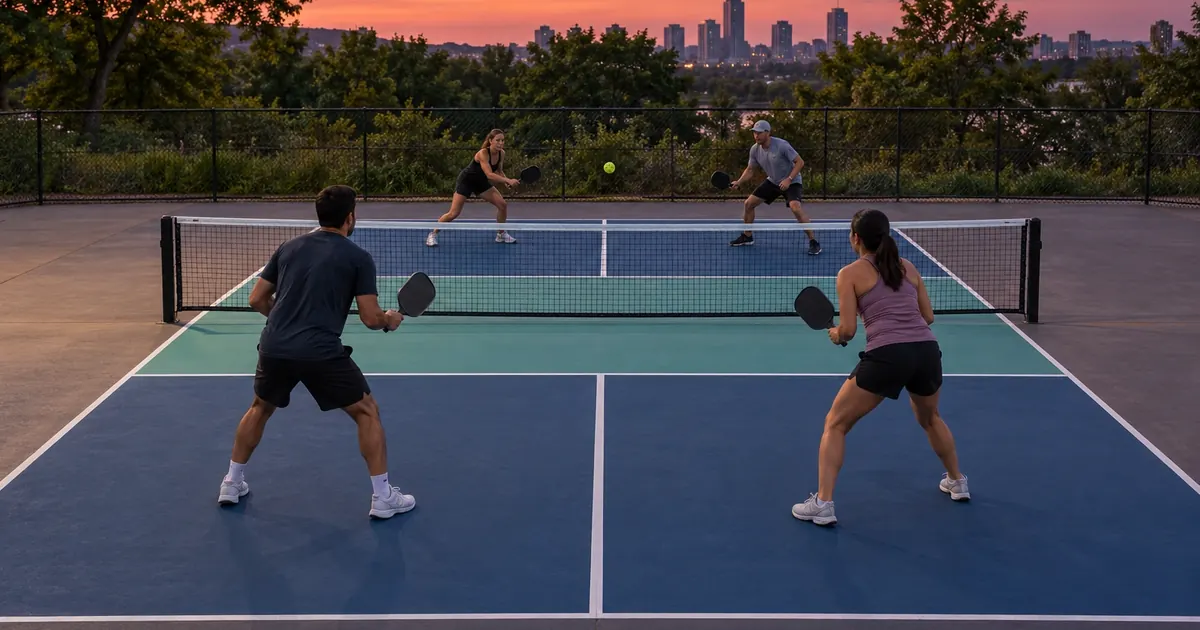
Pickleball for beginners works best as one small goal a day. Over seven days you learn the court, the serve, the return, the kitchen and the score, and on day seven you play a real game to 11. Every day has a task, a pass mark and one rule to check.
For the full rulebook view, see the rules page. For the rules in order, read how to play pickleball. This page is about what to practise, and when. It's for someone who hasn't played, with or without a court this week. The pass marks are our own targets, not a published standard.
What do you need before day one?
A paddle, a ball and, from day 4, one other person. Days 1 and 2 need no court and no partner. Day 3 needs a court. Borrowing a paddle is fine for the first week. If you try a few, what a lighter or heavier paddle changes explains why they feel different.
That's the whole list.
The week at a glance
| Day | Goal | Pass mark (our own) | Time | Rule to check |
|---|---|---|---|---|
| 1 | Know the court | Draw and label it without looking | 20 min, no paddle | 3.A.1, 3.A.4.c, 3.A.4.d |
| 2 | Control the ball | 10 hits in a row, with a partner or a wall | 20 min | 10.B |
| 3 | A legal serve | 7 of 10 into the right box, then 7 of 10 into the left | 30 min, a court | 7.D, 7.E |
| 4 | Return and wait | 5 serve-and-return pairs in a row, both sides letting it bounce | 30 min, two players | 10.A |
| 5 | Stay out of the kitchen | A 10-ball soft rally with no volley from inside the zone | 30 min, two players | 11.A |
| 6 | Keep score | A full game to 11, score called before every serve, no disputes | 40 min, 2 or 4 players | 4.A, 6.B, 5.A.1 |
| 7 | Play a real game | Two games to 11, plus a fault tally | 60 min | 4.B, 6.D |
Rule numbers are from the 2026 USA Pickleball rulebook. Don't move on until you hit the pass mark. If you miss it, repeat the day.
Day 1: learn the court
Spend 20 minutes with a pencil and no paddle. Draw the court from memory and label it.
It's 20 feet wide and 44 feet long (Rule 3.A.1). The net sits in the middle, 22 feet from each baseline. The kitchen is 7 feet deep on each side of the net, and its lines count as part of it (Rule 3.A.4.c). The centre line runs only from the kitchen line to the baseline (Rule 3.A.4.d). That leaves four service boxes, each 10 by 15 feet. The court dimensions page explains where that figure comes from.
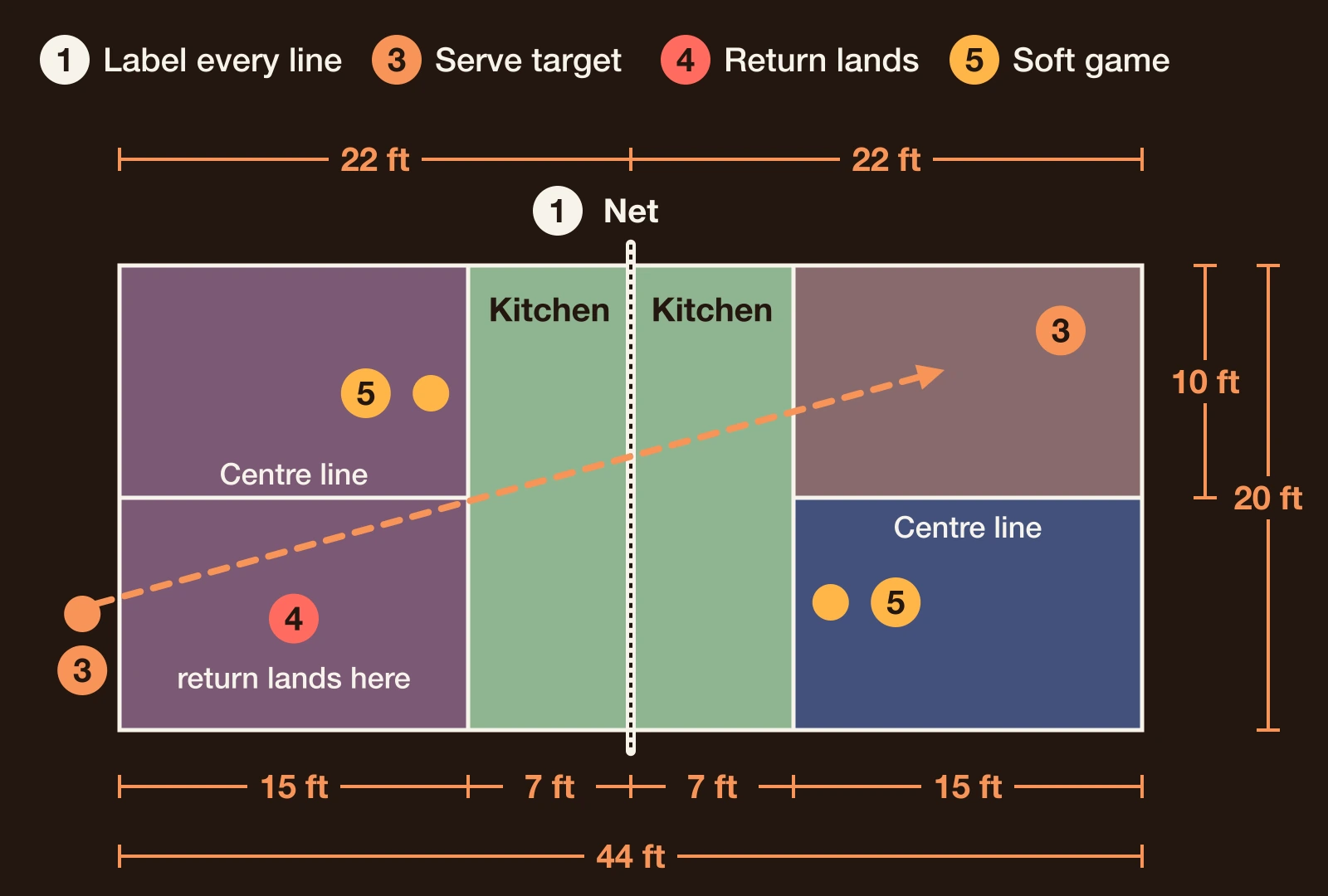
Pass mark: draw the net, kitchen, centre line, service boxes and baseline without looking, then check your drawing against the diagram.
If you want a rehearsal, open the free game, pick Low and play a few points. Watch where the server stands and what the score call says. It runs in a browser and needs a keyboard and mouse.
Day 2: get a feel for the ball
You need 20 minutes and a ball, plus a partner or a wall. With a partner, rally gently back and forth. Alone, hit against a wall.
Don't think about technique yet. The only job is to keep the ball going. Bounces are allowed: a ball may bounce once before you hit it, never twice (Rule 10.B).
If the ball keeps flying off, check how you're holding the paddle: how to hold a pickleball paddle has a quick self-test.
Pass mark: 10 hits in a row.
Day 3: serve
Take 30 minutes and a court. This is the first day on court, so what to wear is worth a look, shoes especially. Use the drop serve. You drop the ball, let it bounce, and hit it. Unlike the volley serve, it has no paddle-arc or waist-height tests (Rule 7.D, against Rule 7.C), so it's the easier one to get right. The serving rules cover both.
Stand behind the baseline and serve diagonally (Rule 7.A). The ball has to clear the kitchen and land in the correct box (Rule 7.E). A serve that lands in the kitchen or outside the box is a fault (Rules 7.E.1 and 7.E.2). Count a serve into the net as a miss too.
Pass mark: 7 of 10 into the right box from the right side, then 7 of 10 into the left box from the left side. You move on only when both sides get there.
Here's how a log might look. It's an example, not a real session:
- Right side: 8 of 10 in.
- Left side: 5 of 10 in.
The left side fails, so you repeat the day. No court this week? Book one for this day.
Day 4: return, and let it bounce
You need 30 minutes and two players. A six-minute pickleball warm-up fits inside that if you want one. The server serves. The receiver lets the ball bounce and returns it. Then the server's side lets the return bounce before hitting it (Rule 10.A). Both sides wait once, then play is open.
For the drill, aim each return past the kitchen line. That's our target, not a rule. The double bounce rule page covers the bounces in full.
Pass mark: 5 serve-and-return pairs in a row where both sides let the ball bounce.
Day 5: the kitchen and the soft game
Allow 30 minutes and two players. Stand just behind the kitchen line on each side. Rally gently, using soft shots that land in the other side's kitchen.
You'll need to step in sometimes. That's allowed, but only to hit a ball that has bounced. You can't volley while you or anything you carry touches the kitchen, and that includes its line (Rule 11.A). Your momentum counts too. If a volley carries you into the zone, even after the ball is dead, it's a fault (Rule 11.A.2). The kitchen rules have the full list.
Pass mark: a 10-ball rally from behind the kitchen lines with nobody volleying from inside the zone.
Day 6: score a whole game
Set aside 40 minutes. Play doubles if you have four people and singles if you have two. Say the score aloud before every serve (Rule 6.B).
Only the serving side scores (Rule 4.A). In singles the server's score decides the side: right when it's zero or even, left when it's odd (Rule 5.A.1). The scoring guide has the calls, in singles and doubles.
Pass mark: one full game to 11 with the score called before every serve and no disputes about it.
No players? Play the game on Low against the computer, and say the call out loud along with it. It's singles or doubles against the computer, on a keyboard and mouse, not on a phone.
Day 7: play
You get an hour. Play two games to 11, win by 2 (Section 1 and Rule 4.B). The server must serve within 10 seconds after the score call (Rule 6.D).
Keep a tally with tick marks while you play. Use five labels: out, net, double bounce, kitchen and serve fault. The how to play guide lists the common faults if you need a reminder.
An example tally sheet, not a real match: "Game 1: out 4, net 3, kitchen 1, double bounce 2." The biggest number is next week's focus. Here that's balls hit out.
Pass mark: two games finished, and a tally you can read.
Five beginner mistakes, and the day that fixes each
- Volleying the return of serve. The receiver must let the serve bounce, and the serving side must let the return bounce (Rule 10.A.1). Day 4.
- Stepping into the kitchen after a volley. Momentum is a fault even after the ball is dead (Rule 11.A.2). Day 5.
- Serving into the kitchen or past the line. Both are faults (Rules 7.E.1 and 7.E.2). Day 3.
- Serving from the wrong side. In singles your own score decides which side. If someone spots it before the rally ends, it's replayed (Rule 5.C.1.a). Day 6.
- Hitting everything as hard as you can. Get it in play first. That's a common coaching line, not a rule. Days 2 and 7.
What to do on day 8
Pick the one item on your tally that cost you the most points, and repeat that day's drill.
Keep each session to its time box. If you have a health condition or an injury, check with a doctor before starting a new sport.