Pickleball vs Tennis: The Differences, Rule by Rule
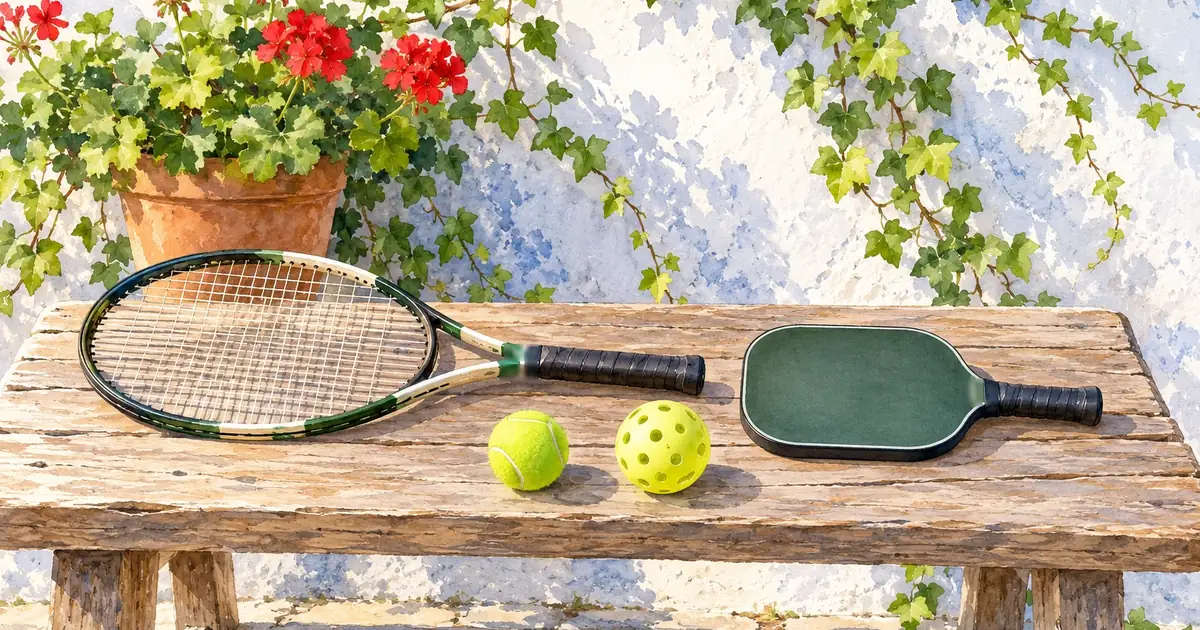
Pickleball vs tennis in short: a pickleball court is about a third the size of a doubles tennis court, and the game uses a solid paddle, a perforated plastic ball and a lower net. Pickleball has no second serve, a 7-foot no-volley zone and games to 11. Tennis has two serves, no such zone and 15-30-40 scoring.
If you're new to the sport, what is pickleball gives the one-screen overview. This page is for people who already know tennis.
Pickleball and tennis side by side
Every figure comes from the two governing rulebooks: the 2026 USA Pickleball Official Rulebook and the ITF Rules of Tennis. Pickleball ball figures come from the USA Pickleball Equipment Standards Manual. The sizes are computed from the court figures, and the sums are shown in the next section.
| What | Pickleball (USA Pickleball rule) | Tennis (ITF rule) |
|---|---|---|
| Court | 20 ft by 44 ft, for singles and doubles (3.A.1) | 78 ft long, 27 ft wide for singles, 36 ft for doubles (Rule 1) |
| Size | 880 sq ft | 2,106 sq ft singles, 2,808 sq ft doubles |
| Net | 36 in at the sidelines, 34 in at the center (3.B.6, 3.B.7) | 42 in at the posts, 36 in at the center (Rule 1) |
| Ball | 2.87 to 2.97 in across, 0.78 to 0.935 oz (22.1 to 26.5 g), 26 to 40 holes (Equipment Standards Manual 2.D.3, 2.D.4, 2.D.8) | 2.57 to 2.70 in across, 56.0 to 59.4 g (1.975 to 2.095 oz), fabric cover, for the two standard types. The slower Type 3 ball is 2.76 to 2.87 in (Rule 3, Appendix I) |
| Hitting tool | Solid face, up to 17 in long, length plus width up to 24 in, no weight limit (3.D.2, 3.D.3) | Strung frame, up to 29.0 in long and 12.5 in wide, hitting surface up to 15.5 by 11.5 in (Appendix II) |
| Serve | Upward swing with the ball no higher than the waist, or a drop serve. A fault loses the rally (7.C, 7.D, 7.E) | Any motion once the ball is released by hand and hit before it lands. A second serve after a fault (Rules 16, 20) |
| Serve touches the net | No let. If it clears the kitchen and lands in the correct court, it's good (7.E) | A let, so serve again (Rule 22) |
| Bounce rule | The serve and the return each bounce before anyone volleys (10.A) | Only the receiver has to let the serve bounce (Rule 24e) |
| Volley ban | A 7 ft kitchen next to the net (3.A.4.c, 11.A) | No such zone in the ITF rules (Rule 24 lists how a point is lost) |
| Scoring | Only the serving side scores. Typically first to 11, win by 2 (4.A, Section 1) | 15, 30, 40, game, deuce. Games make a set, sets make a match (Rules 5 to 7) |
One thing carries over. In both sports a ball that touches a line is good (ITF Rule 12, USA Pickleball Rule 8.E). The only exception in pickleball is a serve on the kitchen line, which is a fault. The line rules page covers who calls it.
How big is the real gap in size and weight?
Start with the court. A pickleball court is 20 by 44, which is 880 square feet. A doubles tennis court is 36 by 78, which is 2,808. That's 3.19 times the area. A singles tennis court is 27 by 78, which is 2,106, or 2.39 times. Flip it around and pickleball uses 880 divided by 2,808, about 31 percent of a doubles court. How many pickleball courts fit on a tennis court has the sums and scale drawings for a whole tennis pad.
The ball goes the other way on size. A pickleball is slightly wider than a standard tennis ball, 2.87 to 2.97 inches against 2.57 to 2.70. But a tennis ball weighs far more. Divide the heaviest tennis ball by the lightest pickleball allowed and you get 59.4 over 22.1, which is 2.69. Divide the lightest tennis ball by the heaviest pickleball and you get 56.0 over 26.5, which is 2.11. So a tennis ball weighs about 2.1 to 2.7 times as much.
The nets are harder to compare than they look. Tennis is 6 inches higher at the sides and 2 inches higher in the middle, but the two are measured in different places. Pickleball is measured at the sidelines. Tennis is measured at the posts, which stand 3 feet outside a doubles court. The court versus tennis court page shows both to scale.
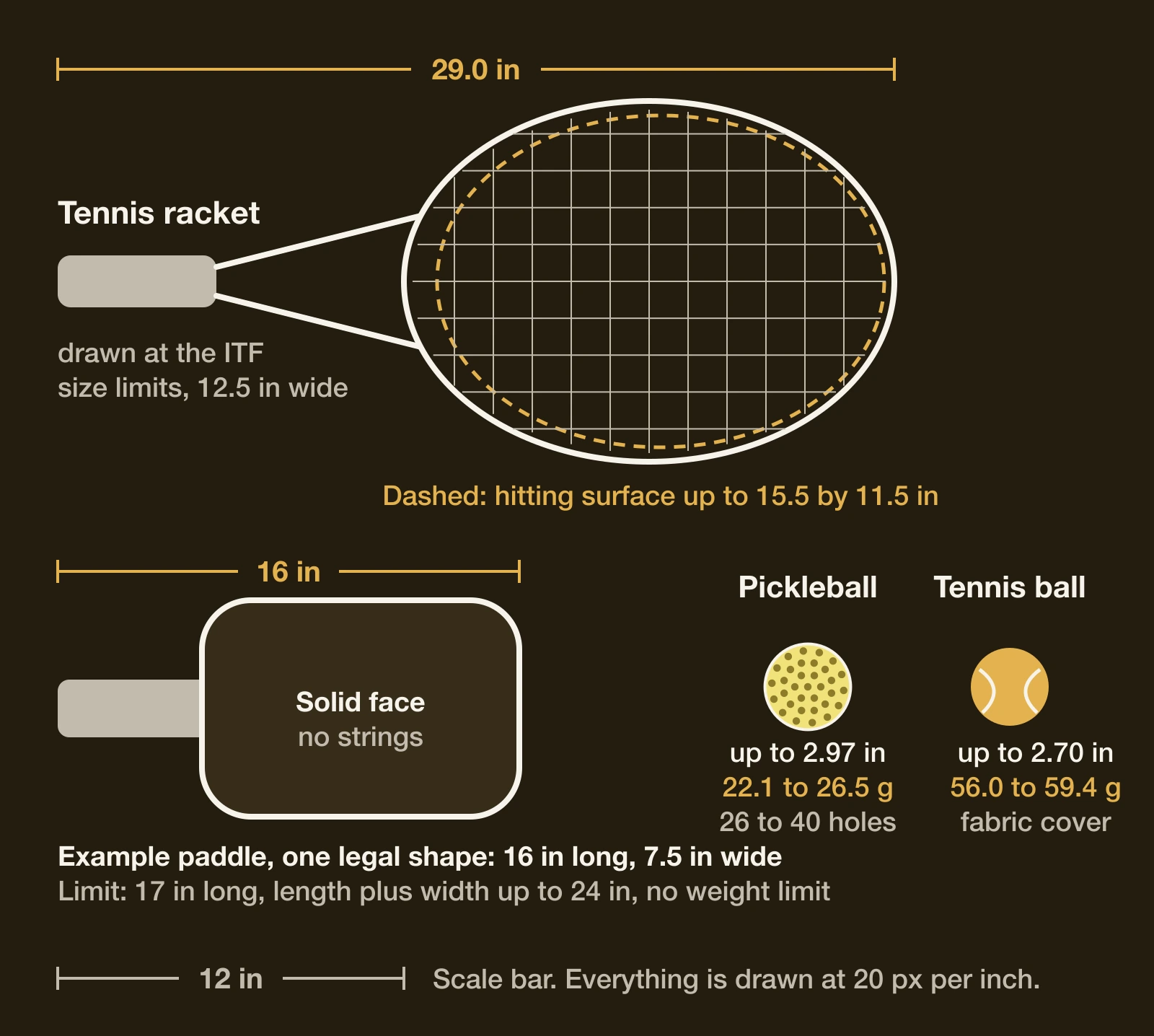
The picture draws the racket at the ITF size limits and the paddle as one legal shape. The balls are at their upper size limits.
Five tennis habits that cost points in pickleball
Volleying from the net
Tennis players volley at the net all day. In pickleball you can't volley while you or anything you're carrying touches the kitchen or its line (Rules 11.A, 11.A.1). Step back behind the line first. The kitchen rules explain the momentum part too.
Serving with a toss and an overhead swing
If you hit the ball out of the air, the paddle has to move in a clear upward arc, the ball no higher than your waist and the paddle head not above your wrist (Rules 7.C.1 to 7.C.3). Break one and it's a fault (Rule 7.C.5). The other option is a drop serve: let go of the ball, don't throw it up, and hit it after it bounces (Rule 7.D). The serving rules have the foot rules.
Hitting the return out of the air
Tennis already makes the receiver let the serve bounce (Rule 24e). Pickleball adds a second bounce: the serving side has to let the return bounce too, and a server who volleys it commits a fault (Rule 10.A.2). That's the double bounce rule.
Expecting a second serve or a let
A fault on the serve loses the rally. A serve that clips the net and still lands in the correct court is simply good, because the rule says it must clear the kitchen "with or without touching the net" (Rule 7.E).
Counting 15, 30, 40
Only the serving side scores, one point for each rally it wins. The server calls the score as two plain numbers in singles and three in doubles (Rules 4.A, 6.B.1, 6.B.2). The scoring guide has the calls.
Racket and paddle: what the rules measure
The rulebooks fix size, not feel. The ITF limits a racket's overall length and width, and the hitting surface's length and width. USA Pickleball limits the paddle's length to 17 inches and its length plus width to 24, and puts no limit on thickness (Rule 3.D.2). It puts no limit on weight either (Rule 3.D.3). A pickleball paddle must be made of rigid material (Rule 3.D.4), where a racket must be strung. If you've heard of padel or paddle tennis, those are different sports again: see pickleball vs padel and pickleball vs paddle tennis.
Here's the same four rallies under each scoring system. The server wins the first three and loses the fourth.
| Sport | After three rallies won | After the fourth is lost | Who serves next |
|---|---|---|---|
| Tennis | 40-love | 40-15 | The same player. A tennis server serves the whole game (Rule 14) |
| Pickleball singles | 3-0 | No point. Side out, and the new server calls 0-3 (Rule 6.B.1) | The opponent |
Same rallies, different story. In tennis the server who loses a rally keeps serving. In pickleball the serve has gone.
Your first hour as a tennis player
This is a self-test, not a rule from either book.
- Hit ten serves from behind the baseline with a low upward swing, aiming past the kitchen into the diagonal box. A pass is 8 of 10 in.
- Play ten rally balls and let your first shot after the serve bounce. Then wait one beat before you step up to the kitchen line.
Pass both and the serve and the bounce rhythm are in hand. Do the ten-serve check at your next session, and read the kitchen rules before you step up to the net. If you'd rather watch a point first, Pickleball Game is free in your browser, singles or doubles against the computer.