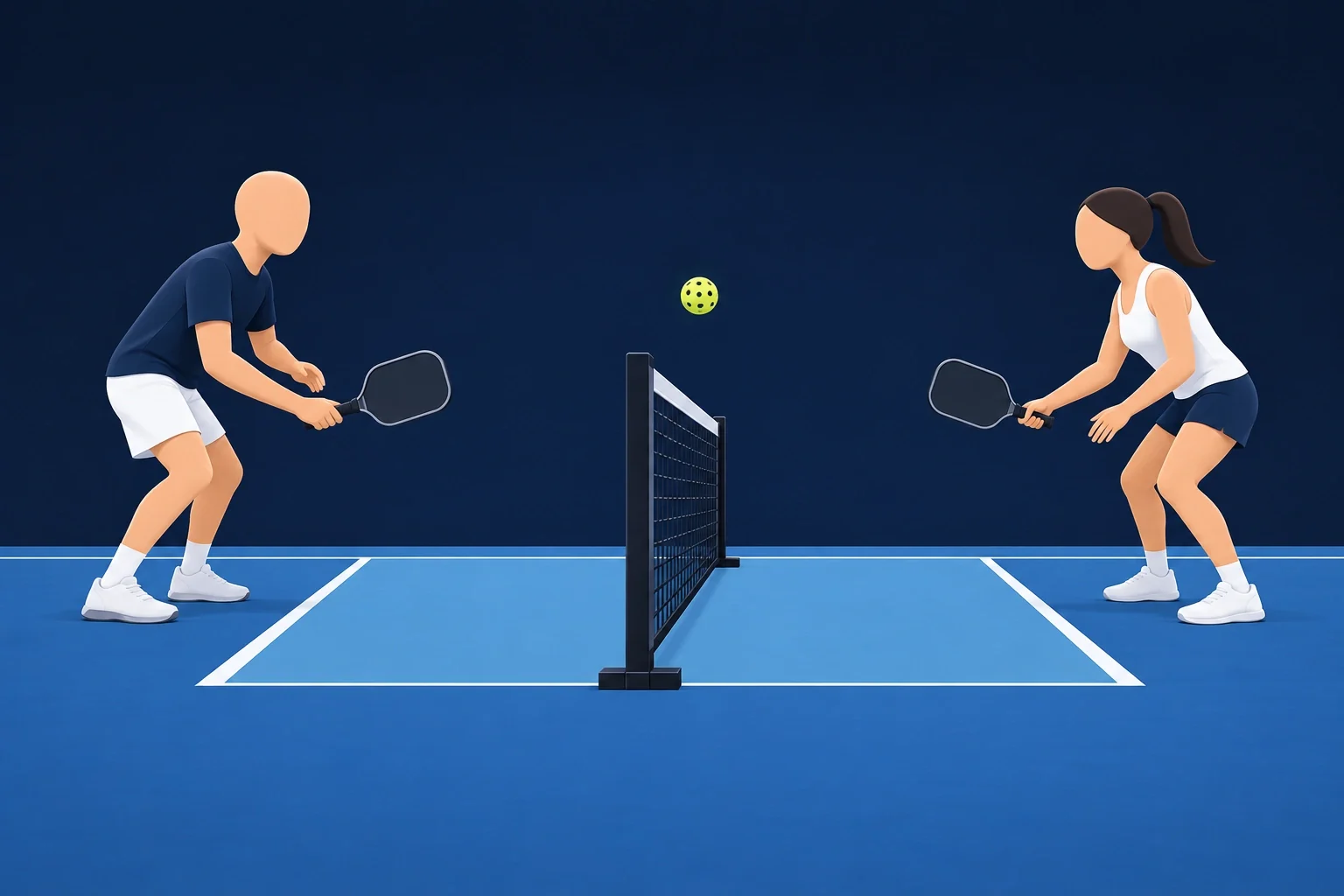
Pickleball Kitchen Rules: The No-Volley Zone

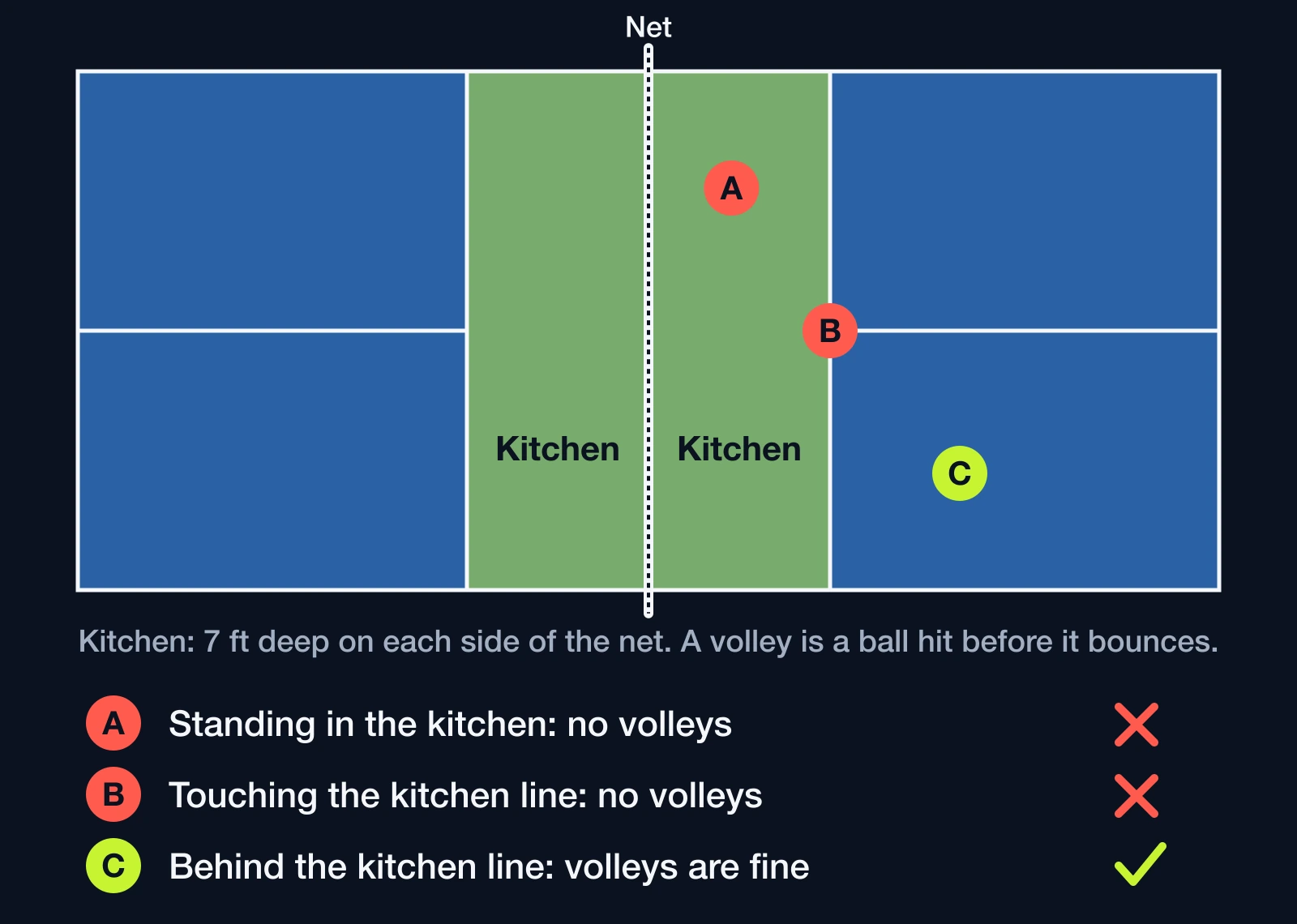
The kitchen is the 7-foot strip on each side of the net where you can't hit the ball out of the air. You can stand in it whenever you like. You just can't volley while any part of you touches it, and the painted line at its back edge counts as part of the zone.
The official name is the non-volley zone. Most players say kitchen, and the two mean exactly the same thing.
What the kitchen is
It's a rectangle 7 feet deep and 20 feet wide, as wide as the court, on both sides of the net. That makes it a little under a third of your half of the court. All the lines that bound it belong to it (Rule 3.A.4.c in the 2026 USA Pickleball rulebook).
The zone is flat. It doesn't reach up into the air, so you can lean over it and volley a high ball as long as nothing of yours touches it.
A volley is any shot hit before the ball bounces. A shot hit after a bounce is a groundstroke, and the kitchen allows those.
What you can and can't do
You can:
- stand in the kitchen at any moment when you aren't volleying
- step in to hit a ball that has already bounced, even one that bounced inside the kitchen
- reach over the zone for a volley without touching it
You can't:
- volley with a foot, a knee, a hand or your paddle touching the zone or its line
- volley and then let your momentum carry you into the zone
- volley again after stepping in, until both feet are fully back outside
Your paddle, your clothes and anything else you wear or carry count as part of you. Your partner counts only when you're touching them: if you touch a partner who is in the kitchen while you volley, or your momentum carries you into one afterward, it's a fault (Rule 11.A). A partner standing in the kitchen on their own doesn't make your volley a fault.
The momentum rule
Say you volley from a foot behind the line. Your swing carries you forward and your toe lands on the line. That's a fault, even if your opponents never touch the ball.
The fault stands even after the ball is dead. The rulebook says the volley isn't over until your forward motion stops (Rule 11.A.2).
Doubles adds a twist. You volley, stumble, and bump your partner, who is standing in the kitchen. You touched something that touches the zone, so it's a fault.
Hitting the ball into the kitchen is fine
The ban is on where you stand when you volley. It says nothing about where the ball goes. A rally shot that lands in the opponent's kitchen, or on its line, is in. That's the idea behind soft shots at the net: the ball drops short and the other side has to step in after the bounce to reach it.
Serves and the kitchen
A serve has to clear the kitchen. One that lands inside it, or on its line, is a fault (Rule 7.E.2). The line is part of the kitchen, so even a serve that just clips it loses the rally.
What a kitchen fault costs
It ends the rally. If you were serving, you lose the serve. If you were receiving, the other side gets a point. The scoring guide shows how that plays out in a real game.
Who makes the call? You're expected to call it on yourself. Your opponents can call it on you too. If the two teams disagree about whether a foot touched the line, the rally is replayed (Rule 9.B.3.b).
A habit that keeps your feet honest
After every volley near the net, stop and look at your feet. Are both behind the line? If not, you already know why you're losing points there.
To practice it, stand two feet behind the kitchen line and have a partner feed you easy balls out of the air. Hit each one and freeze at the end of your swing. Check where your feet ended up, then step back to the start. Do twenty, and you'll find out how far your body really travels.
The rules page shows the kitchen on the court diagram if you want to see the zone laid out. You can also play a few points against the computer in Pickleball Game, where the referee calls kitchen faults the same way.