Pickleball Doubles Rules and Serving Order

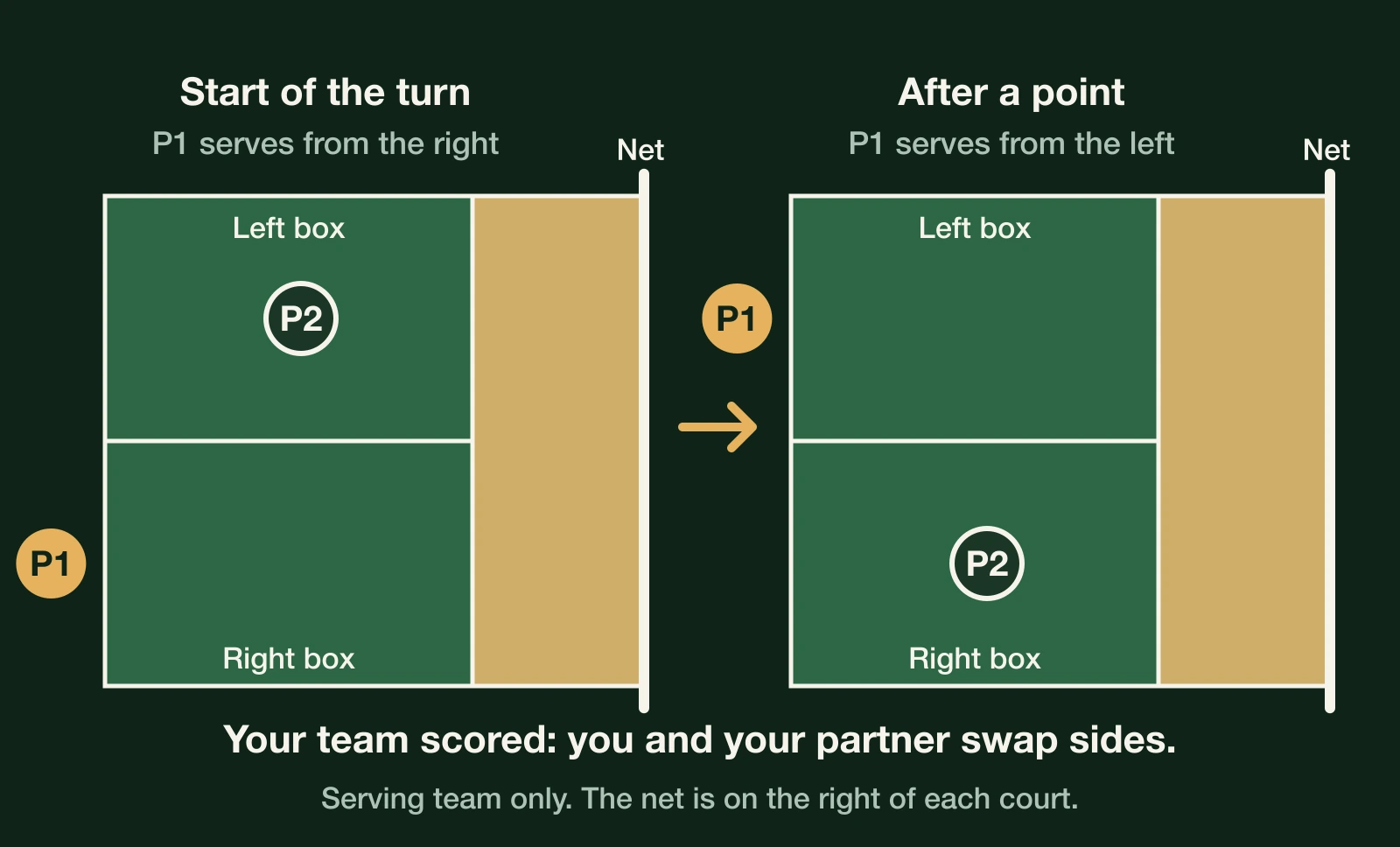
In doubles, both players on a team serve before the serve goes to the other team. The one exception is the start of a game, when only one of them does. Each service turn begins from the right side of the court, and partners swap sides every time their team wins a point.
The rotation is the part that trips people up, so we'll walk through it once with real positions.
How does doubles serving work?
When your team wins the serve, the player standing on the right serves first. That player is server 1. They keep serving, switching sides after each point, until your team loses a rally.
Then their partner becomes server 2 and serves until the team loses another rally. That second loss is a side out, and the other team takes over.
At the very start of a game, the team serving first only gets one server. Its starting server counts as server 2, which is why the first call is "0-0-2". The same player serves until the first lost rally, and then it's a side out (Rule 5.B in the 2026 USA Pickleball rulebook).
Who serves first in doubles?
A coin toss or another fair method decides which team chooses to serve or receive first (Rule 17.C.4). The team that serves first starts at 0-0-2 and gets just one server on its first turn. Every turn after that gets two.
A walk through with positions
Team A is P1 on the right and P2 on the left. Team B is Q1 on the right and Q2 on the left. Team A serves first.
- 0-0-2: P1 serves from the right and wins the rally. P1 and P2 swap sides.
- 1-0-2: P1 now stands on the left and serves from there. P1 loses the rally. Side out.
- 0-1-1: Q1 serves from the right. Q1 wins the rally. Q1 and Q2 swap.
- 1-1-1: Q1 serves from the left, and loses. Q2 takes over.
- 1-1-2: Q2 happens to be standing on the right, so Q2 serves from the right even though the score is odd. Q2 loses. Side out.
Step 5 is the one that looks wrong. In singles an odd score means serving from the left, but in doubles the second server serves from wherever they're standing. Nobody moves when the serve goes from server 1 to server 2.
Only the team that scores swaps sides. The team receiving stays where it is.
Where do you stand in doubles?
Only two players have to be in a set position when the serve is hit: the server and the receiver. The server stands behind their baseline and the receiver stands in the box diagonally opposite. Their partners can stand anywhere on their own end of the net, so starting both partners on one side is legal, and stacking shows how teams use that. Partners often stand near the kitchen line, but the rulebook doesn't require it. That's where most dinks are hit. For where both partners stand on each of the first shots, see doubles strategy.
The receiver has to be the right one. If the partner of the correct receiver hits the return, it's a fault on the receiving team, even if the rally has finished, as long as someone calls it before the next serve (Rule 5.C.1.c).
Rules that only matter in doubles
- The two-bounce rule covers both players on a team. The receiving side lets the serve bounce, and the serving side lets the return bounce, including the server's partner waiting at the net. That's why the serving team's first hit is often a soft third shot drop.
- Your partner counts as you at the kitchen. If you volley and your momentum carries you into a partner who is touching the kitchen, that's a fault. The kitchen rules explain it.
- Only one of you can hit the ball. If you and your partner both strike it, that's a fault on your team.
- Either of you can make a line call. If partners disagree, the ball is in.
Playing one-on-one instead? The singles rules show what changes when you have no partner.
When someone serves from the wrong place
If the wrong player serves or someone stands in the wrong spot, any player can stop the rally to say so. A correct claim means the rally is replayed. A wrong claim is a fault on the player who stopped play (Rule 5.C.1).
Before a serve you can also ask your opponents who the server is or whether everyone is standing correctly, and they have to answer. If nobody notices until the rally has ended, the result stands.
One habit avoids most of this. The server calls the score, and both partners check that they're standing where the score says before the ball is hit. The scoring guide has a full list of calls from one game to practice with, the serving rules cover the motion itself, and how long a game lasts lists the points each format needs.
To try the rotation without arranging four players, play doubles against the computer in this free pickleball game for your browser and watch where your partner stands after each point. You can also check the rules page for the serving-order diagram.