Pickleball Scoring: How to Keep Score

In pickleball, only the serving side can score a point. A game goes to 11 and you have to win by 2. Before every serve the server calls the score out loud: three numbers in doubles, two in singles.
That's the whole system. The three-number call is the part that trips people up, so most of this page is about it.
How a point is won
Every rally has a server and a receiver. If the server's side wins the rally, it scores a point. If the receiving side wins, nobody scores. The serve just changes hands, which is called a side out.
That's why you'll see lopsided games like 11-2. A team that holds the serve can run up the score. A team that never gets it can't score at all.
Calling the score in doubles
The server calls three numbers: the serving team's score, then the receiving team's score, then the server number, 1 or 2.
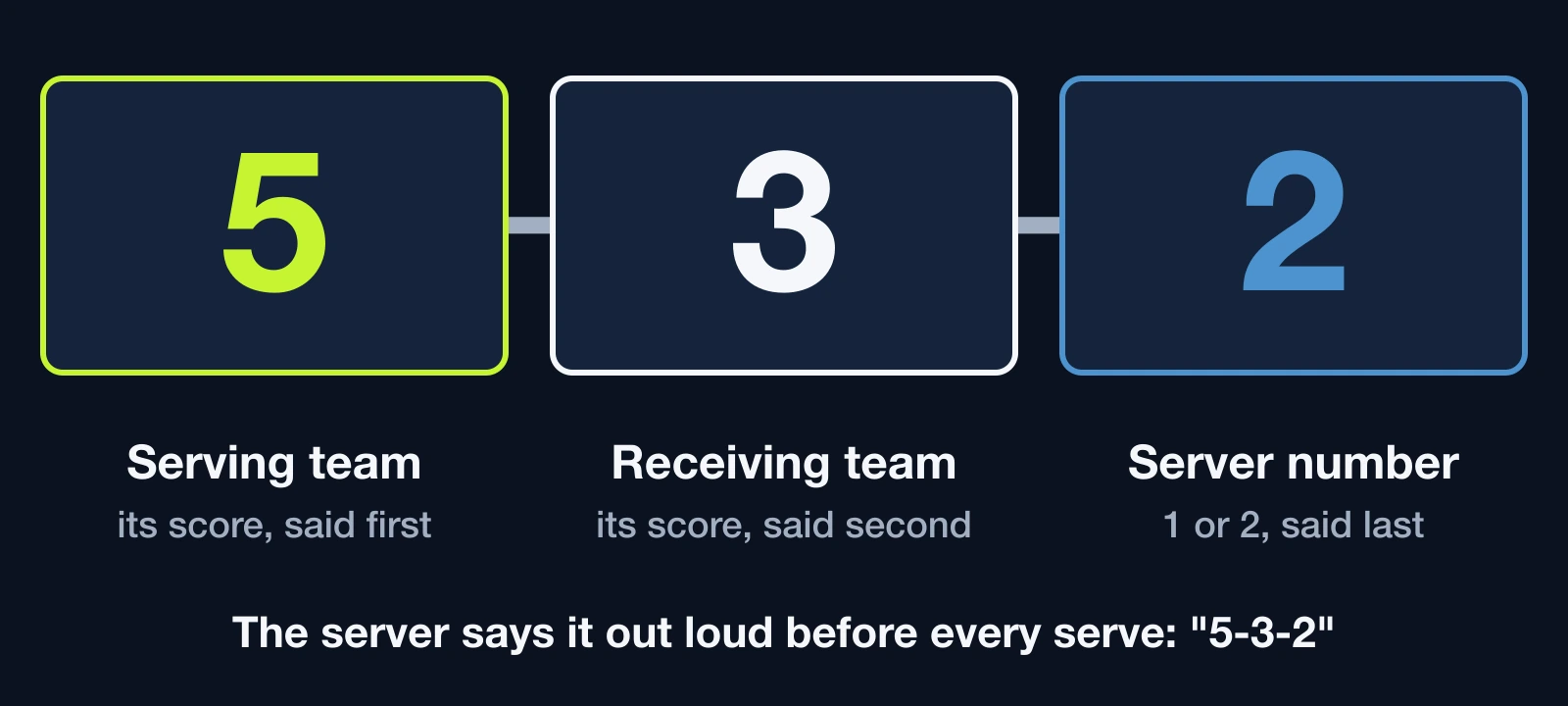
A game always starts at "0-0-2". The 2 is deliberate. Each team normally gets two servers per turn, but the team serving first gets only one. Its starting server counts as the second server, so one lost rally sends the serve over.
Here's a short game from the start, with Team A serving first.
| Call | What happens |
|---|---|
| 0-0-2 | Team A's player on the right serves and wins the rally. |
| 1-0-2 | That player swaps sides with their partner, serves from the left, and loses the rally. Side out. |
| 0-1-1 | Team B serves. Its own score goes first, so it's 0-1. The player on its right is server 1, and wins two rallies in a row. |
| 2-1-1 | Server 1 loses the next rally. Their partner takes over. |
| 2-1-2 | Server 2 loses a rally. Side out again. |
| 1-2-1 | Team A serves, and its score is back at the front of the call. |
Read the call as "mine, theirs, which server." The numbers swap places every time the serve changes teams, because the server always says their own team's score first.
The rules page has a diagram of the doubles serving order if you'd rather see it drawn.
Calling the score in singles
Singles has one server, so there's no third number. The server calls their own score, then the receiver's. A game starts at "0-0".
The server's score also tells both players where to stand. An even score (0, 2, 4) means serving from the right. An odd score (1, 3, 5) means serving from the left. Win a point and you switch sides. Lose the rally and the other player takes over the serve.
Say you're serving and leading 4-2. You call "4-2" and serve from the right. You win the point. Now it's "5-2" and you serve from the left.
Winning the game
The first side to 11 wins, as long as it leads by at least 2. At 10-10 play goes on until someone is two clear, so 12-10 and 13-11 are normal finishes. Some tournaments play to 15 or 21 instead, always with the two-point margin (Rule 15.C in the 2026 USA Pickleball rulebook).
What if someone calls the wrong score?
Say "stop" before the return of serve is hit. The rally is replayed with the right score. Speak up after the return and it's a fault on you. If you only notice once the rally is over, the result stays and the score is corrected before the next serve (Rule 6.F). Stopping play to challenge a score that was actually correct is also a fault on you.
Does rally scoring exist?
Yes, as an option. Under rally scoring every rally gives a point to whoever wins it, server or not, and the score is called with two numbers. The 2026 rulebook lists it as a provisional rule that an event organizer may choose. The scoring above is the standard version.
Practice it
Next time you play, say the full score out loud before every serve, even in a friendly game. Say it early enough that your partner can correct you. After a few games the three numbers run on their own.
Faults decide who serves and who scores. The kitchen guide explains one fault that ends rallies at the net. To see a score call before each serve without setting up a court, play a game against the computer. Pickleball Game shows the call on screen.