Pickleball Paddle Size Rules: 17 and 24 Inch Limits
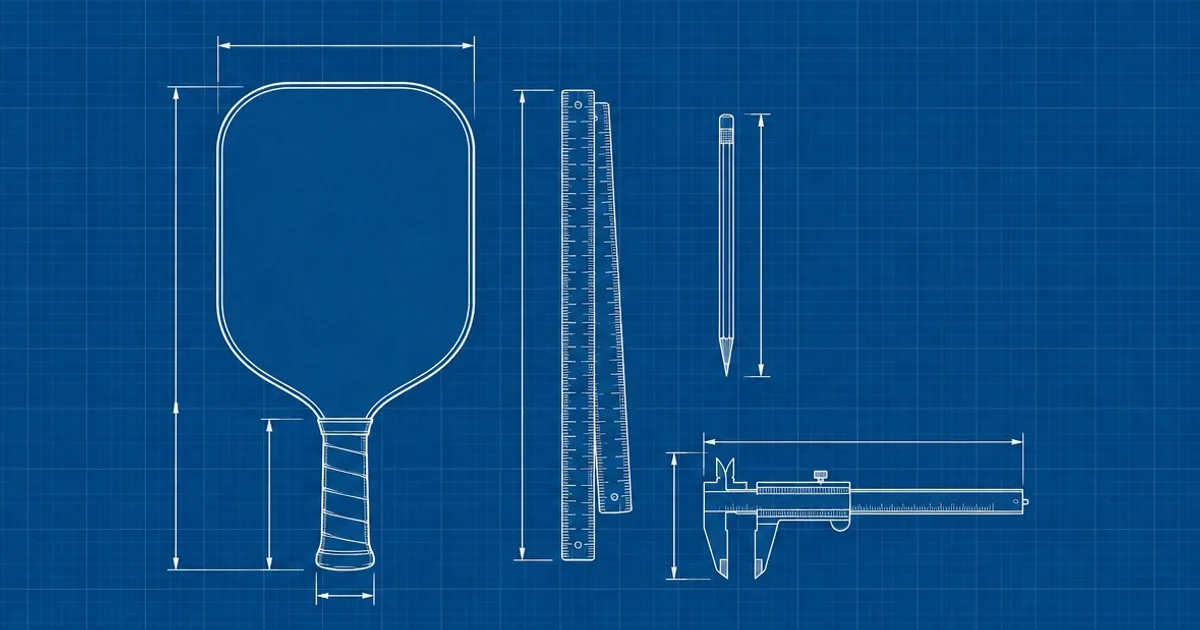
A legal pickleball paddle is at most 17 inches long, and its length plus its width, counting the edge guard and butt cap, is at most 24 inches (Rule 3.D.2 of the 2026 USA Pickleball rulebook). Weight and thickness have no limit. Shape is free, so any outline that passes both measurements is allowed.
Those are the size rules. The rules page covers the rest of the book. This page shows how to measure a paddle and what "approved" means.
What are the legal paddle size limits?
A paddle must pass two tests: length of 17 inches or less, and length plus width of 24 inches or less. Passing one isn't enough. These are made-up sizes, not real products.
| Length | Width | Total | Result |
|---|---|---|---|
| 16.5 in | 7.5 in | 24.0 in | Legal |
| 17.0 in | 7.0 in | 24.0 in | Legal |
| 16.0 in | 8.0 in | 24.0 in | Legal |
| 17.0 in | 7.5 in | 24.5 in | Too big: the total is over 24 |
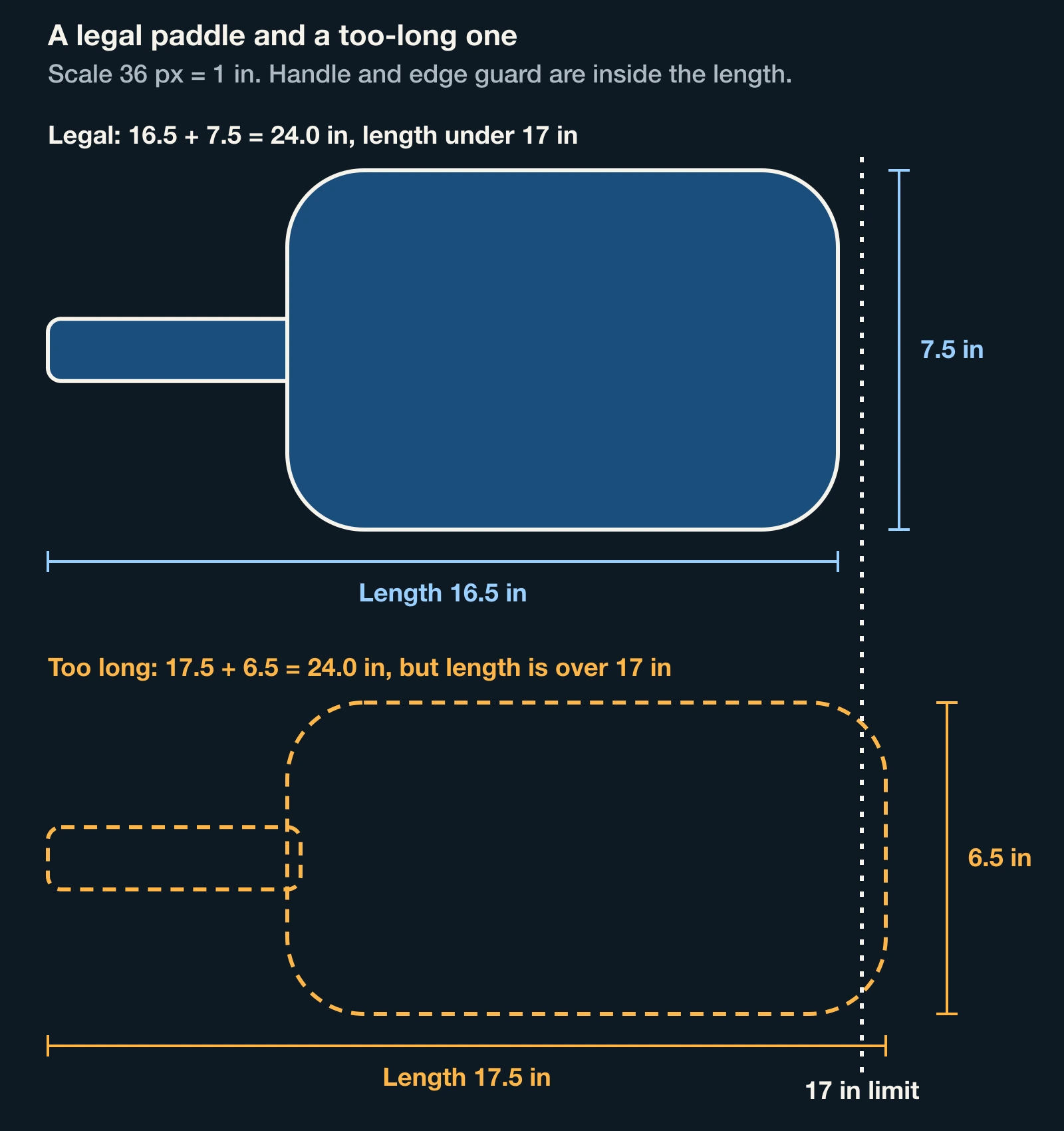
| 17.5 in | 6.5 in | 24.0 in | Too long: the length is over 17, even though the total is 24 |
The drawing shows two of those rows to scale. The legal paddle, 16.5 by 7.5 inches, stops before the 17 inch line. The too-long paddle, 17.5 by 6.5 inches, crosses it, although its total is also 24.0.
How do you measure a pickleball paddle?
Use a ruler or tape measure. Four steps:
- Lay the paddle flat.
- Measure the full length, from the top of the edge guard to the end of the butt cap.
- Measure the width at the widest point of the face, with the edge guard on. The rulebook doesn't say where to measure width, so the widest point is the safe reading.
- Add the two numbers. Check that the length is 17 or less and the total is 24 or less.
The rule counts the edge guard and the butt cap (Rule 3.D.2). A paddle that measures exactly 24.0 inches can go over if you add edge tape or fit a thicker cap.
Is there a weight or thickness limit?
No. The rulebook says there is no restriction on paddle thickness (Rule 3.D.2) or weight (Rule 3.D.3). The paddle weight page covers what weight changes in play, and how to choose a paddle turns size, weight, thickness, shape and grip into five questions you can test.
Size isn't the only thing the rules limit. The paddle must be rigid and made of non-compressible material (Rule 3.D.4). The hitting surface can't have holes, rough texturing, sandpaper, rubber or spin paint (Rule 3.D.5).
What does "approved" mean, and when does it matter?
"Approved" means the model is on USA Pickleball's tested list. Rule 3.D.1 asks paddle makers to print the "USA Pickleball Approved" seal on the paddle, but the list is only checked in sanctioned tournaments.
- Size limits apply to everyone. Section 3 sits in Part I, which the rulebook says applies to all play. A casual paddle has to meet Rule 3.D.2 too.
- The list is a separate test. A model has to pass USA Pickleball's testing against the Equipment Standards Manual (revision 3.0, January 2025). In tournaments, players must use a paddle that is on the list (Rule 18.A). If it's found before the match, you switch with no penalty. If it's found during the match, you forfeit the match. If it's found after, the result stands (Rules 18.A.1 to 18.A.3).
- How to check. The Manual says players are responsible for confirming a paddle is listed as "Pass" (2.F.3). Open the approved paddle list and search by brand or model. The page itself doesn't define "approved". That's in the rulebook and the Manual.
- Approved isn't praise. The Manual says approval "does not imply any other form of approval or endorsement". It can also be withdrawn: the Board can revoke it on 18 months' notice if a model is materially changed or degrades in use (2.F.1). USA Pickleball's certification updates page says some models were sunset for sanctioned play on 1 July 2025 after new testing.
Can you use a tennis racket?
No. A tennis racket can be up to 29 inches long (ITF Rules of Tennis 2026, Appendix II), far past the 17 inch limit, and it is strung. The pickleball rule asks for a rigid hitting surface (Rule 3.D.4). The strings point is our reading of that rule. The length point is plain arithmetic against Rule 3.D.2.
Balls have their own approval rule. Pickleball vs Wiffle ball shows how the two balls differ and why a Wiffle ball is fine for a casual hit only.
Mistakes to avoid
- Checking only the total. A paddle can total 24 inches and still be too long.
- Forgetting that tape and caps count.
- Thinking the size limits only matter in tournaments. They apply to every game; only the approved-list check is limited to sanctioned play.
- Believing a weight rule exists. There isn't one (Rule 3.D.3).
For the whole game on one page, see how to play pickleball. To check your paddle now, measure it with a ruler, add the two numbers, then search its model on the approved list. For a sense of scale, the paddle in our free game is 16.5 by 7.4 inches, inside the limit. You can play a game in your browser.
Sources
- 2026 USA Pickleball Official Rulebook: Rule 3.D.1 (seal), 3.D.2 (17 inch length, 24 inch length plus width, no thickness limit), 3.D.3 (no weight limit), 3.D.4 (rigid, non-compressible), 3.D.5 (surface features), 18.A to 18.A.3 (approved paddle in sanctioned play and the penalties), and the introduction (Part I applies to all play).
- USA Pickleball Equipment Standards Manual: revision 3.0, January 2025; approval "does not imply any other form of approval or endorsement"; 2.F.1 (approval can be revoked on 18 months' notice); 2.F.3 (players confirm a paddle is listed as Pass).
- USA Pickleball Approved Paddle List: where to search a model.
- USA Pickleball, paddle certification updates: paddles sunset for sanctioned play on 1 July 2025.
- ITF Rules of Tennis 2026: Appendix II, racket length limit of 29 inches.