Indoor vs Outdoor Pickleball Balls: The Real Difference
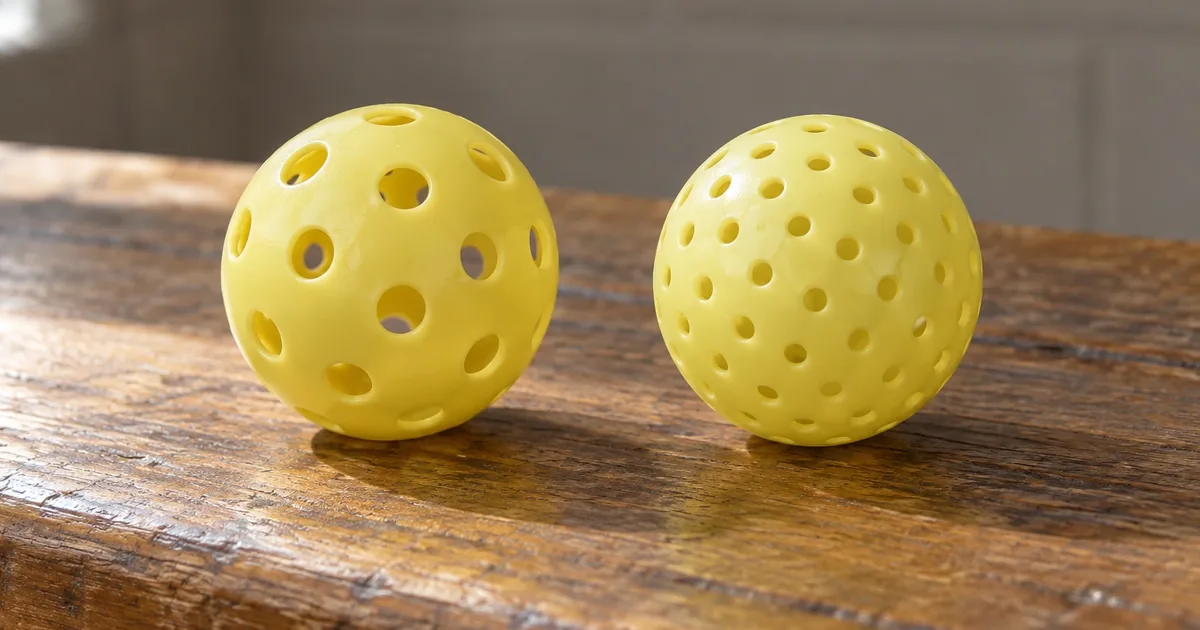
Indoor vs outdoor pickleball balls differ mainly in the holes: indoor balls usually have 26 larger holes, outdoor balls usually have 40 smaller ones. The rulebook treats them the same, because every approved ball is legal indoors and outdoors (Rule 3.C.1). One set of size, weight and bounce limits covers both, so the choice is about wind, floor and feel. The rules page covers the rest of the game.
What does the rulebook say about every ball?
One set of limits. The 2026 rulebook covers use, color and construction in Rule 3.C. The numbers for size, weight, bounce and holes sit in USA Pickleball's Equipment Standards Manual (revision 3.0, January 2025), which the rulebook points to.
| Limit | Value | Source |
|---|---|---|
| Where it can be used | Any approved ball, indoors or outdoors | Rule 3.C.1 |
| Width | 2.87 to 2.97 in (7.29 to 7.54 cm), out of round by no more than 0.020 in | Manual 2.D.3 |
| Weight | 0.78 to 0.935 oz (22.1 to 26.5 g) | Manual 2.D.4 |
| Bounce | 30 to 34 in (76.2 to 86.4 cm) when dropped from 78 in (198.1 cm) onto granite at 70 F, plus or minus 5 F. That's 38 to 44 percent of the drop height. | Manual 2.D.5 |
| Holes | 26 to 40 circular holes | Manual 2.D.8 |
| Compression | Under 43 lbf, a lab test (ASTM F1888-09) | Manual 2.D.6 |
| Color | One uniform color. Colors may vary. | Rule 3.C.3 |
| Marking | Maker's name or logo on the ball | Rule 3.C.4 |
| Material | Durable, molded, smooth. A slight seam ridge is allowed. | Rule 3.C.5 |
| Hardness | Recorded for data only, no longer a compliance requirement | Manual 2.D.7 |
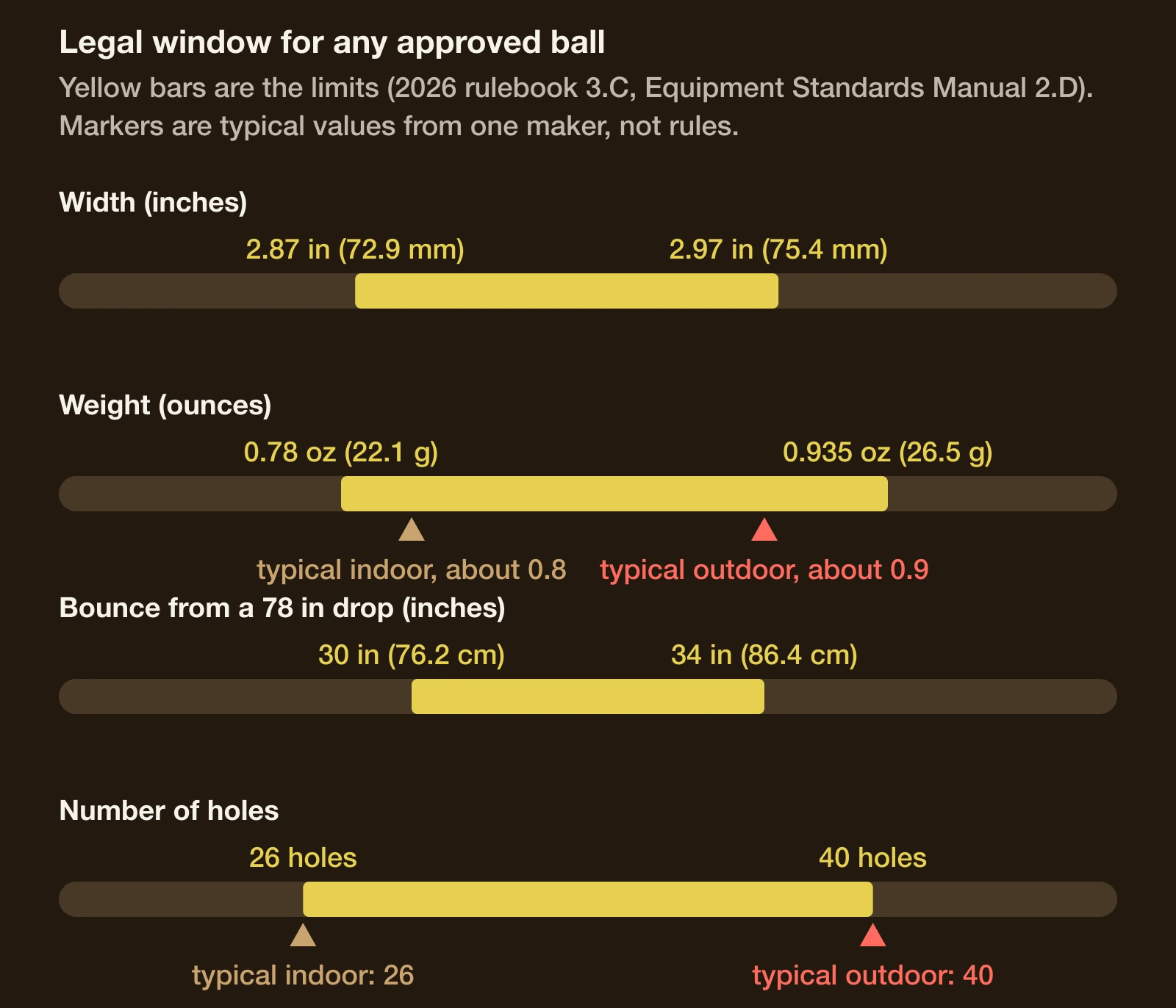
The bars show the same limits. The lime part is legal. The blue and red markers are the typical indoor and outdoor values from one maker, covered below. Both sit inside the legal window.
Is there an official indoor ball and an outdoor ball?
No. Rule 3.C.1 says all approved balls are acceptable for indoor or outdoor play. The rulebook's Figure 3-2 only says the ball with larger holes is customarily used indoors and the one with smaller holes outdoors.
USA Pickleball's approved ball list has a "Ball Type" column with the values Out, Ind and I/O, and it listed 393 models when we looked on 2026-10-04. A maker can label a ball, but the rulebook doesn't require it.
How do indoor and outdoor balls usually differ?
In the holes first, then in how the plastic feels. These are the typical values one maker, Paddletek, gives on a page dated 2026-09-30. They aren't rules, and they describe one brand's usual designs.
| Typical indoor ball | Typical outdoor ball | |
|---|---|---|
| Holes | 26, larger (about 0.43 in) | 40, smaller (about 0.28 in) |
| Plastic | Softer, for smooth gym floors | Harder and thicker, for rough courts |
| Weight | About 0.8 oz | About 0.9 oz |
| Bounce | Higher on smooth floors | Lower and faster on rough courts |
| Noise | Quieter | Louder |
| When it wears out | Deforms over time, rarely cracks | Cracks under impact, gets replaced more often |
Do outdoor balls have bigger holes? No, smaller. Those two sizes make indoor holes roughly half again as wide, 0.43 against 0.28 (a ratio of 1.5). Weights differ by model, so don't assume an indoor ball is always lighter.
Can you use an outdoor ball indoors, or the reverse?
Yes, by the rules. The effects are practical. Makers report that an outdoor ball on a smooth gym floor plays faster and louder, and an indoor ball in wind gets pushed around.
In a sanctioned tournament the director picks the ball from the approved list (Rule 16.G, Manual 2.D.2). A gym or club can have its own house ball, so check the facility.
If a ball breaks during a rally, play on to the end of the rally. It's replayed only if every player agrees a broken or cracked ball affected the outcome (Rules 10.G, 10.G.1). A ball that has gone soft is not replayed (Rule 10.G.2).
How can you tell them apart?
Count the holes. Fewer, bigger holes (around 26) point to an indoor design. More, smaller holes (up to 40) point to outdoor. Then read the packaging for the "USA Pickleball Approved" seal (Manual 2.D.8) and look the model up on the approved list. The color won't tell you. The rulebook only says a ball is one uniform color, and colors may vary (Rule 3.C.3).
What is a pickleball made of, and how big is it?
Rule 3.C.5 asks only for a durable, molded material with a smooth surface. Makers describe it as plastic, and the Paddletek page above talks about softer and harder plastic. The size is 2.87 to 2.97 inches across (Manual 2.D.3). Courts are the same size indoors and outdoors: 20 by 44 feet, as the court dimensions page shows. The ball in Pickleball Game is 74 millimeters across, inside the legal window, and you can play it free in a browser.
Could this ball be legal?
Three made-up balls, to show that "indoor" or "outdoor" on the box never changes the limits. This is arithmetic, not products.
| Ball | Width | Weight | Holes | Verdict |
|---|---|---|---|---|
| A | 2.92 in | 0.90 oz (25.5 g) | 40 | Inside every limit |
| B | 2.90 in | 0.95 oz | 26 | Fails on weight. It's over the 0.935 oz limit by 0.015 oz, about 0.4 g |
| C | 2.80 in | 0.85 oz | 40 | Fails on width. It's under the 2.87 in minimum |
Some retail guides still say a hardness of 40 to 50 is required. The January 2025 manual says it's recorded for data only (Manual 2.D.7). And a perforated toy ball isn't automatically legal at a sanctioned event, because the ball must be on the approved list (Rule 16.G). A Wiffle ball is the usual example, and pickleball vs Wiffle ball compares the two row by row.
Pick up the ball you use. Count the holes, measure across with a ruler (2.87 to 2.97 inches), then find the model on the approved list. If it's listed, it's legal anywhere. The two-bounce rule is why bounce matters, and how to play pickleball covers the basics. For the paddle, shoes and everything else a first game needs, see the equipment checklist for beginners.