Is Pickleball Hard to Learn? What's Easy and What Isn't
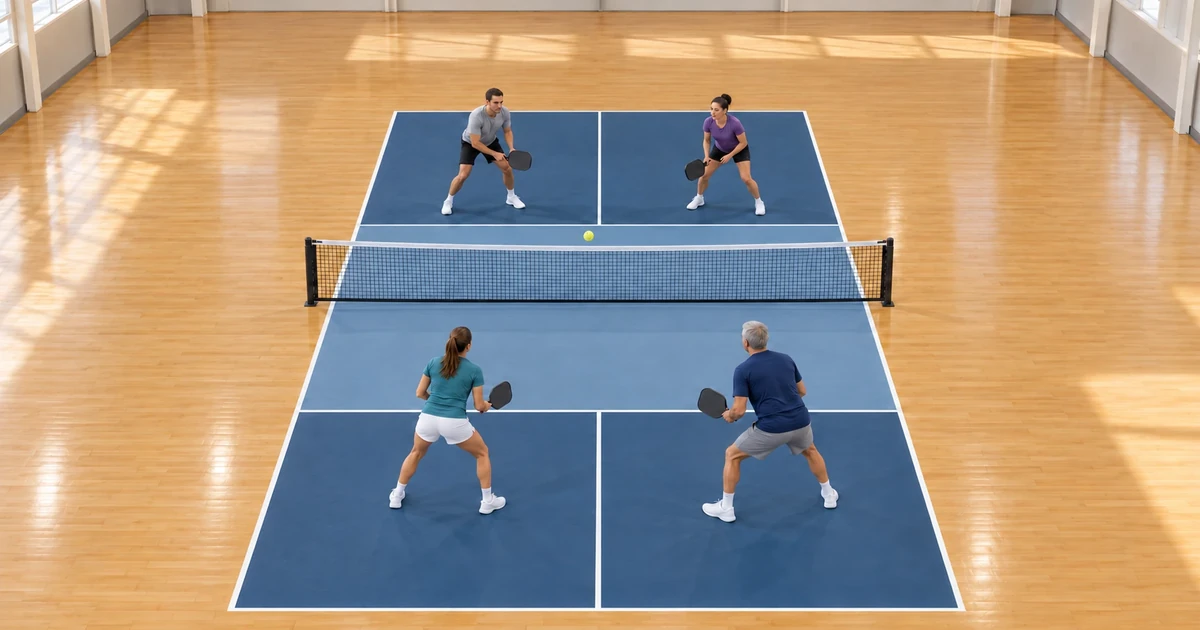
Is pickleball hard? Not to start, and slow to master. The basic rules are short and the court is small, so you can play a real game on day one. What takes time is the kitchen habit, the three-number doubles score and the soft touch shots at the net.
The rules page holds the full rulebook. This page is a judgment, so each claim is tied to a rule number or a named source. Where it's our opinion, we say so. If you want a plan instead, the beginner guide has one.
What is easy about pickleball?
The start is easy because the game is small and slow.
- The court is small. It's 20 by 44 feet (Rule 3.A.1), or 880 square feet.
- The serve is underhand. You can use a volley serve or a drop serve (7.C, 7.D).
- The first rally is slower. The serve and the return must each bounce before anyone volleys (10.A).
- Opinion. USA Pickleball calls pickleball "easy to learn but challenging to master". Paddletek, a paddle maker, says pickleball is relatively easy for beginners to learn.
"Easy to learn" is a judgment from those sources. Nobody measured it. If you're coming from tennis, is pickleball easier than tennis compares the two rule by rule.
What do new players find hard?
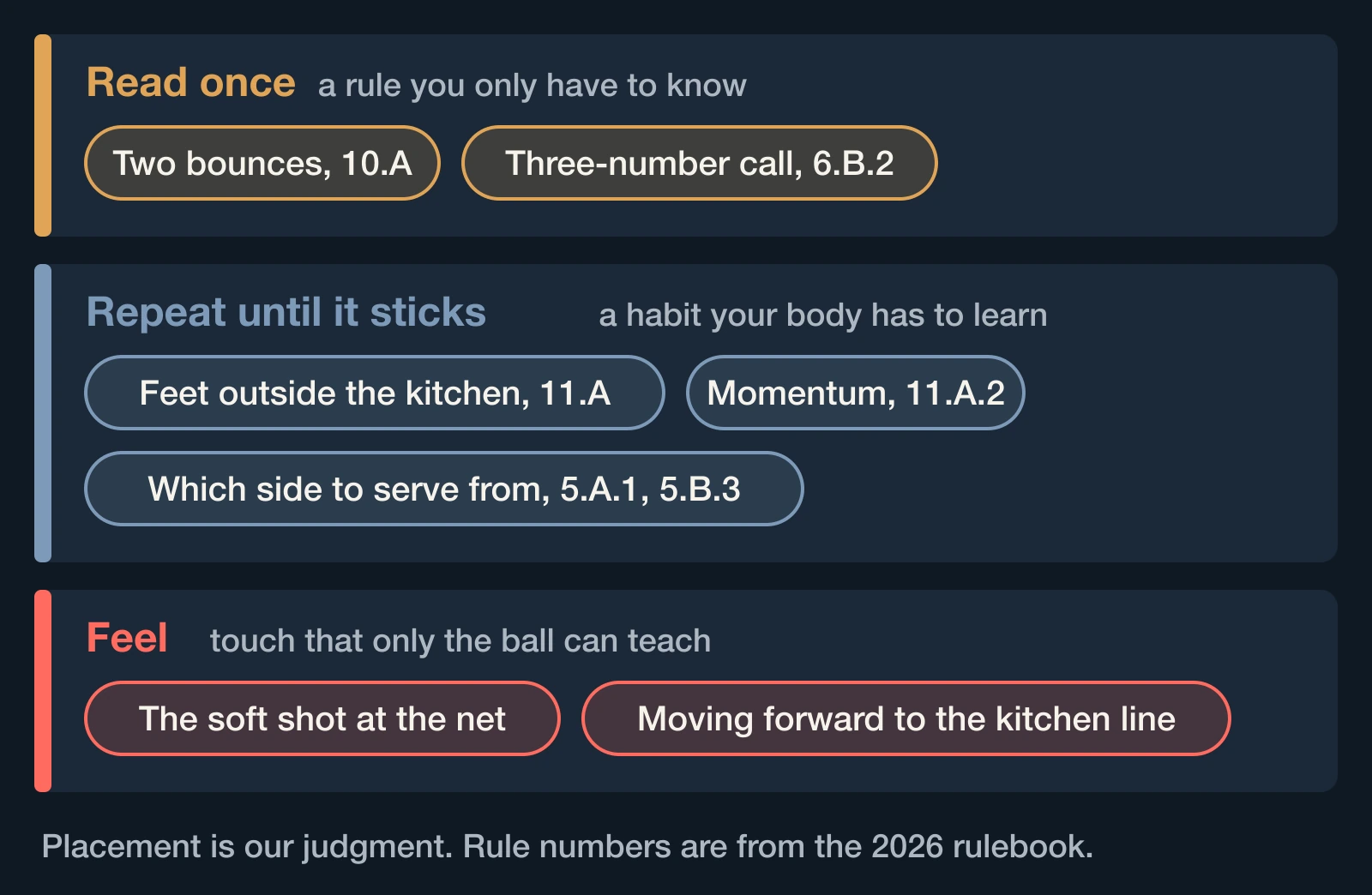
Some of it you read once, some you repeat until it sticks, and some you feel. We sorted the hard parts into those three kinds.
| The hard thing | Why it is hard | Kind | What practice fixes it |
|---|---|---|---|
| Not volleying from the kitchen | Touching the zone while you volley is a fault, and so is carrying into it afterwards (11.A, 11.A.2) | Repeat | Look at your feet after each volley. See the kitchen rules |
| The serve and return must each bounce | The first two shots must bounce before anyone volleys (10.A) | Read once | Say "bounce, bounce" aloud. See the two-bounce rule |
| The three-number doubles call | Serving score, receiving score, then the server number, starting at "zero, zero, two" (6.B.2, 5.B.2) | Read once | Say it before every serve. See the scoring guide |
| Serving from the correct side | In singles, an even score means the right side and an odd score the left (5.A.1). In doubles, the team's score sets the starting server's side and the partner takes the other (5.B.3). A correct claim of the wrong side means a replay (5.C.1.a) | Repeat | Check your score before you step to the line |
| The soft shot at the net (the dink) | It rewards touch and patience, and only the ball gives you feedback | Feel | Easy repetition with a partner or a wall. See what a dink is |
| Moving from the baseline to the kitchen line | It mixes footwork with the kitchen rule and the two-bounce rule. USA Pickleball's skill matrix first lists moving quickly toward the kitchen line at level 3.5 | Feel | Practice with a partner. No source gives a time |
The soft-shot rows are our judgment. No study measured which part is hardest. Paddletek's list of hard parts names the kitchen and serving rules, dinking and third-shot drops, so it agrees with ours. It goes further and ranks the third-shot drop as the hardest shot in the game. That is the paddle maker's opinion, and we rank nothing as hardest.
How long does it take to learn pickleball?
No source we found gives a time, so we won't make one up. USA Pickleball calls it easy to learn but challenging to master, and Paddletek gives no timeframe either. You'll find posts that claim a number, and each is one person's story.
If you want a number to aim at, measure something. A serve that lands in the box and a game with no kitchen faults are two checks we'd use. That's our suggestion, not a standard.
Can you teach yourself?
You can learn the rules from a page, but touch needs feedback. Touch needs a partner or a wall. That's our opinion, and no source tested it. A video helps you see a shot, but it can't tell you whether your feet touched the line. To find which skill to work on first, the four self-tests in how to get better at pickleball give you a score for each.
A worked example: why the doubles call confuses
Team A serves first. The call is "zero, zero, two": zero for the serving team, zero for the receivers, and server number two. The starting server counts as the second server, so the team gets one turn (6.B.2, 5.B.2).
Team A wins the rally and calls "one, zero, two". Team A then loses a rally, and the serve goes over. Team B's first server calls "zero, one, one": Team B has zero, Team A has one, and this is server one.
What do the top results leave out?
- You may stand in the kitchen. You just can't volley while touching it (11.A). That's the opposite of what the nickname suggests.
- Momentum counts. Carrying into the zone after a volley is a fault, even if the ball is already dead (11.A.2).
- The call changes after a side out. The new server calls their own team's score first.
Pick the row in the table that cost you the most points last game, and practice only that in your next session. The free Pickleball Game runs in your browser against the computer, with a referee who calls kitchen and two-bounce faults.
Sources
- 2026 USA Pickleball Official Rulebook: Rules 3.A.1 (court size), 5.A.1 (singles server position), 5.B.2 and 5.B.3 (doubles servers and positions), 5.C.1.a (replay after a correct claim), 6.B.2 (the three-number call), 7.C and 7.D (serves), 10.A (two bounces), 11.A and 11.A.2 (the kitchen and momentum).
- USA Pickleball, What Is Pickleball?: easy to learn but challenging to master.
- USA Pickleball Player Skill Level Matrix: moving quickly toward the non-volley zone appears at level 3.5.
- Paddletek, Is Pickleball Difficult? (4 May 2023): easy for beginners, with the kitchen, serve and return, dinking and third-shot drops named as hard parts, no learning time given.