What Is Pickleball? The Sport Explained in One Table

Pickleball is a paddle sport for two or four players. You hit a perforated plastic ball over a net on a 20 by 44 foot court until one side can't return it. A game usually goes to 11 points, you win by 2, and a 7-foot no-volley zone called the kitchen keeps volleys away from the net.
Pickleball at a glance
USA Pickleball is the national governing body of the sport in the United States, and it writes the rulebook. Every number below comes from a named document. Rule numbers are from the 2026 USA Pickleball Official Rulebook. The ball figures come from the USA Pickleball Equipment Standards Manual, because the rulebook sends ball specifications there (Rule 3.C.2). The rules page has every rule in full.
| What | The number | Where it comes from |
|---|---|---|
| Players | 2 for singles, 4 for doubles | Rulebook, Section 1 |
| Court | 20 ft by 44 ft, the same for singles and doubles | Rule 3.A.1 |
| Kitchen | 7 ft deep on each side of the net, and its lines belong to it | Rule 3.A.4.c |
| Net | 36 in high at the sidelines, 34 in in the middle | Rules 3.B.6, 3.B.7 |
| Ball | Perforated plastic, 2.87 to 2.97 in across, 0.78 to 0.935 oz, 26 to 40 holes | Equipment Standards Manual 2.D.3, 2.D.4, 2.D.8 |
| Paddle | Solid and rigid, up to 17 in long, length plus width up to 24 in, no weight limit | Rules 3.D.2, 3.D.3, 3.D.4 |
| Serve | Hit diagonally into the far service court, past the kitchen, with a low upward swing or after a drop. A fault on the serve loses the rally | Rules 7.C, 7.D, 7.E |
| Scoring | Only the serving side scores. Typically first to 11, win by 2 | Rule 4.A, Section 1 |
| Bounce rule | The serve and the return each bounce once before anyone volleys | Rule 10.A |
| Origin | Summer 1965, Bainbridge Island, Washington | USA Pickleball |
A pickleball isn't just a plastic ball with holes in it. It has to meet a written specification for size, weight, bounce and hole count before USA Pickleball approves it.
Three things in the table trip up beginners. The court is the same size for singles and doubles. The net is lower in the middle, at 34 inches, than at the sidelines, at 36. And the paddle has a size limit but no weight limit.
How does a game work?
The server hits the ball diagonally over the net and past the kitchen. The receiver lets it bounce, then hits it back. The serving side lets that return bounce too. After those two bounces, anyone can volley, as long as they stay out of the kitchen while they do.
The rally goes on until someone faults. The ball goes out or into the net, it bounces twice on your side, or you volley from inside the kitchen. If the serving side wins the rally, it scores and the server moves to the other court. If the receiving side wins, the serve passes on.
Here's the score math. "First to 11, win by 2" means 11 to 10 isn't over. The game carries on until someone leads by two, so 12 to 10 is a win (Section 1).
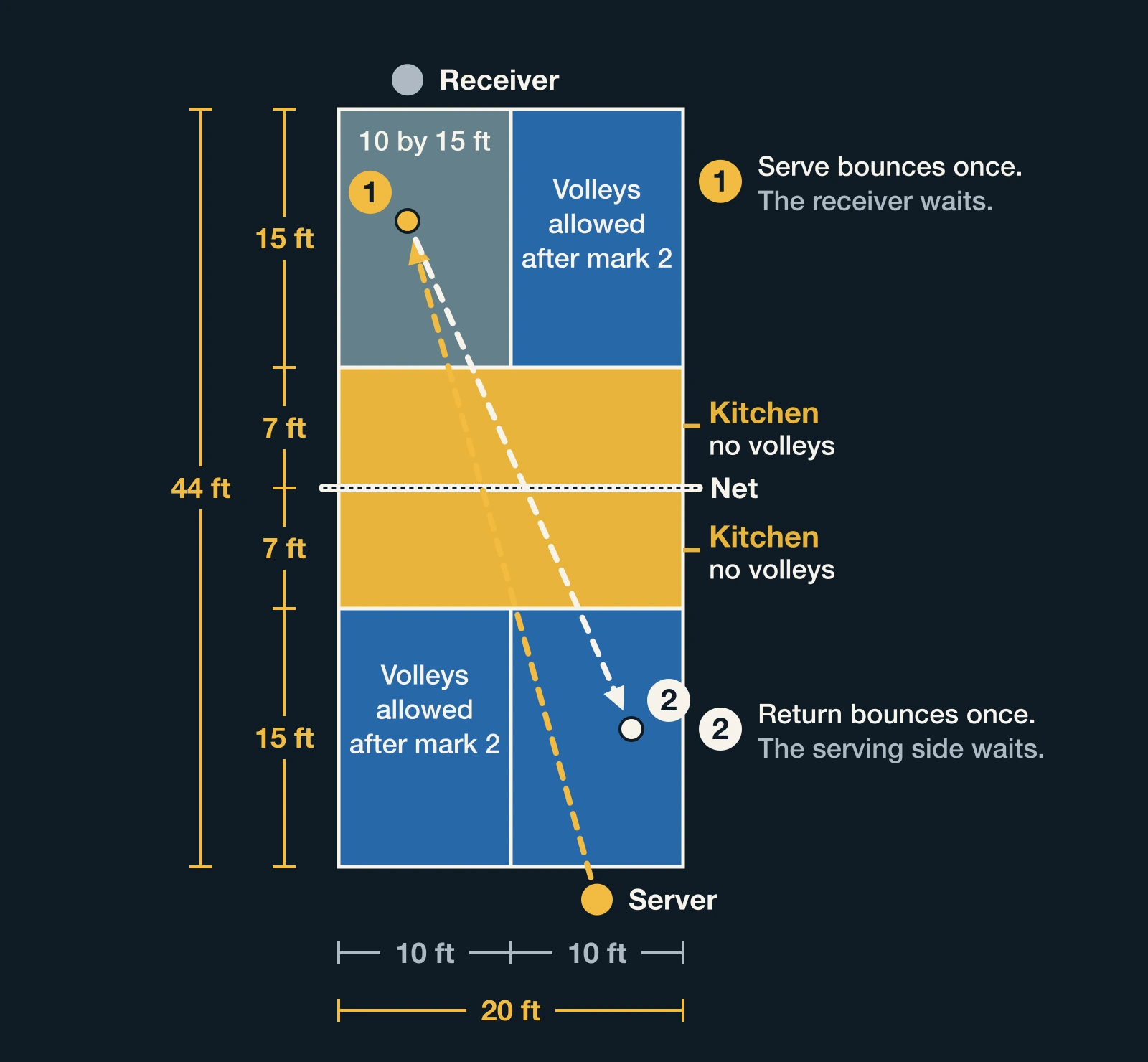
The diagram follows one point from the serve to the first legal volley. Mark 1 is where the serve bounces, and the receiver waits for it. Mark 2 is where the return bounces, and the serving side waits for that. From then on a volley is legal anywhere outside the two kitchens.
Singles and doubles use the same court and the same rules. Doubles adds a partner who also serves, and a third number in the score call (Rule 6.B.2). The singles rules and doubles rules cover each format.
The ordered steps are on how to play pickleball. Calls and scores are in the scoring guide. Words like kitchen, dink and erne are sorted into official and slang in the list of 40 pickleball terms.
Is it always first to 11?
No. The rulebook says "typically" for a reason. Rally scoring, where every rally earns a point whoever served, is a provisional option (Rule 14.A). Tournaments pick their own targets: one game to 15 or 21, or the best of 3 or 5 games to 11 (Rule 15.C.1). Nearly every option is still win by 2 (Rule 15.C).
For a social game, play to 11 unless everyone agrees on something else.
What makes pickleball different from other racket sports?
The rulebook lists three unique features: the two-bounce rule, the non-volley zone, and the allowance for wheelchair and adaptive players to let the ball bounce twice (Section 1). Two more show up the moment you pick up a paddle. The net is lower than a tennis net, and the paddle is solid, with no strings.
Tennis is the usual comparison, so start with space. A pickleball court is 20 by 44 feet, which is 880 square feet. A doubles tennis court is 36 by 78 feet, which is 2,808 (Rule 1 of the ITF Rules of Tennis). Divide 880 by 2,808 and you get 0.31. Pickleball gets by on about 31 percent of the space.
The serve is different too. A pickleball server swings low and upward, or drops the ball and hits it after it bounces. And the kitchen has no tennis counterpart: the ITF rules have no such zone. The court versus tennis court page puts the two to scale, and the rule-by-rule comparison with tennis sets the net, ball, paddle, serve and scoring side by side.
Where did pickleball come from?
USA Pickleball says the game began in the summer of 1965 on Bainbridge Island, Washington, and credits three founders: Joel Pritchard, Bill Bell and Barney McCallum. The first game used a badminton court and net, a pair of table tennis paddles, and a perforated plastic ball from a plastic bat and ball set.
On the name, USA Pickleball says Joan Pritchard chose it after the "pickle boat" of crew races. The story that it came from the family dog is common. USA Pickleball says the dog was born in 1968, three years after the game was named. The same body published the sport's first official rulebook in March 1984. Whether it's an Olympic sport is covered on the Olympic question page, which lists where the federations, USA Pickleball and the law stand.
How many people play pickleball?
SFIA, the Sports and Fitness Industry Association, estimates that 24.3 million Americans aged 6 and up played pickleball in 2025. It put the number at about 4.2 million in 2020 (SFIA's pickleball participation page).
Treat that as one survey's figure. Surveys differ in who they count and how often someone has to play to be included, and SFIA's page doesn't say where it draws that line. This survey-by-survey comparison sets SFIA's count beside the older APP one and shows why the two differ.
Where to go next
Pick the question you can't answer yet and read that page.
| Your question | Read this |
|---|---|
| How do I play? | How to play pickleball, the five basic rules in the order to learn them |
| How big is the court? | Pickleball court dimensions |
| How do I keep score? | Pickleball scoring explained |
| What are the serving rules? | Pickleball serving rules |
| How do I serve? | How to serve in pickleball |
| What is the kitchen? | Pickleball kitchen rules |
| Singles or doubles? | Singles rules and doubles rules |
| What counts as a fault? | Pickleball faults |
| Is the line in or out? | Pickleball line rules |
| Can I try it first? | Pickleball Game is free in your browser, singles or doubles against the computer at three levels, with keyboard and mouse. The game page says what it does and doesn't do |