Pickleball Terms: 40 Words, Official or Slang
Pickleball terms fall into two groups: words the 2026 USA Pickleball rulebook defines, such as fault and volley, and slang players made up, such as kitchen and dink. This page explains 40 of them in one line each and marks which kind each one is. The rules page covers the rules themselves.
Official means the 2026 rulebook defines the word or uses it, and the rule number follows the meaning. Slang means the rulebook never uses it. Of the 40 words here, 24 are official and 16 are slang.
That split surprises people. The book's Section 2 defines 46 terms. We searched the text of the book for kitchen, dink, erne, lob, poach, stack, groundstroke, drop shot, reset and drive, and none of them appears. Even "kitchen" is a nickname. The book says non-volley zone.
Court words
The book names the lines and zones. Players nickname the zones.
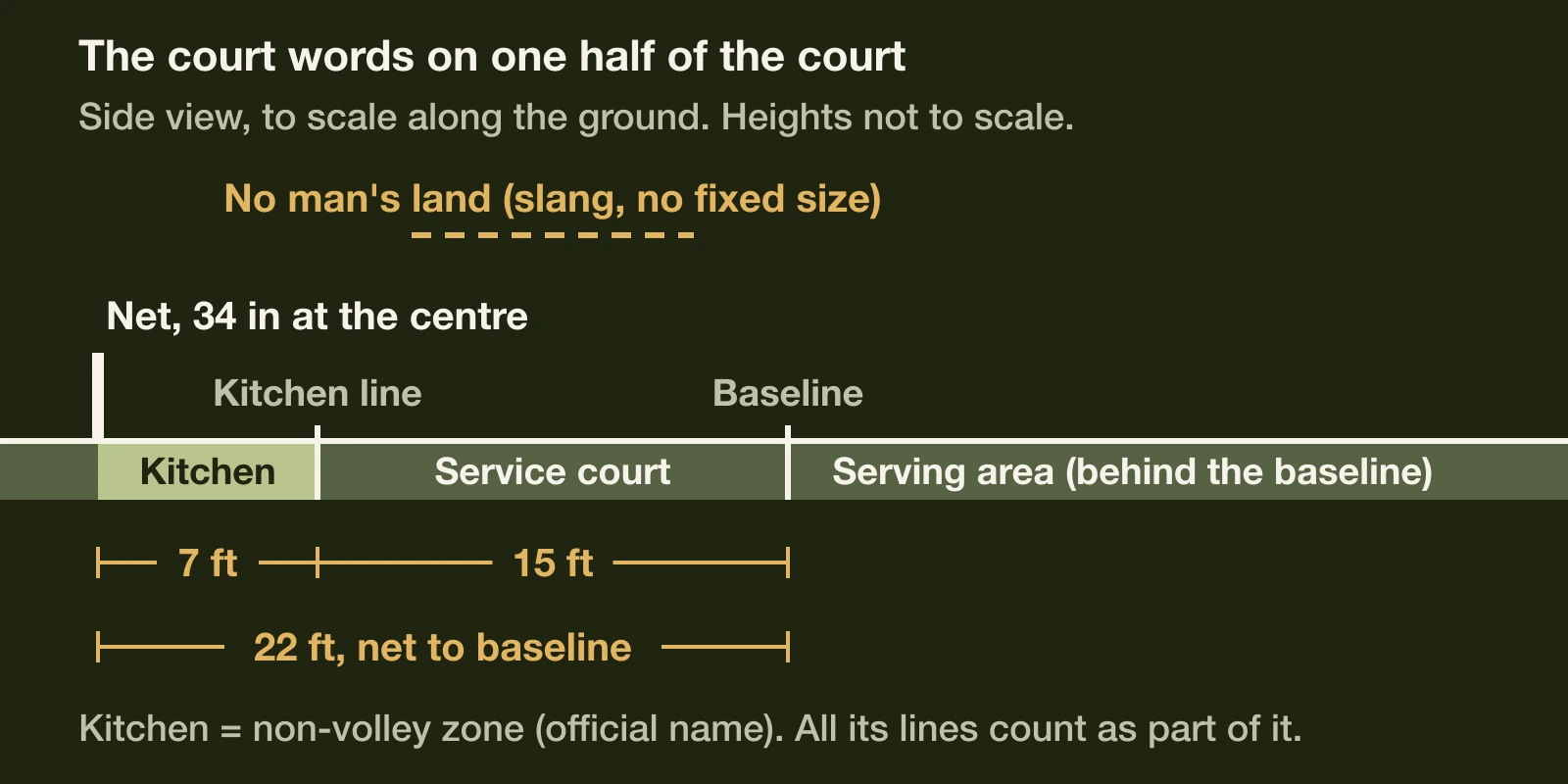
The kitchen is 7 feet deep and the service court is 15 feet deep, so the baseline sits 22 feet from the net (the court is 44 feet long, Rule 3.A.1). "No man's land" is the middle of that 15 feet. It has no official size.
| Term | Official or slang | What it means (rule or page) |
|---|---|---|
| Non-volley zone | Official | The 7 by 20 foot zone beside the net where you can't volley. Its lines count as part of it. Rule 3.A.4.c. |
| Kitchen | Slang | Nickname for the non-volley zone. Kitchen rules |
| No man's land | Slang | The middle stretch between the kitchen line and the baseline. |
| Baseline | Official | The line at each end of the court, parallel to the net. Rule 3.A.4.a. |
| Sideline | Official | One of the two long lines down the sides of the court. Rule 3.A.4.b. |
| Centerline | Official | Splits each end into right and left service courts. It stops at the kitchen line. Rule 3.A.4.d. |
| Service court | Official | The area beside the centerline between the kitchen line and baseline, where a serve must land. Rule 3.A.4.f. Court dimensions |
| Serving area | Official | The area behind the baseline where the server stands. Rule 3.A.4.g. |
| Plane of the net | Official | The vertical sheet of space in line with the net, above, below and to both sides. Section 2. |
Serving words
| Term | Official or slang | What it means (rule or page) |
|---|---|---|
| Serve | Official | The first hit of a rally. Only the serving side can score. Section 2, Rule 4.A. |
| Volley serve | Official | A serve hit out of the air at waist height or lower, with an upward swing. Rule 7.C. Serving rules |
| Drop serve | Official | A serve where you drop the ball and hit it after it bounces. Rule 7.D. |
| Service foot fault | Official | A foot on the court, outside the serving area, or both feet off the ground when you serve. Rules 7.A, 9.B.3. |
| Starting server | Official | In doubles, the player who serves first at the start of a game. Section 2. |
| First server, second server | Official | In doubles, the two partners serve in turn. The second server is the first server's partner. Rule 5.B.2. Doubles rules |
| Side out | Official | The serve passes to the other team after the serving side loses a rally. Rule 5.A.3. Scoring |
| Let | Slang | A serve that clips the net. If it lands in the right box, it's in play. See Rule 7.E. Let page |
Rally and scoring words
Two of these sound alike and are not the same thing. A double bounce is a fault (Rule 10.B.1): the ball bounced twice on your side before you hit it. The two-bounce rule is the opening sequence, where the serve and the return must each bounce first (Rule 10.A).
| Term | Official or slang | What it means (rule or page) |
|---|---|---|
| Rally | Official | Play from the serve until the ball is dead. Section 2. |
| Fault | Official | A rule violation. It ends the rally, and the side that committed it loses the rally. Rule 9.B. Every fault |
| Dead ball | Official | A ball that's no longer in play. Section 2. |
| Replay | Official | The rally restarts with no point and no change of server. Section 2. |
| Volley | Official | Hitting the ball before it bounces. Section 2. |
| Double bounce | Official | The ball bounces twice on your side before you return it. It's a fault. Rule 10.B.1. |
| Two-bounce rule | Official | The serve and its return must each bounce before anyone volleys. Rule 10.A. Two-bounce rule |
| Double hit | Official | Hitting the ball twice. Legal only in one continuous stroke in a single direction by one player. Rule 10.D. |
| Momentum | Official | Still moving after a volley. If it carries you into the kitchen, it's a fault. Rule 11.A.2. Kitchen rules |
| Rally scoring | Official | An optional, provisional format where every rally scores a point, not just the server's. Rule 14.A. |
Shot words
Almost all of these are slang. Players use them for how a shot is hit and where it lands.
| Term | Official or slang | What it means (rule or page) |
|---|---|---|
| Groundstroke | Slang | A shot hit after the ball has bounced. |
| Dink | Slang | A soft shot, hit after a bounce, that arcs over the net into the opponent's kitchen. |
| Drop shot | Slang | A soft shot from the back of the court that lands in the opponent's kitchen. A third shot drop is one hit as the third shot of a rally. |
| Drive | Slang | A hard, fast, low shot over the net. |
| Lob | Slang | A high, arcing shot over an opponent's head toward their baseline. |
| Overhead smash | Slang | A hard downward shot hit with the paddle above your head. |
| Reset | Slang | A soft shot that takes the pace off a fast ball and lands in the kitchen. |
Doubles and strategy slang
| Term | Official or slang | What it means (rule or page) |
|---|---|---|
| Poach | Slang | In doubles, crossing over to hit a ball that was your partner's. |
| Stacking | Slang | Both partners start a point on the same side, then split. It's legal. See Rule 5.B.4. Stacking rules and examples |
| Erne | Slang | A volley near the net, hit from outside the sideline without touching the kitchen. The erne explained |
| Around the post (ATP) | Slang | A shot that goes around the outside of the net post instead of over the net. The rulebook allows it. Rule 13.C. |
| Pop-up | Slang | A ball hit high enough to be easy to attack. |
| Banger | Slang | A player who mostly hits hard drives. |
Read a rally with these words
The server calls the score, 4-2-1, and hits a volley serve into the service court. The receiver lets the serve bounce and returns it, as the two-bounce rule needs. The serving side lets the return bounce too, then plays a drop shot into the kitchen, and the point turns into dinks.
A receiver hits a pop-up. The server's partner hits an overhead smash. The receiver volleys it back with a foot on the kitchen line. That's a fault on the receiving side (Rule 11.A.1), so the serving side scores. The call is now 5-2-1.
Two details are easy to miss. A "volley" depends on the bounce, not on where you stand. And the kitchen line belongs to the kitchen, so a foot on it counts as a foot in it.
Questions people ask
What are the five P's of pickleball?
We found no official list. The rulebook doesn't have one, and neither does USA Pickleball's basic terms page. Coaches and clubs publish their own five P's, and the lists differ, so check which list your coach means.
What is a person who plays pickleball called?
A pickler. It's slang, listed in the Wikipedia glossary of pickleball as a pickleball player.
What is it called when you hit someone with the ball?
Players call it a body bag, and the rulebook gives it no name. The player who gets hit has made a fault, unless the ball hit the paddle or the hand below the wrist while holding it (Rule 10.C.3). If you hit a ball that touches your opponent before it lands, that's a legal return (Rule 10.C).
You'll also hear skill ratings such as 3.5 on court, and what each skill level means explains the numbers. Next time you hear a word you don't know on court, find it here and check which kind it is. In the free browser game the referee calls faults and side outs by name, so you hear the official words as you play.