How to Serve in Pickleball: A Legal, Deep Serve in 4 Steps

Here's how to serve in pickleball: stand behind the baseline, release the ball, and swing upward through it so it clears the kitchen and lands in the far diagonal box. Hit it below your waist, or let it bounce first. You get one try, so aim for deep and safe.
The full rule list is in the serving rules and on the rules page. This page is about hitting the serve.
Step 1: Set your feet
Stand with both feet behind the baseline and inside the lines that continue the sideline and the center line. The baseline counts as court, so a toe on it is a fault (Rule 7.A.2 in the 2026 USA Pickleball rulebook). Look down before you swing to check that your front toe is clearly behind the line. The foot rules apply only when you hit the ball (7.A), so you can step in right after.
Call the score first, then serve within 10 seconds (Rules 6.C and 6.D). That's long enough for a short routine, such as a bounce, a breath and a look at your target. USA Pickleball's serve tips suggest finding a rhythm like that. The scoring guide covers the call.
Step 2: Release the ball
Let go with one hand, in front of your body on your paddle side. Don't spin it or push it. Use one hand or the paddle (7.B.1), add no spin before the hit (7.B.2) and let the receiver see the release (7.B.3).
Pickleball has no toss. Bounce the ball first and it's a drop serve, covered in the serving rules.
Step 3: Swing and make contact
Swing like a pendulum from the shoulder, low to high, and finish toward your target. USA Pickleball's serve tips favor a loose swing and a reliable serve over a flashy one.
On a volley serve, three things are checked at contact. Each is something you can check on your own body.
| Test | What you check | Rule |
|---|---|---|
| Upward arc | The paddle is moving up, low to high | 7.C.1 |
| Paddle head | The top of the paddle head is clearly not above the highest part of your wrist | 7.C.2 |
| Ball height | The ball is clearly no higher than your waist | 7.C.3 |
Fail any one and it's a fault (7.C.5). The 2026 rulebook says "clear" or "clearly" in all three, so a serve that is only just legal is the one to avoid. "Underhand" and "navel" are the old everyday words. The rule now uses these three tests, and the limit is the waist.
A drop serve has none of the three tests. Rule 7.D asks only for a natural release and no push, so it's the easiest legal serve to start with.
Step 4: Aim deep, past the kitchen
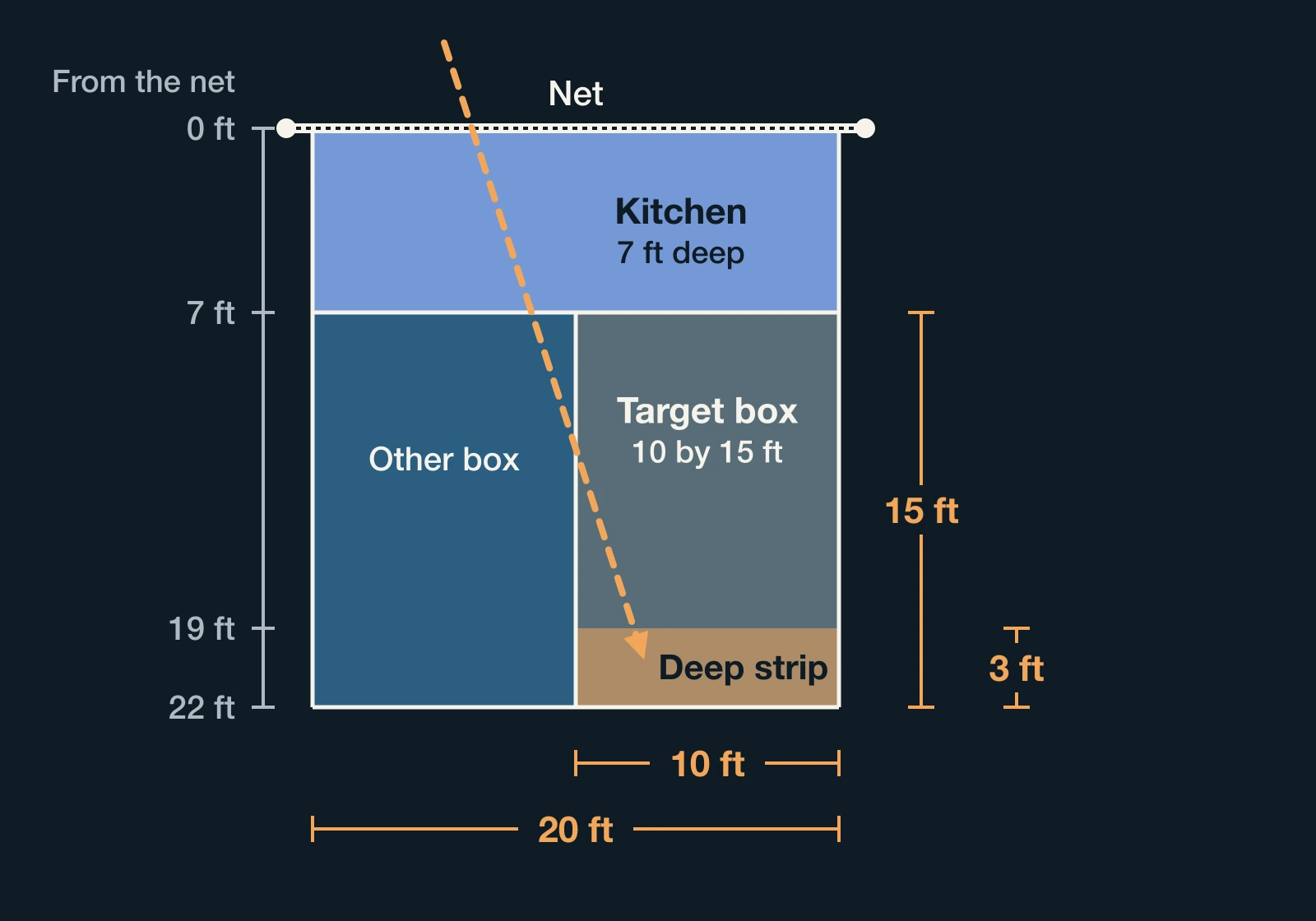
Aim diagonally for the back 3 feet of the far box. The ball has to clear the kitchen and land in the box across from you (7.E).
The kitchen is 7 feet deep and its line counts as kitchen, so a serve on that line is a fault (7.E.2, 8.C). The kitchen rules explain why. From that line the service box runs to the baseline, 22 feet from the net. That makes it 15 feet deep and 10 feet wide (3.A.4.f). Playing on tennis lines? The taping steps in pickleball court vs tennis court show where the boxes go.
The deep strip is the back 3 feet of the box, 19 to 22 feet from the net. USA Pickleball's serve tips say to land the serve 2 to 3 feet inside the baseline and aim at the opponent's backhand. A deep serve keeps the receiver back.
Spin added at contact is legal, and the topspin article shows how. Get depth first.
Fix it: why serves miss
A serve fails four ways.
| What happened | Rule | Usually because | Check |
|---|---|---|---|
| Into the net | 7.E, 7.E.1 | A flat swing or a low contact | Finish higher and aim above the tape, not at it |
| Long or wide | 7.E.1 | More pace than the swing needed | Aim at the strip, not the baseline, and shorten the swing |
| Into the kitchen | 7.E.2 | A soft swing that stops short | Pick a target 12 to 15 feet past the kitchen line (the strip starts 19 feet out, the line is at 7) |
| Foot fault | 7.A.2, 7.A.3 | A toe on the baseline or a step before contact | Start a shoe length back and step in after contact |
A 10-serve depth card
Hit ten serves and score each one: a fault is 0, a serve in the box is 1 and a serve in the back 3 feet is 2. The top score is 20. Lay a towel or tape across the box 3 feet from the baseline to see the strip. This builds on the towel drill in the serving rules and adds depth.
A worked example: two serves go into the net, one goes long, one lands in the kitchen, four land in the box and two land in the strip. That's 4 x 1 + 2 x 2 = 8 out of 20, with 6 of 10 in the box. The net balls are the biggest block of misses, so this server starts with the first row of the table above.
As a target, try 8 of 10 in the box and 3 of 10 in the strip. That's our own suggestion, not a rule. Raise it when you hit it twice in a row. With no partner, play pickleball by yourself puts serves in a 20-minute solo plan, and drill 9 in pickleball drills adds a returner. Day 3 of the seven-day beginner plan is a serve day.
In Pickleball Game you aim a marker inside the legal box and hold the mouse button to set the power, so you can rehearse picking a depth against the computer.