Pickleball Line Rules: In or Out, and Who Calls It
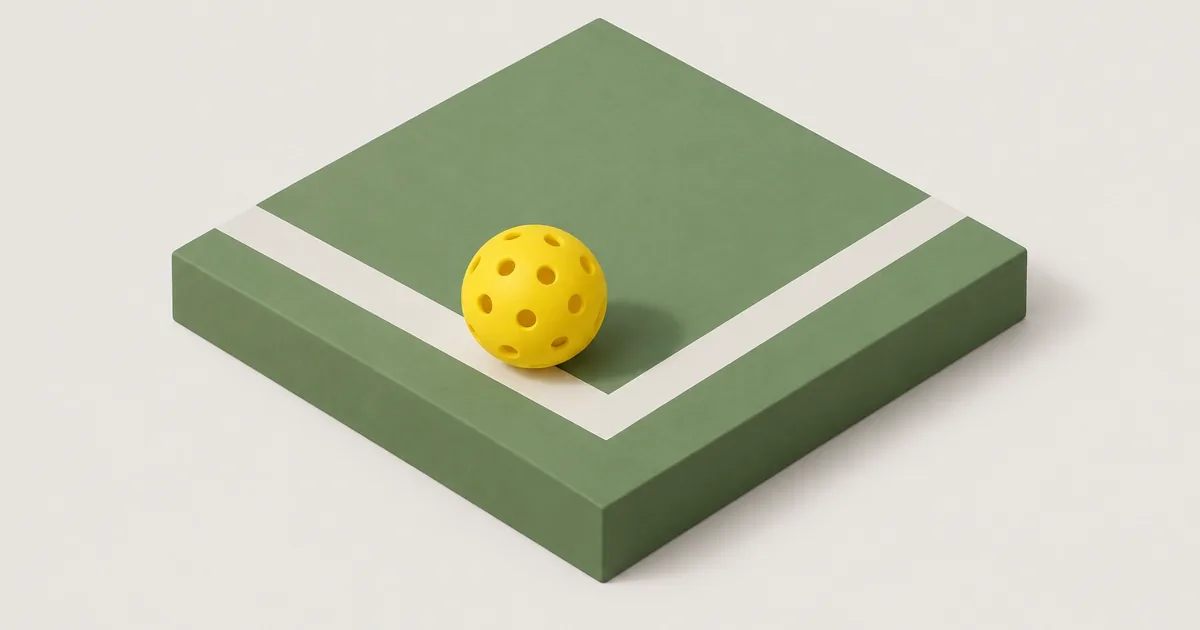
The pickleball line rules are short. A ball that touches any part of a line is in, except a serve that lands on the kitchen line, which is a fault. Call a ball out only when you can clearly see space between it and the line. If you can't, it's in.
These are Section 8 of the 2026 USA Pickleball rulebook. The rules page has the rest.
Is a ball on the line in or out?
In, with one exception. The court is measured to the outside edge of the lines (Rule 3.A.2), and a service court includes its own baseline, sideline and center line (Rule 3.A.4.f). The exception is a serve on the kitchen line, because every line around the kitchen belongs to the kitchen (Rule 3.A.4.c).
| Spot | Where the ball lands | Call | Rule |
|---|---|---|---|
| 1 | Rally, touches the baseline | In | 8.B, 8.E |
| 2 | Rally, touches a sideline | In | 8.B, 8.E |
| 3 | Rally, lands on the kitchen line or inside the kitchen | In | 8.B, 11.A |
| 4 | Rally, clear space between the ball and the line, on the outside | Out | 8.C, 8.E |
| 5 | Serve, touches the sideline or baseline of the correct service court | In | 3.A.4.f, 8.B |
| 6 | Serve, touches the center line | In | 3.A.4.f |
| 7 | Serve, lands on the kitchen line | Out, a fault | 7.E.2, 8.C |
| 8 | Serve, lands in the wrong service court | Out, a fault | 7.E.1, 8.C |
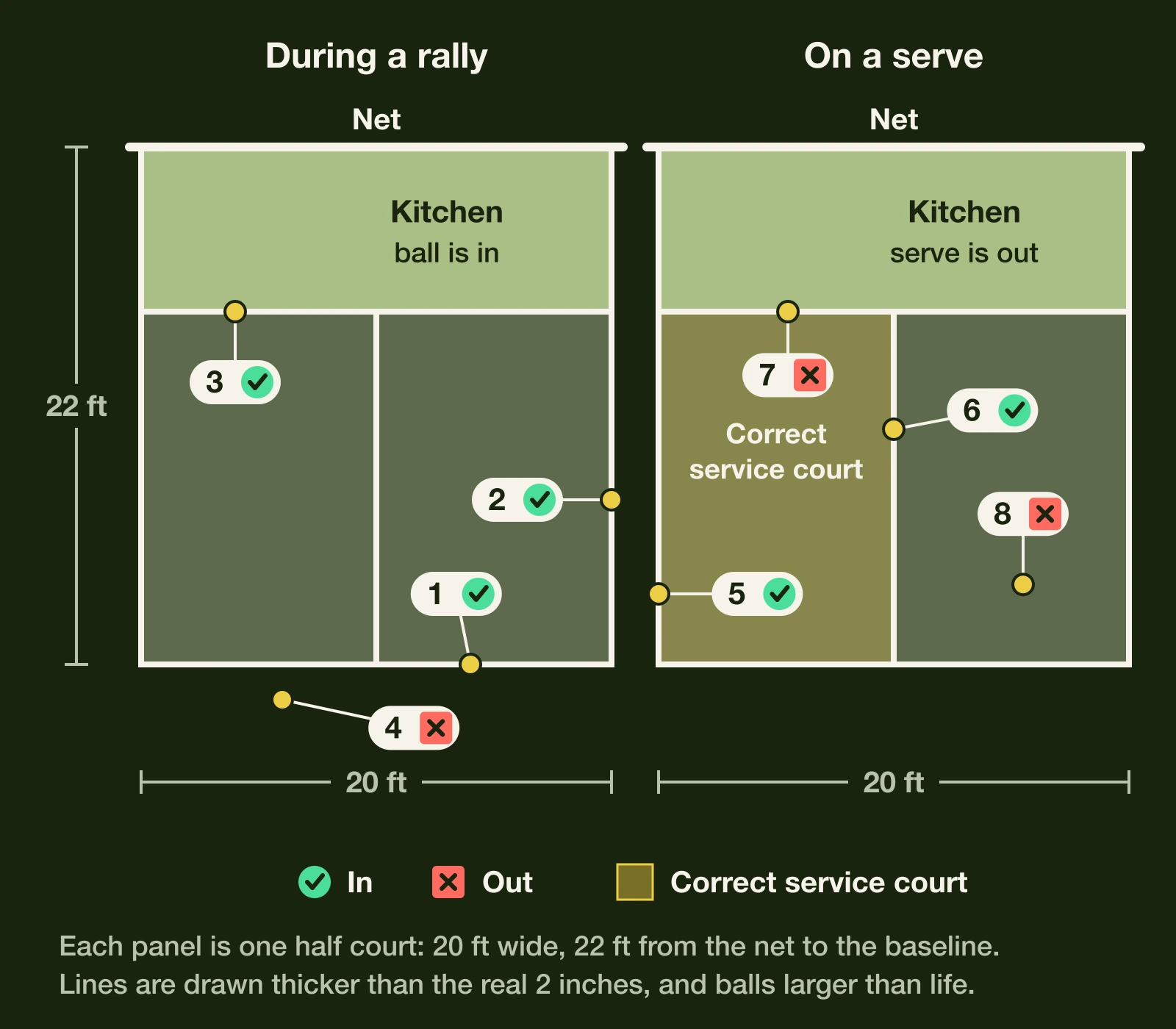
The diagram's numbers match the table. Green circles with a tick are in, red squares with a cross are out. Lines are drawn thicker than the real 2 inches.
Row 3 is worth a second look. In a rally the kitchen only limits volleys (Rule 11.A), so a ball can land in it and it's in. Only the serve has to clear it. See the kitchen rules, the serving rules and every line on the court.
A ball that touches the net during a rally stays in play (Rule 13.A). That isn't a line call.
How do you decide a close ball?
Look for space. Call a ball out only if you clearly see a gap between the line and the ball when it lands (Rule 8.E). Saw a gap, it's out. It felt long, or you caught only a glimpse? Then you didn't see a gap.
The opponent gets the benefit of the doubt, and a ball you can't promptly call out is in (Rule 8.D). USA Pickleball's guidance on judging a ball in or out says the same: a visible gap means out, and no gap or no certainty means in.
Who makes the call, and how fast?
You call the lines on your own end of the court (Rule 8.A). In doubles, either partner can make the call. Call "out" by voice, by hand signal or both, and do it promptly (Rule 8.F). The rulebook gives no number of seconds, so think right away. A line call stops play (Rule 8.F.2).
Timing is the part most guides leave out (Rule 8.F.3). It depends on whether you returned the ball.
- You returned it. Your opponent's shot lands near the baseline and you hit it back. Then you see the gap you missed. Call "out" before your opponent hits your return, or before the ball goes dead. If you wait until they've hit it, play carries on.
- You didn't return it. The ball lands near the line and you let it go. A prompt "out" counts, even if the ball is already dead.
In doubles, talk between partners while the ball is in the air isn't a call (Rule 8.F.4). "That looks out!" is a comment. The call comes after the ball lands.
What if you and your partner disagree?
Then the call is "in" (Rule 8.H). The rulebook calls it a conflict, and a conflict goes to the opponents. Two more rules cover second thoughts:
- You can override your own call, your partner's call or an "in" ruling, but only to your own side's disadvantage (Rule 8.G). You can't change a call to win a point.
- You can ask your opponents what they saw, until the next serve is hit (Rule 8.I). A clear call from them stands. If they don't make one, your call stands, or the ball is in if you hadn't made one. Once you ask, you and your partner can't call it yourselves, except to give the point away.
Spectators don't get a vote (Rule 8.J). The doubles rules cover how partners share the court. The faults list covers what else ends a rally.
What changes in a tournament?
Tournament play only. With a referee and no line judges, players call the baseline, sidelines and center service line on their end (Rule 19.B). With line judges, players call only the center service line (Rule 19.C.2). Only rally-ending shots can be appealed, before the next serve (Rules 19.D, 19.D.1). If nobody can make the call on appeal, the ball is in (Rule 19.G.2). Social games use Section 8 only.
Before your next game
Agree with your partner that anything close is in. Then make "out" or "good" a habit you say out loud, within a second of the bounce. If you play with strangers at a drop-in session, the open play etiquette guide covers the paddle queue and the other habits that keep a game friendly.
In Pickleball Game the referee calls the lines for you, so you can watch a ball on the line ruled in and a serve on the kitchen line ruled a fault.