Pickleball Warm-Up: A 6-Minute Routine Before You Play
A pickleball warm-up can be as short as five minutes of easy movement that gets you breathing a little harder before you play. Harvard Health suggests marching in place, arm circles and gentle wrist and elbow flexes. Below is a six-minute version, move by move, with the seconds for each.
This page is general information, not medical advice. It comes from two medical sources, named where they're used. The rules page has the full pickleball book, and the 2026 rulebook says nothing about warm-ups.
What does a good warm-up do?
It prepares the body for harder activity. The American Academy of Orthopaedic Surgeons' OrthoInfo page on warming up says a good warm-up gets your blood flowing, raises your muscle temperature and increases your breathing rate. When we read it on 8 October 2026 it showed no review date.
OrthoInfo says the simplest way to warm up is an aerobic activity at an easy pace. For pickleball, that means walking or marching before you swing. For what the game itself burns, see how many calories pickleball burns.
How long should a pickleball warm-up be?
Harvard Health's article on pickleball elbow (1 September 2023) says five minutes. OrthoInfo says it depends on your fitness, and that if you're newer to exercise, a longer warm-up suits your body better. If you're starting later in life, pickleball for seniors has a safe-start checklist. This page uses six minutes because the moves divide neatly into seconds, not because six is special.
The six-minute routine
Keep every move easy. If it feels like work, you're going too hard. Run the table top to bottom once.
| Time | Move | Seconds | How to do it |
|---|---|---|---|
| 0:00 | Easy march or walk around the court | 90 | Start slow and pick the pace up a little. Harvard Health suggests marching in place. |
| 1:30 | Arm circles, forward then back | 45 | About 20 seconds each way. Small circles first, then bigger. Harvard Health names arm circles. |
| 2:15 | Leg swings | 45 | Hold a fence or post. Swing a leg front to back, easily, and switch legs halfway. Our choice. |
| 3:00 | Easy trunk twists | 45 | Feet set, turn the shoulders left and right. Our choice. |
| 3:45 | Gentle wrist and elbow flexes | 30 | Open and close the hand, bend and straighten the elbow. Harvard Health says to flex them gently. |
| 4:15 | Side steps along the baseline | 60 | An easy shuffle, left then right, staying loose. Our choice. |
| 5:15 | Slow shadow swings, then easy hits | 45 | A few forehands, backhands and volleys at half speed, then rally gently. Our choice. |
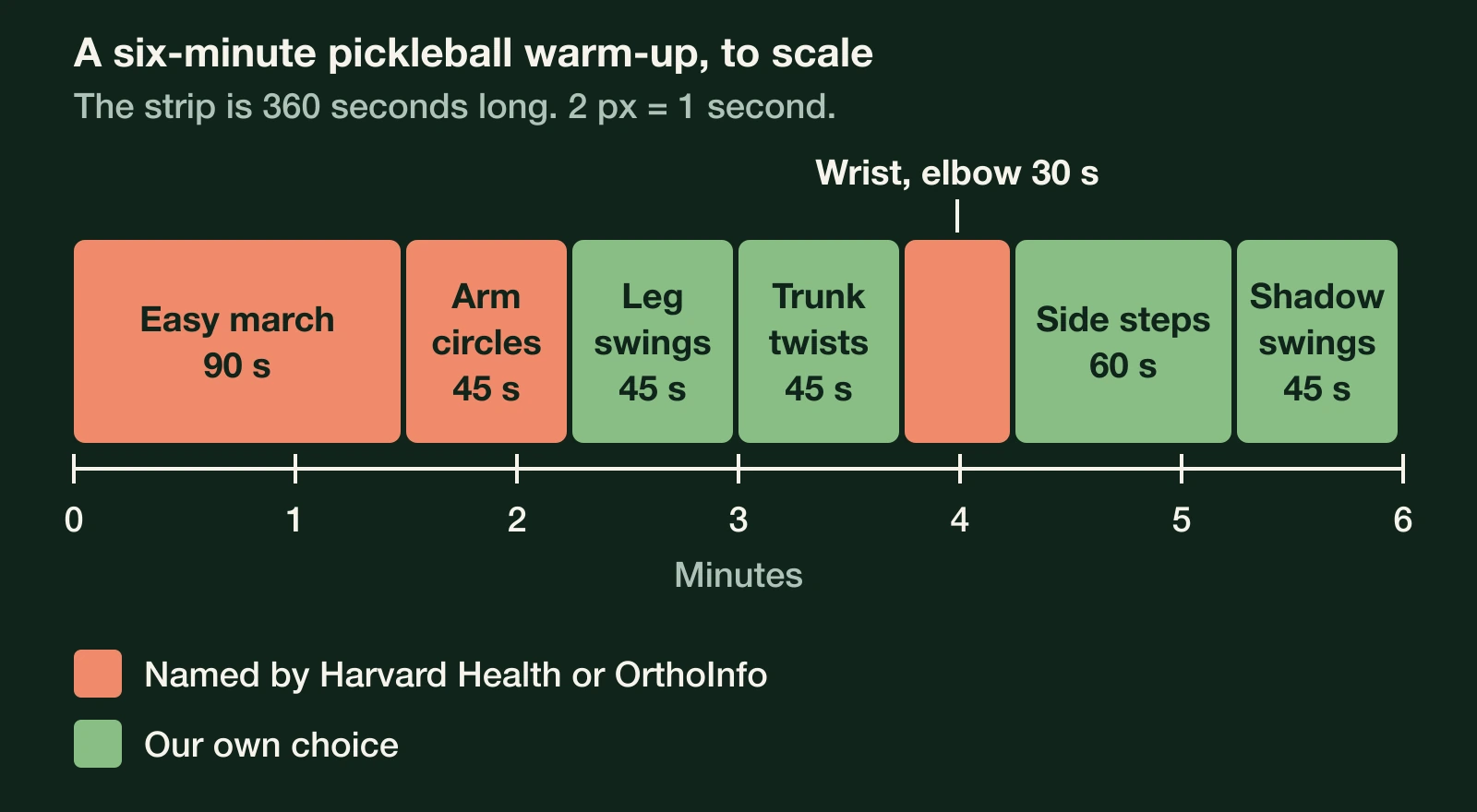
The seconds add up to 360: 90 + 45 + 45 + 45 + 30 + 60 + 45. The march, the arm circles and the wrist and elbow flexes come from Harvard Health. The leg swings, trunk twists, side steps and shadow swings, and all the seconds, are our own choices. No source says this exact routine prevents injury.
Should you stretch before you play?
Warm up first, then stretch if you like. OrthoInfo says to always warm up before you stretch, because stretching cold muscles can cause injury. It also says that once your muscles are warm, a few minutes of stretching may improve performance, and that stretches you can do standing up suit a warm-up.
This page doesn't list stretches. OrthoInfo's page does list general ones, by body part: thigh, calf, hamstring, upper body, triceps, shoulder, inner thigh and hip, and lower back. Neither source gives a pickleball-specific list, so we'd be guessing at one.
What if you want advice for your own body?
Ask a professional. OrthoInfo says anyone who wants specific orthopedic advice should consult an orthopedic surgeon. Harvard Health's site says its content shouldn't be used as a substitute for direct medical advice from your doctor or another qualified clinician. This page can't tell you what's right for your joints, your age or your health. For the injuries players most often get hurt with, and the signs that need a doctor, see pickleball injuries.
Mistakes to avoid
- Starting with stretches while you're cold (OrthoInfo's warning above).
- Doing the routine at full effort and arriving at the first point already tired.
- Treating six minutes as a rule. It's a plan you can shorten or lengthen.
To use it, set a timer for six minutes before your next game and run the table once. Then spend your first rallies on the basics in the pickleball drills or the wall drills if you're on your own. New to the game? Start with pickleball for beginners, or read how to play pickleball. You can also play a game in your browser once you're warm.
Sources
- 2026 USA Pickleball Official Rulebook: the full rules, which say nothing about warm-ups.
- American Academy of Orthopaedic Surgeons, OrthoInfo: Warm up, cool down and be flexible: what a warm-up does, easy aerobic activity first, warm up before stretching, the list of general stretches, and the advice to see an orthopedic surgeon. No review date shown (read 8 October 2026).
- Harvard Health, How to avoid this common pickleball injury (1 September 2023): five minutes of marching in place, arm circles and gentle wrist and elbow flexes.