How to Get Better at Pickleball: 4 Self-Tests and a Plan
How to get better at pickleball: test four skills, find the one furthest from its pass mark, and practice it until you pass twice in a row. This plan starts where the first-week plan ends. The pass marks are our own targets, not an official standard.
The rules page has the rulebook, and the first-week plan covers days one to seven. This page is for someone who has done a first week or two and keeps making the same mistakes. It promises no speed. For how long learning takes, see is pickleball hard to learn.
What are the four tests?
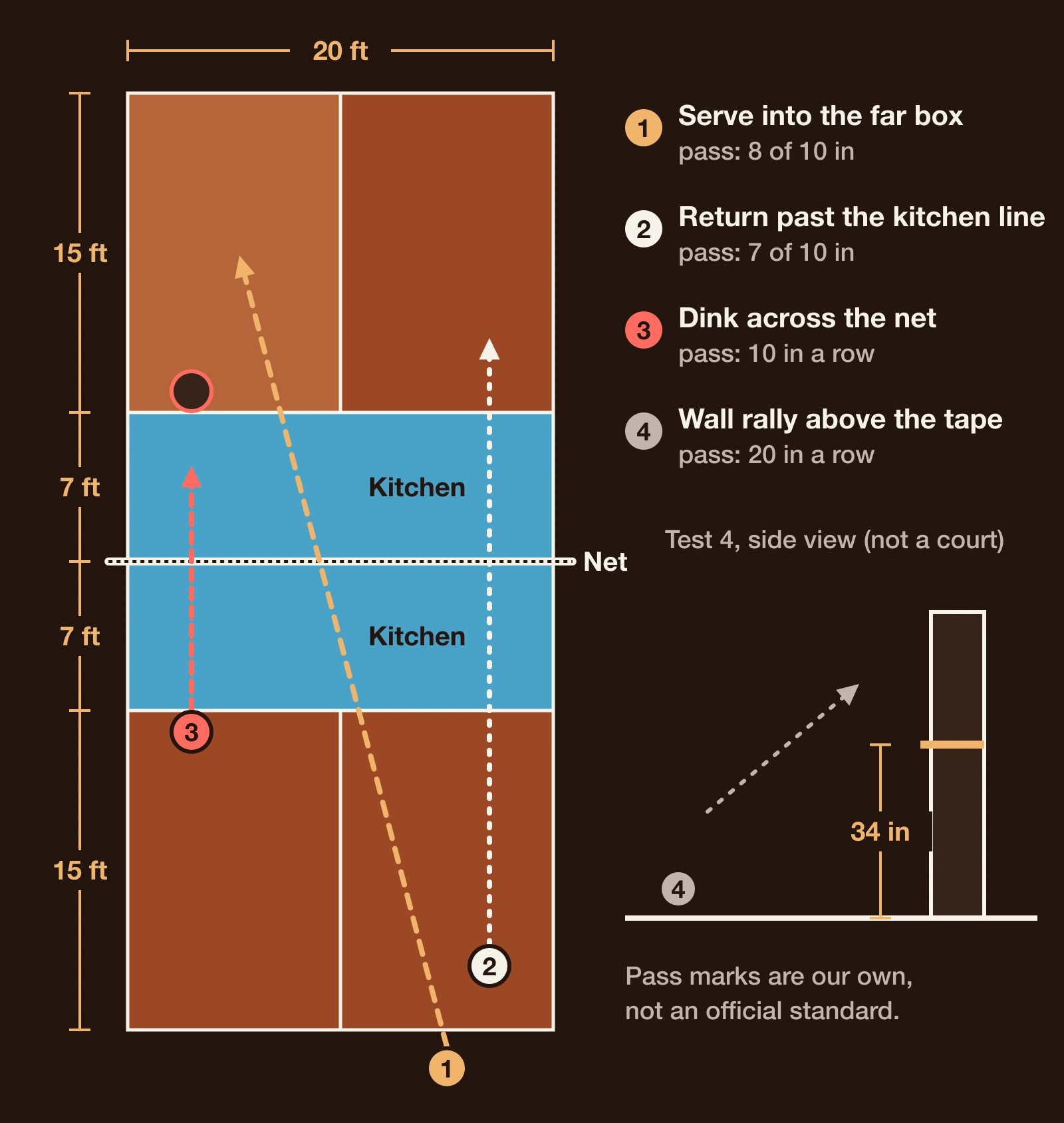
Serve, return, dink and wall rally, because each one is a skill you can score alone or with one partner in 10 minutes. Test after a warm-up, not cold or tired.
| Test | How to run it | Pass mark (ours) | Rule behind it |
|---|---|---|---|
| Serve | Ten serves from behind the baseline into the diagonal box. A serve into the kitchen or on its line is a fault | 8 of 10 in the box | 7.A, 7.C or 7.D, 7.E, 8.C |
| Return | A partner serves ten easy balls. Let each bounce, then hit it past the kitchen line and in | 7 of 10 | 10.A, 3.A.4.c (the kitchen is 7 ft deep) |
| Dink | Both of you stand behind the kitchen lines and rally soft shots that land in the kitchen. Count your longest run in a row, best of three tries | 10 in a row | 11.A |
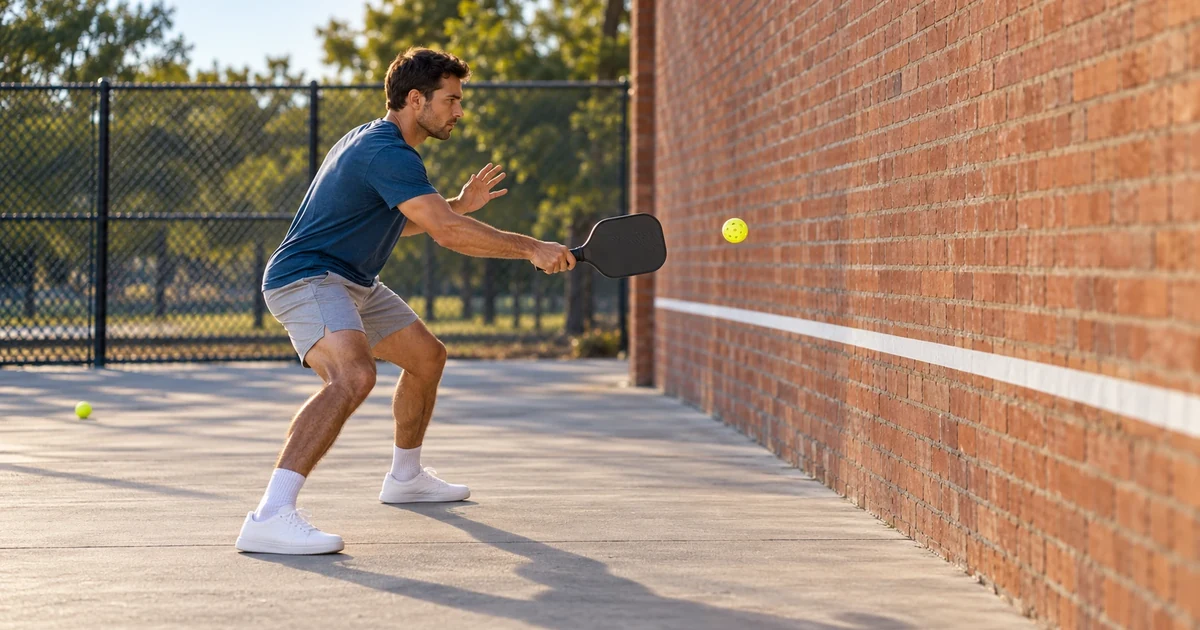
| Wall rally | Alone, face a wall with a tape line 34 inches above the floor. Count your longest run of hits that rise above the line, best of three tries | 20 in a row | 3.B.7 (the net is 34 in at the center) |
The pass marks are our own. No study set them, and you should change them if your court or partner makes them silly. The serve guide has a 10-serve depth card with the same 8-of-10 target. A dink is a soft shot into the other side's kitchen. The wall drills have a ladder to follow.
Rule 10.A says the serve and the return must each bounce before anyone volleys.
How do you run each test fairly?
Use the same setup every time, so a change in score means a change in you. Write the date and the score on a card.
- Serve. Hit ten serves in a row. A serve counts as in only if it lands in the diagonal box and not on the kitchen or its line (7.E.2). Net balls and long balls are misses.
- Return. Ask your partner to serve at an easy, steady pace and not to try to win the point. Let each serve bounce (10.A). A return counts only if it lands past the kitchen line and inside the court.
- Dink. Count every hit, yours and your partner's. The run ends when a ball goes into the net or lands outside the kitchen, or when either of you can't reach it.
- Wall. A hit counts if the ball strikes the wall above the tape and you return it. A ball that hits below the tape ends the run.
Take your best of three runs for the dink and the wall, and the one set of ten for the serve and the return.
How do you pick what to practice?
Divide your score by the pass mark and work on the lowest percentage. Retest on a different day. When you pass twice on two different days, drop that skill to a five-minute warm-up and move on.
Here's an example scorecard, not a real player.
| Test | Score | Pass mark | Percent of the pass mark |
|---|---|---|---|
| Serve | 7 of 10 | 8 | 7 / 8 = 88 |
| Return | 5 of 10 | 7 | 5 / 7 = 71 |
| Dink | best run 6 | 10 | 6 / 10 = 60 |
| Wall rally | best run 24 | 20 | 24 / 20, a pass |
The dink is the lowest, so it gets the first focus. That holds even though the serve is the thing everybody likes to practice.
What does a four-week plan look like after week one?
Weeks two to five, three sessions a week of about 35 minutes. Each week has a focus and a rule for moving on.
| Week | Focus | Move on when |
|---|---|---|
| 2 | Serve and return. Run the serve card and the return test | Serve 8 of 10 and return 7 of 10, on two different days |
| 3 | Dink and the kitchen line. Run the dink test and play the soft game, with the dinking drills as a menu | The dink test reaches 10 in a row, twice |
| 4 | Third shot and reset. Run the marked-target drill on the third shot drop page and step 1 of the drill ladder on the reset shot page | 6 of 10 drops land between the lines and 9 of 12 resets land in the kitchen, on two different days |
| 5 | Play and retest. Three games to 11 with a fault tally, then all four tests again | Your biggest fault type has fallen by half against your first tally (our target) |
Here's what one session might look like in week 3, as an example. Five minutes of warm-up. Ten minutes on the dink test, best of three runs. Then ten minutes on the first two dinking drills at 14 feet and 17 feet. Finish with ten minutes of points where you answer every ball that lands in your kitchen with a dink, not a drive. That last rule is our suggestion, and it keeps the skill honest.
The week 5 tally works as on day seven of the first-week plan: tick marks for out, net, double bounce, kitchen and serve fault. Here's a session shape for every week. Spend 5 minutes on a warm-up, 20 minutes on the week's focus (the drills page has more), and 10 minutes of points where you must use the skill.
What do good practice habits have in common?
This is coaching, not rules. Pickleball England's Top Tips give three pieces of advice worth copying.
- A consistent serve before a varied one. Its first tip is to get your serve into play every time.
- Returns down the middle. Its second tip is to return slow and high, down the middle, without going for a winner.
- Leave balls that will land out. Its tenth tip is to anticipate shots that are likely to go out and not hit them.
Some advice online says to practice drills and not only play matches. We found no study behind that, so the plan mixes both: drill first, then points.
Mistakes that stall progress
- Testing once and never retesting. A score only means something against the last one.
- Practicing what you already pass. Go back to the table and pick the lowest percentage.
- Stepping into the kitchen to volley while "practicing the line". That's a fault (11.A.1).
- Setting the wall tape at 36 inches. That's the net height at the sidelines (3.B.6). The center is 34 inches (3.B.7).
Run the four tests this weekend and write the four scores on a card. Start with the lowest percentage. If you also want a rating to compare yourself with, pickleball skill levels explains what the common numbers mean. The free Pickleball Game lets you practice serve order and the kitchen rule against the computer at Low, Medium or Hard, but it doesn't train paddle feel.
Sources
- 2026 USA Pickleball Official Rulebook: Rules 3.A.4.c (the kitchen), 3.B.6 and 3.B.7 (net height), 7.A, 7.C to 7.E and 7.E.2 (serving), 8.C (a serve on the kitchen line), 10.A (two bounces), 11.A and 11.A.1 (the kitchen).
- Pickleball England, Top Tips: never miss your serve, return down the middle, leave shots that will go out.