How to Hold a Pickleball Paddle: The Continental Grip
To grip a pickleball paddle the standard way, use the continental grip. Hold the handle so the V between your thumb and first finger sits on top, with your index knuckle just past the flat top edge, and squeeze lightly. The rulebook only says you must hold the paddle, in one hand or both (Rule 12.B). The rest is coaching convention.
The rules page covers the rest of the game. The steps here follow three coaching pages: Pickleheads, PlayPickleball (a site run with paddle maker Selkirk) and PickleballKitchen. The self-test is ours.
What does the rulebook say about grip?
Very little. Rule 12.B in the 2026 USA Pickleball rulebook says you must have the paddle in your possession when you hit the ball. You may hold it with one hand or both, and you may switch hands at any time. If the paddle isn't in your possession when you hit, it's a fault (12.B.1).
Three more rules touch the handle.
- You may replace the grip on a paddle that has interchangeable grips (3.D.6.d).
- You may change the grip size with inserts (3.D.6.g).
- You may add or replace grip wrap (3.D.6.h).
The rulebook calls these "paddle grip adjustments": non-mechanical devices that change the size of the grip or steady your hand on it. Which size to pick is on the paddle-choice page.
One more rule matters if you serve with a volley serve. The highest point of the paddle head must clearly not be above the highest part of your wrist joint when you hit the ball (7.C.2). The serve guide has the full motion.
No rule says which grip you must use. That's a coaching question.
How do you hold the paddle? Step by step
Use the continental grip. Pickleheads calls it the hammer grip.
- Hold the paddle out in front of you with the face upright and the edge pointing up.
- Put your hand on the handle from the side, as if you were shaking hands with it.
- Find the V between your thumb and first finger. Set it on top of the handle.
- Place the knuckle of your index finger just to the right of the flat top edge of the handle. Left-handers use the first bevel to the left instead (Pickleheads).
- Wrap your other fingers around the handle and rest your thumb on it.
- Loosen your squeeze (see the pressure section below).
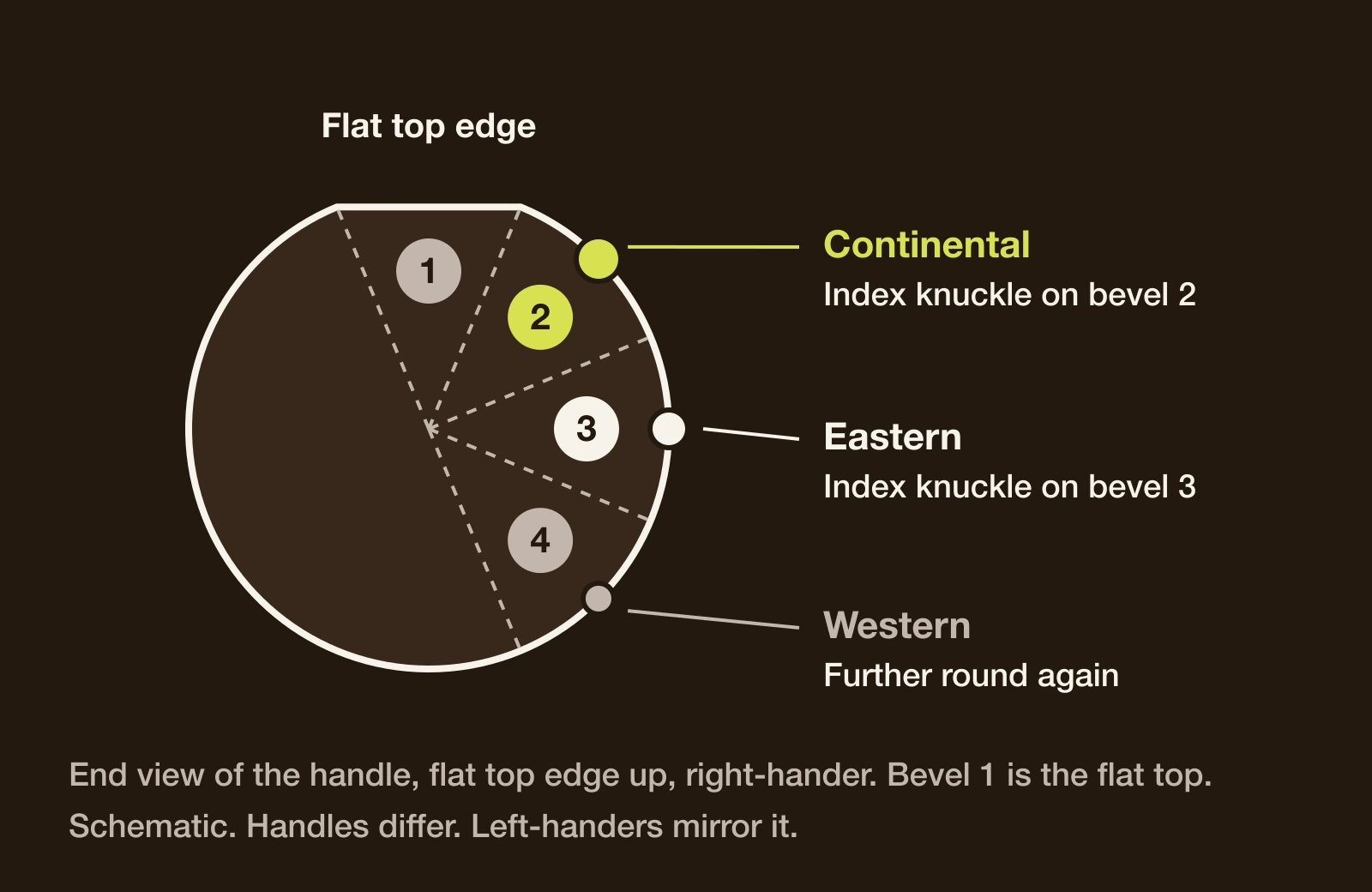
The drawing is a schematic. It counts the flat top edge as bevel 1, the way PlayPickleball does. Handles differ in shape and size, so look at your own paddle and find the flat top edge first. Left-handers mirror it.
For a right-hander, the continental grip puts the index knuckle on bevel 2. The eastern grip is one bevel further round, on bevel 3. The western grip is further round again.
Continental, eastern, western: which name is which?
Coaches don't use the names the same way, so copy the hand position, not the name. Three pages we read describe the handshake image differently.
| Source | Continental | Eastern | Western |
|---|---|---|---|
| Pickleheads (2023) | The hammer grip. Index knuckle just right of the flat top bevel, V on top of the handle | The handshake grip. Index knuckle on the 2nd bevel right of the top | The frying-pan grip. Index knuckle on the 3rd bevel right of the top |
| PlayPickleball, grips (2024) | Bevel 2, like holding a hammer | Bevel 3, called the handshake grip | Four bevels over, like swatting a fly |
| PickleballKitchen (2018) | The handshake hold, with a "neutral" V pointing toward you | Not covered | Not covered |
The same handshake picture is stuck to continental on one page and to eastern on two others. What decides the grip is where the V and the index knuckle sit, not the label. If a coach says "continental" and you can't tell which hold they mean, ask them to show you where the index knuckle goes.
One more word from PickleballKitchen: it calls a V that points toward you "neutral", and a V that points off to one side "strong" or "weak". Neutral is the one it recommends for most shots, dinks included.
How tight should you grip?
Lighter than you think. Pickleheads gives a squeeze of about 3 to 4 out of 10 for control and touch, held in the fingers rather than the palm. That is one site's guide, not a measurement.
Here's a scale you can try. Squeeze the handle as hard as you can and call that a 10. Now ease off until the paddle feels firm but nothing is tense. That's about where 3 to 4 sits.
Do you change grip during a point?
Most beginners shouldn't, and many pros do. PlayPickleball's page on switching grips (July 2025) says most recreational players stick to one grip but the pros don't, and that the continental grip may be a good place for a beginner to start. PickleballKitchen says switching grips during a point becomes automatic with practice.
A fair plan is to start with one hold, learn it well, and let any change come later. Rule 12.B lets you switch hands at any time, but that is about which hand holds the paddle, not which grip you use.
A three-check self-test
These three checks are ours. No coach or study set them. Do them after a warm-up, with your paddle in your usual hand.
- The V check. Look down at your hand. The V between your thumb and first finger should sit on top of the handle and point toward you, not off to one side.
- The two-sides check. Without moving your hand on the handle, swing a slow forehand and a slow backhand. The paddle face should stay roughly upright on both. If it points at the floor or the sky on one side, your hand has rolled too far round.
- The squeeze check. Squeeze to your 10, then relax to 3 or 4 and hold for ten seconds. The paddle should still feel secure.
Pass mark: all three, three tries in a row. Re-check after a long rally, because the hold drifts when you're tired.
Common mistakes
- Squeezing until your knuckles go white. Run the squeeze check again and relax to 3 or 4.
- Rolling the hand so far round that the face points down. PlayPickleball describes the western grip as swatting a fly. Run the V check and the two-sides check.
- Checking your hold at the start and never again. Look at the V after every game.
If a grip causes pain in your wrist or elbow, see a doctor or physiotherapist. A change in hold won't fix that on its own.
Try it at a wall
Spend ten minutes at a wall with the grip you chose, then run the three checks again. The wall drills have a ladder to follow. Once the hold feels natural, the dink guide is the next skill, and how to play pickleball covers the whole game.
FAQ
Can I hold the paddle with two hands?
Yes. Rule 12.B allows one hand or both.
Can I change or add grip on my paddle?
Yes, within Rules 3.D.6.d, 3.D.6.g and 3.D.6.h: replace an interchangeable grip, add inserts to change the size, or add or replace grip wrap. The paddle-choice page covers grip size.
Sources
- 2026 USA Pickleball Official Rulebook: Rule 12.B and 12.B.1 (paddle possession, one or both hands), 3.D.6.d, 3.D.6.g and 3.D.6.h (grip changes), 7.C.2 (paddle head on a volley serve).
- Pickleheads (27 April 2023): the hammer, handshake and frying-pan names, knuckle position by bevel, a squeeze of 3 to 4 out of 10.
- PlayPickleball (14 February 2024): continental on bevel 2, eastern on bevel 3, western four bevels over. PlayPickleball is run with paddle maker Selkirk Sport, not USA Pickleball.
- PlayPickleball, switching grips (9 July 2025): pros switch grips, a beginner can start with continental.
- PickleballKitchen (3 March 2018): the handshake hold, a neutral V, grip changes becoming automatic.