Pickleball Doubles Strategy: Where to Stand on Every Shot
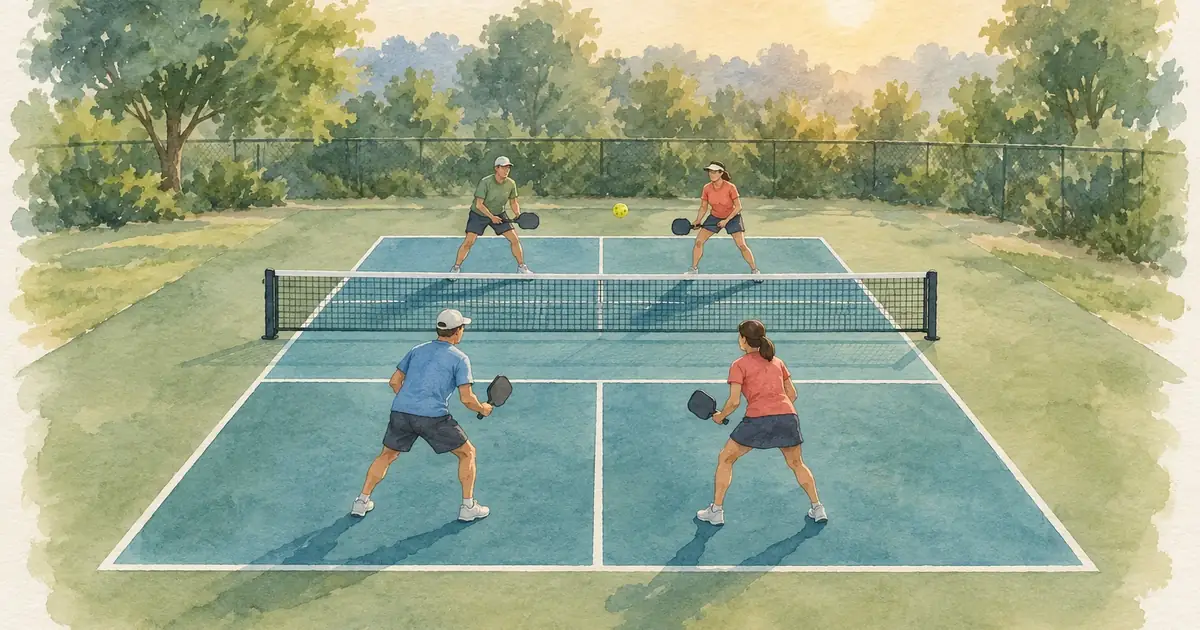
Pickleball doubles strategy starts with one picture: both partners at the kitchen line, side by side, each covering half the court. Everything earlier is a way to get there. The serving team has to let the return bounce (Rule 10.A.2), so it needs a slow third shot to give both players time to walk forward.
This page shows where both partners stand on the first four shots, who takes the middle ball, and which parts are rules and which are advice. Serving order and the score call are on the doubles rules page, so they aren't repeated here. Playing without a partner changes the plan, and how to cover the court in singles is on its own page.
What does the rulebook say about where you stand?
Almost nothing. Only the server and the receiver have a set place when the serve is hit, and the score decides which side each one stands on (Rule 5.B.3). After that, there's no restriction on where players stand, on or off the court, as long as they stay on their own end of the net while the ball is live (Rule 5.B.4 in the 2026 USA Pickleball rulebook).
One position rule does bite. If the partner of the correct receiver returns the serve, it's a fault on the receiving team (Rule 5.C.1.c).
Everything else on this page is advice. Pickleball positioning draws the same spots in feet from the net, with each rule and coaching tip labeled. The sources are USA Pickleball's doubles strategy tips and the Pickleheads doubles guide.
The four moments
Here's one point, in four pictures. The courts are drawn to the same scale, 20 by 44 feet. The baseline is 15 feet from the kitchen line, which is half the court (22 feet) minus the 7-foot kitchen.
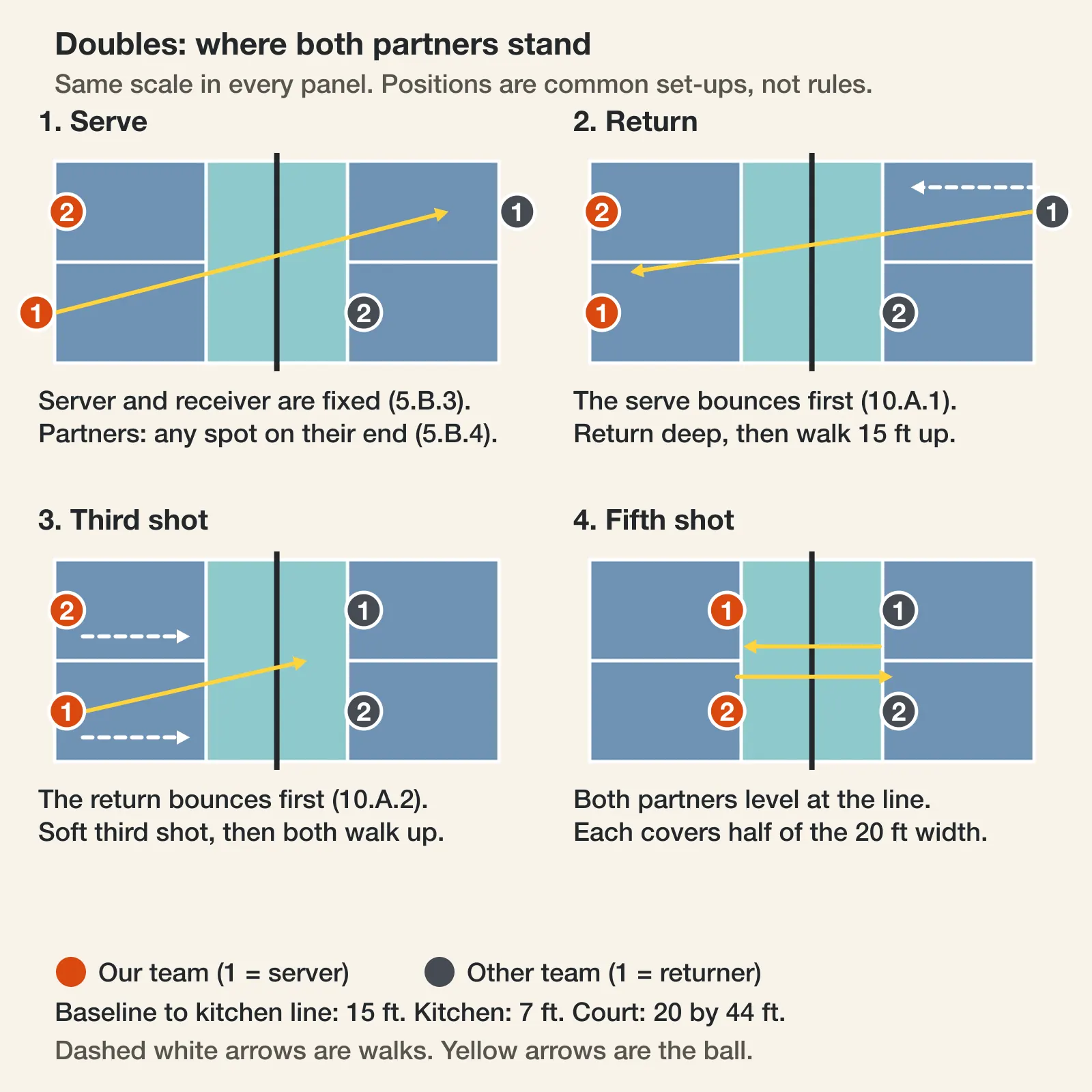
Serve
The server stands behind the baseline in the correct area, and the receiver stands diagonally across. The two partners can stand anywhere on their own ends. The drawing shows a common set-up: the server's partner back, and the returner's partner at the kitchen line. USA Pickleball suggests a deep serve, and Pickleheads says to stand a few feet behind the baseline to return, so a deep serve doesn't force you to back-pedal.
Return
The serve must bounce before it's returned (Rule 10.A.1). Return it deep, and toward the middle if you can. USA Pickleball says a deep return buys you time to get to the kitchen line. The returner then walks the 15 feet while the partner holds the line.
Third shot
The serving team must also let the return bounce (Rule 10.A.2). So the third shot is the first ball the serving team can hit, and after it, volleys are allowed (see the double-bounce rule). The shot's job is to give the server and partner time to come forward. A soft shot into the kitchen does that. Both partners then walk up.
Fifth shot
By now both partners should stand level at the kitchen line. USA Pickleball says most points are won there, and that both partners should move up as soon as the two-bounce rule is satisfied. From here the rally is mostly dinks, and a ball that arrives low and fast is a reset.
One point, start to finish
Our player 1 serves from behind the baseline. The other team's player 1 lets it bounce and returns deep, then walks 15 feet to the kitchen line while their player 2 holds it. Our player 1 lets the return bounce (Rule 10.A.2) and hits a soft shot into their kitchen. Now both of our players walk toward the line, a trip of up to 15 feet.
The other team hits the fourth shot, and by the fifth both teams stand at their kitchen lines. That's the first moment our team is back in attacking range. The walk took three shots, which is why the third shot has to be soft.
Who takes the middle ball?
Agree on it before the game, because both of you can reach it.
USA Pickleball's tip is that hitting down the middle reduces sharp angles and forces opponents to talk. That makes the middle your best target and your biggest risk, since the same applies to you. Pickleheads says to practice saying "mine" or "yours", because hesitation costs points.
Don't both swing. If a player and their partner both strike the ball, it's a fault on your team (Rule 10.D.2).
Pairs often pick a default and say it out loud. Pickleheads mentions one way to build it in: putting a left-handed player on the right, so both forehands cover the middle.
Poaching is a player taking a ball meant for the partner. Pickleheads defines it that way. It's legal, since the rulebook puts no limit on position during a rally (Rule 5.B.4). A double hit isn't.
Five rules of thumb
This is advice, not rules. The source is in brackets.
- Move up together. (USA Pickleball tip 3)
- Stay level, so no gap opens between you. The court is 20 feet wide (Rule 3.A.1), so each partner covers about 10 feet. The court math in the pickleball for seniors guide compares that lane with a singles player's. (court geometry)
- When unsure, hit down the middle. (USA Pickleball tip 7)
- Dink crosscourt. The net is 34 inches in the center and 36 at the sidelines (Rules 3.B.7 and 3.B.6). (USA Pickleball tip 6)
- Talk on every point. (USA Pickleball and Pickleheads)
What else do the guides agree on?
A few more points show up in both guides. They're advice, not rules.
- Decide fast and commit. USA Pickleball says rallies move in fractions of a second, and hesitation leads to mistakes.
- Play to your strengths and aim at your opponents' weaker shots, such as a poor backhand.
- Aim at feet. Pickleheads says a ball near the feet is hard to return without popping it up.
- Keep opponents back while you hold the line. Pickleheads says that if you're at the kitchen line and they're pinned at the baseline, the advantage is yours.
- Let out balls go. Pickleheads suggests a phrase to remember it: "shoulder high, let it fly".
Rule or advice?
| Statement | Rule or advice | Rule number |
|---|---|---|
| Only the server and receiver have required positions on the serve | Rule | 5.B.3 |
| Otherwise players may stand anywhere on their own end | Rule | 5.B.4 |
| The serve and return must each bounce | Rule | 10.A.1, 10.A.2 |
| Both partners can't hit the same ball | Rule | 10.D.2 |
| Your partner touching the kitchen when you volley is a fault | Rule | 11.A.1 |
| Move up together | Advice | none |
| Hit down the middle when unsure | Advice | none |
| Call "mine" or "yours" | Advice | none |
| Stay level at the line | Advice | none |
The rules page has the full list.
Mistakes to avoid
- One partner at the line and one at the baseline. That leaves a hole in the middle.
- Both partners swinging at the same ball (Rule 10.D.2).
- Volleying at the line and carrying yourself, or your partner, into the kitchen (Rules 11.A.1 and 11.A.2). The kitchen rules explain it.
- The returner's partner taking the return (Rule 5.C.1.c).
- Thinking stacking changes the rules. It changes who stands where, not what's legal. See what stacking is.
Take one point with a partner and no ball. Walk it through, calling each position out loud: serve, return, third shot, fifth shot. Then try it in a game of doubles against the computer and watch where the partner stands.