Pickleball Positioning: Where to Stand on Each Shot
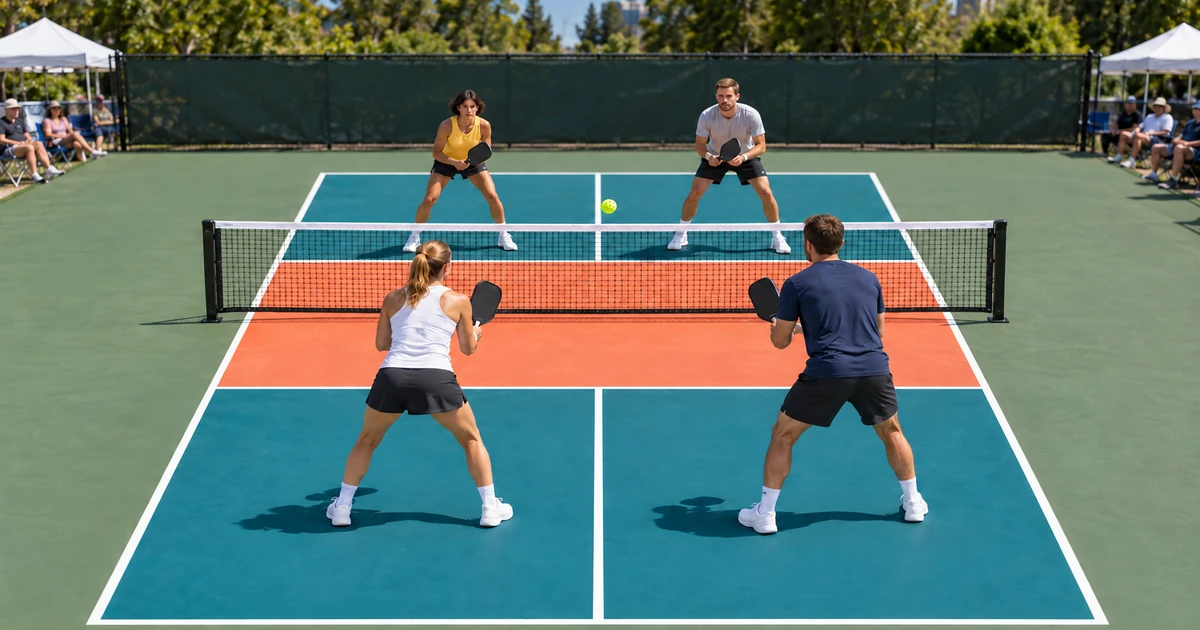
Pickleball positioning in one line: stand behind the baseline to serve, near it to return, then just behind the kitchen line, 7 feet from the net, for most of the rally. Only the server and receiver have required spots (Rules 5.B.3 and 7.A). Everything else is coaching.
So "where to stand" has two parts. The rule part is short. The advice part is the rest, and this page marks which is which. The rules page has the whole rulebook, and the doubles rules and singles rules pages cover who serves from where.
What does the rulebook say about where to stand?
Only the server and the receiver are fixed.
The server stands behind the baseline, between the imaginary extensions of the sideline and the center line (Rules 3.A.4.g and 7.A). At least one foot must touch the serving area. Neither foot may touch the court, and the baseline counts as court (Rules 7.A.1 and 7.A.2).
The side comes from the score. In singles the server's score sets it (Rule 5.A.1). In doubles the team's score sets the starting server's side, and the partner takes the other (Rule 5.B.3). The receiver stands in the diagonal court.
After the serve, doubles players may stand anywhere on their own end of the net, on or off the court (Rule 5.B.4). The rulebook sets no depth for the receiver either. Baseline, kitchen line or somewhere between are all legal.
How far is it from the baseline to the kitchen line?
It is 15 feet. The court is 44 feet long, so the net sits 22 feet from each baseline (Rule 3.A.1), and the kitchen is 7 feet deep (Rule 3.A.4.c). 22 minus 7 is 15.
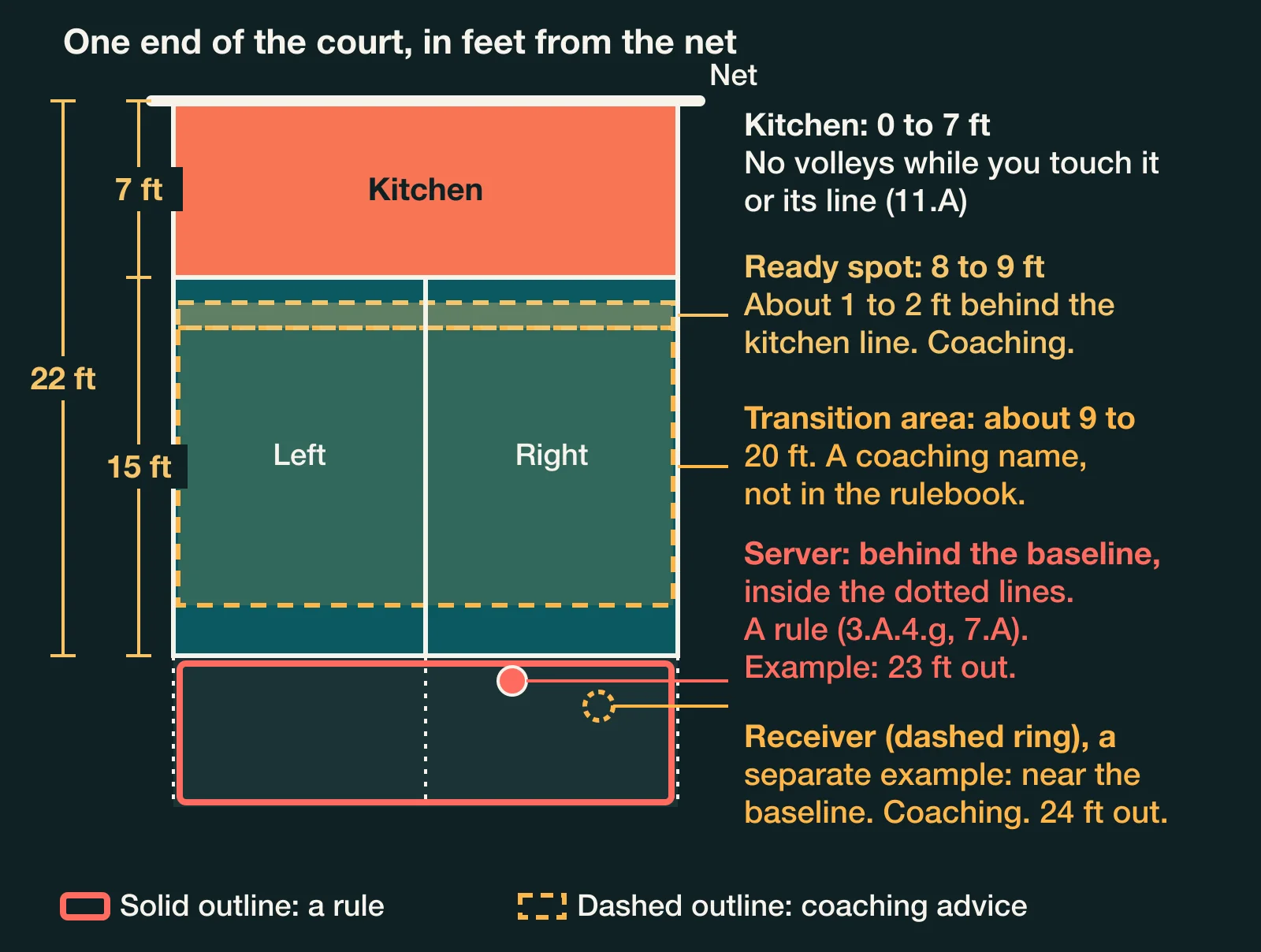
The drawing in words. One end of the court, measured from the net. The kitchen runs 0 to 7 feet out. The baseline is at 22 feet. Behind it, between the dotted extensions of the sidelines and the center line, is the serving area. That is the one solid outline, because it is a rule. The two dashed outlines are advice: a ready spot 8 to 9 feet out, and a transition area from about 9 to 20 feet out.
Each end is 20 feet wide. Two partners who split it take lanes 10 feet wide each. That split is a habit, not a rule. Rule 5.B.4 lets you stand anywhere.
Where do you stand, shot by shot?
| Moment | Where | Rule or coaching | Basis |
|---|---|---|---|
| Serve | Behind the baseline, between the extensions of the sideline and center line | Rule | 3.A.4.g, 7.A |
| Receive | On the side your score sets. How far back is up to you; many coaches say start near the baseline | Rule for the side, coaching for the depth | 5.A.1, 5.B.3 |
| The partner who is not serving or receiving | Anywhere on your end | Rule: anywhere. Coaching: start at the baseline or the kitchen line, then move up | 5.B.4 |
| After the return of serve | Move toward the kitchen line when you can | Coaching | USA Pickleball |
| Crossing the middle | Keep moving. If a ball arrives at your feet, hit it soft and low | Coaching | USA Pickleball |
| At the kitchen line | Just behind the line, not on it | Rule for the line, coaching for the distance | 11.A.1, 11.A.2 |
| Singles | The same spots, with one player covering the whole end | Coaching | arithmetic |
A few notes on the rows.
PlayPickleball's positions page (February 2024) has the receiver wait near the baseline and the server stay back after serving. It starts the server's partner at the baseline and the receiver's partner at the kitchen line. Both pairs then move up to the kitchen line "when they are able to." That is one site's advice, and the rulebook allows other setups. Partner roles and stacking have their own pages.
USA Pickleball's transition area page (September 2025) says most rallies and points are won at the kitchen line. That is why most advice points you there. The ten strategy principles show where that fits among the other habits, in the order a point is played.
The kitchen line is the spot with a rule attached. You may stand in the kitchen at any time, but you may not volley while you touch it or its line, and your momentum can fault you after the ball is dead (Rules 11.A, 11.A.1 and 11.A.2). Standing a foot or two behind the line keeps you out of trouble. Our kitchen page uses two feet in its drill. The 8 to 9 foot ready spot on the drawing is our own arithmetic, not a rule.
In singles one player covers a whole end, 20 by 22 feet, which is 440 square feet. Two partners split that into 220 each. The singles strategy page covers what to do with the extra ground.
What is the transition zone?
The transition zone is a coaching name for the middle of your end, between the kitchen line and the baseline. It is not in the rulebook. The 2026 text never uses "transition zone" or "no man's land".
USA Pickleball's page describes it as the space about a foot or two behind the kitchen to about a foot or two in front of the baseline. Put into feet from the net, that is about 8 or 9 feet out to about 20 or 21 feet out, so 11 to 13 of the 15 feet. The page says it is one of the toughest places to be, because opponents can hit the ball down at your feet. It says you can't avoid it, since you must pass through it on the way from the baseline to the kitchen. Its advice is to stay low, hit controlled shots and move with purpose.
So treat it as a place to pass through. If a ball catches you there, hit it soft and low and keep moving. The reset shot and the third shot drop are the two shots that get you through.
Four positioning mistakes with a rule or source behind them
- Stopping in the middle. USA Pickleball calls the transition area one of the toughest places on the court. Hit, then move.
- Standing on the kitchen line to volley. The line is part of the kitchen, so a volley from there is a fault (Rule 11.A.1). Stand behind it.
- Letting the wrong partner return the serve. If the server and the receiver are both correctly placed when the score is called, the wrong player returning it is a fault, even if the rally finishes first. It must be called before the next serve (Rule 5.C.1.c).
- Thinking the receiver must stand inside the court. Rule 5.B.4 allows you to be on or off the court. The receiver has to be on the correct side when the score is called (Rule 5.C.1.a).
A tape check you can do today
You need a tape measure and tape, or cones. Measure from the net and mark two spots on one end of the court: 9 feet out, which is 2 feet behind the kitchen line, and 20 feet out, which is 2 feet in front of the baseline.
Have a partner feed ten soft balls to the area between the marks. Hit each ball, then move to the 9 foot mark and set both feet before the next ball arrives. The footwork and ready position guide shows how to set them. Eight out of ten is a good pass. That target is ours, not a standard.
Try one worked example first. A server hits from 1 foot behind the baseline, which is 23 feet from the net. The receiver stands 2 feet behind theirs, 24 feet out. After the return, each side has 14 and 15 feet to cover to reach 9 feet from the net (23 minus 9, and 24 minus 9). That is 14 and 15 feet of running, so it pays to start moving as soon as you've hit.
No court? A driveway and a tape measure work. Or play a free game in your browser and watch where the computer players stand and move, singles or doubles at Low, Medium or Hard, with keyboard and mouse.
Sources
- 2026 USA Pickleball Official Rulebook: Rules 3.A.1, 3.A.4.c, 3.A.4.g, 5.A.1, 5.B.3, 5.B.4, 5.C.1.a, 5.C.1.c, 7.A (and 7.A.1, 7.A.2), 11.A, 11.A.1, 11.A.2.
- PlayPickleball, pickleball player positions (February 2024): where each player starts, and moving up when able. PlayPickleball is run with paddle maker Selkirk Sport.
- USA Pickleball, Pickleball Transition Area and Reset Tips: the transition area, most points won at the kitchen line.