Pickleball Singles Strategy: How to Cover the Court
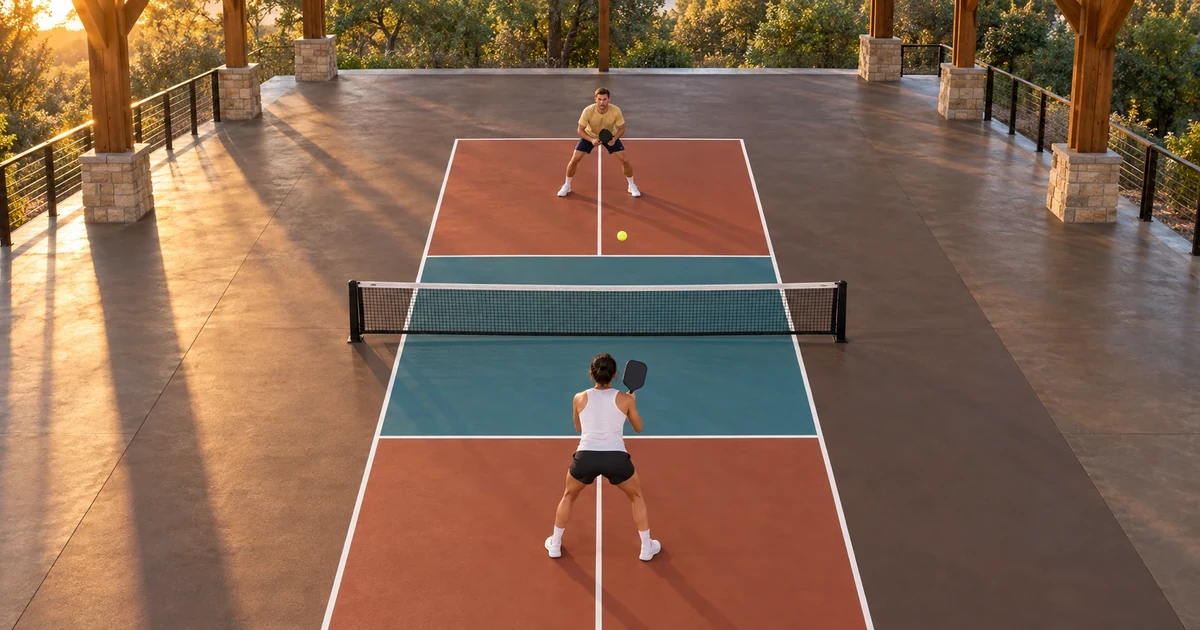
Pickleball singles strategy starts with one number: you cover a 20 by 22 foot half court alone, 440 square feet, twice a doubles player's share. So make your own court smaller and the opponent's bigger. Serve and return deep, hit away from their momentum, and walk back to the middle after every shot.
The rules page has the full rulebook, and the singles rules cover serving and scoring, so this page sticks to tactics. The court is the same size for singles and doubles (Rule 3.A.1). The distances below are measured on that court. The tactics come from USA Pickleball's singles tips page, published 23 September 2025.
How much court is one player covering?
All of your half, and it is twice what a doubles player covers. The court is 20 feet wide and 44 feet long, and the net sits in the middle, so your half is 20 by 22 feet. That's 440 square feet. If a doubles team splits the half side by side, each partner has 10 by 22 feet, or 220.
The kitchen takes 7 feet of your depth (3.A.4.c). That leaves 15 feet behind the kitchen line.
The table shows how far you are from the corners of your half, measured in a straight line. Each distance is the square root of the width squared plus the depth squared.
| If you stand at | Nearest and farthest corner of your half |
|---|---|
| The middle of your baseline (10 ft from each sideline, 0 ft deep) | 10.0 ft to a baseline corner, 24.2 ft to a net corner |
| The middle of your half (10 ft from each sideline, 11 ft from the baseline) | 14.9 ft to every corner |
| The middle of the kitchen line (10 ft from each sideline, 15 ft deep) | 12.2 ft to a net corner, 18.0 ft to a baseline corner |
| A sideline at your baseline | 20.0 ft to the other baseline corner, 29.7 ft to the opposite net corner |
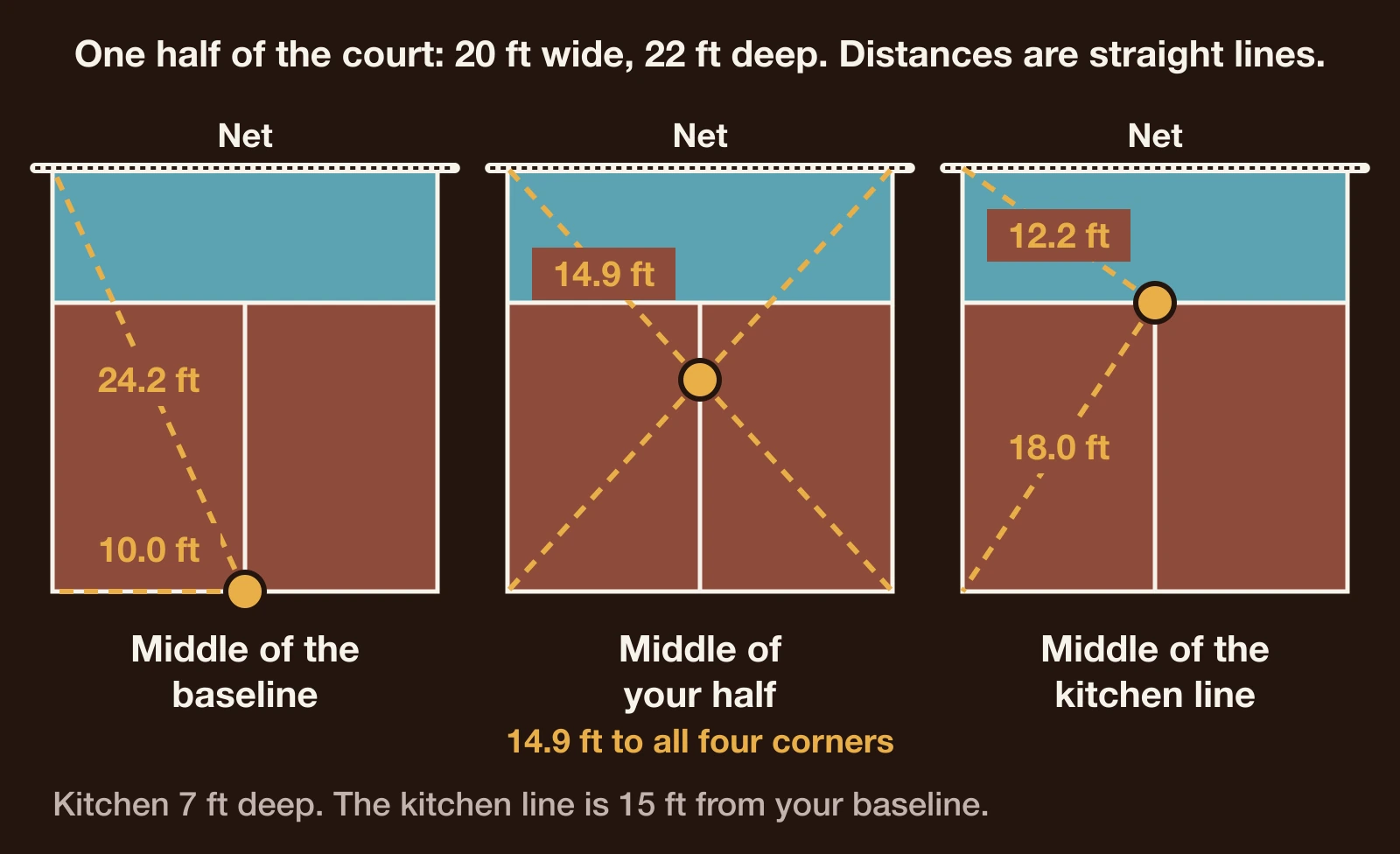
The middle of your half is the one spot that makes your longest run shortest. Real play moves you forward and back, so use it as a home spot, not a place to stand still.
Where should you stand between shots?
In the middle, because it's the point nearest everything. The singles rules page already says to walk back to the middle after every shot. That is the home spot for a rally from the back. USA Pickleball also says to follow your shot toward the kitchen line (see "When do you move forward?" below). Where to stand on each shot draws the other spots in feet from the net. Here is what the middle saves.
You are at the right end of your baseline after a wide ball, 20 feet from your left sideline. Your opponent hits to the left sideline at the kitchen line, 15 feet in front of your baseline. From where you stand, that ball is 25.0 feet away (the square root of 20 squared plus 15 squared). If you had walked back to the middle of the baseline first, it would be 18.0 feet (10 squared plus 15 squared). That is 7.0 feet less to run.
Do it after every shot, including the ones you hit well.
Where should you serve?
Serve deep, and aim near the center line. USA Pickleball's tip is to push the returner behind the baseline with a deep serve and to serve toward the middle. It calls serving near the center line "the T". A serve toward the middle limits the angles your opponent can play, so you have less court to cover.
A few rule points:
- The serve goes diagonally, must clear the kitchen and must land in the correct service court (7.E). A serve that lands in the kitchen or on its line is a fault (7.E.2).
- A service court is 10 feet wide and 15 feet deep.
- Your serving area includes the imaginary extension of the center line (3.A.4.g). You may stand on it, which is as close to the middle as you can get.
- In singles, an even score means the right side (5.A.1).
The serve guide has the steps and a depth target.
How should you return?
Deep, so the server can't attack. USA Pickleball says a deep return complicates the server's third shot and gives you time to move forward. The serve must bounce before you hit it, and the return must bounce before the server hits it (10.A.1, 10.A.2). So the first two bounces belong to the serve and the return. The two-bounce rule has the sequence.
How do you make the other player run?
Hit to the side they are moving away from. USA Pickleball calls this playing against momentum: changing direction is harder than covering open court.
This is where the numbers pay off. A ball from one baseline corner to the opposite sideline at the kitchen line asks the other player to cover 25.0 feet. From the middle, it's 18.0. You pay 18.0 and they pay 25.0. That's an illustration, not a promise, because real rallies move you both.
When do you move forward?
When you can, to the kitchen line. USA Pickleball says most points are won there. That is an opinion from a named source, not a rule.
There's a cost. At the kitchen line the deep corners are 18.0 feet away, so a lob is the price of coming forward. You also can't volley from inside the kitchen (11.A), and the kitchen page explains where that line falls. If your third shot is a soft drop, the third shot drop guide is the next read.
Why is patience a strategy?
Consistency beats risk. USA Pickleball tells singles players not to press for winners that aren't there, and to let the opponent make the mistake. Only the serving side scores (4.A). A miss while you serve costs you the serve. A miss while you receive gives them a point. The ten strategy principles for singles and doubles put these habits in the order a point is played.
What mistakes cost singles players points?
Each of these has a rule behind it, and the singles rules page owns the detail.
- Staying wide after a wide ball. See the 25.0 against 18.0 example.
- Serving from the wrong side. A claim during the rally replays it (5.C.1.a). If nobody notices until the rally ends, the result stands (5.C.2).
- Forgetting the two-number call (6.B.1).
- Volleying with a foot in the kitchen, with no partner to warn you (11.A).
- Serving after the 10-second limit (6.D).
If you only have half a court, skinny singles uses a half-width. Singles on a full court uses the full 20 feet. In doubles, the pair shares the half instead (see doubles strategy).
A recovery drill for singles
You need a partner and some tape. Mark a spot 10 feet from each sideline and 11 feet from your baseline. Your partner feeds easy balls alternately to each baseline corner and each kitchen-line sideline. After each hit, touch the spot with your paddle before the next feed.
Pass mark, ours: 8 of 10 feeds returned in a row, with your paddle at the spot every time. If you play the free Pickleball Game in singles at Low, Medium or Hard, you can watch where the computer stands after each shot.
Sources
- 2026 USA Pickleball Official Rulebook: Rules 3.A.1, 3.A.4.c, 3.A.4.g, 4.A, 5.A.1, 5.C.1.a, 5.C.2, 6.B.1, 6.D, 7.E and 7.E.2, 10.A.1 and 10.A.2, 11.A.
- USA Pickleball singles tips page: serve deep and near the center line (the T), return deep, play against momentum, follow your shot toward the kitchen line, be patient.