What Is an Erne in Pickleball? Rules, ATP and Bert
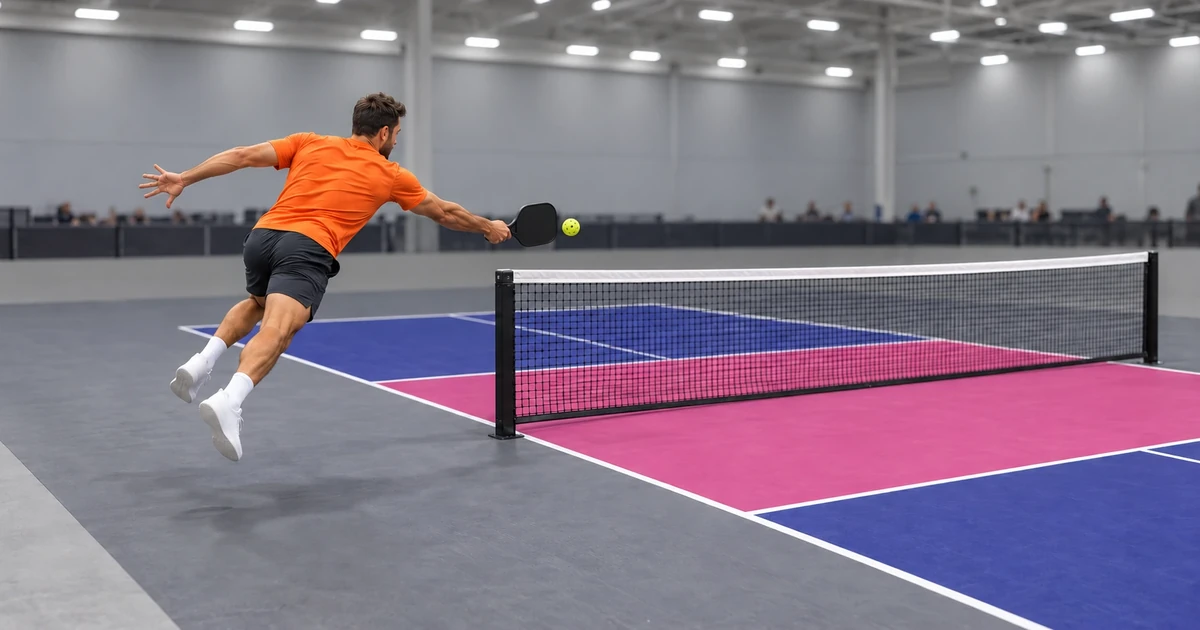
An erne in pickleball is a volley hit from outside the sideline next to the kitchen, by a player who jumped over the zone or ran around its corner. It is legal because the 2026 rulebook bans volleying only while you touch the non-volley zone (Rule 11.A). You may land anywhere outside the zone, its lines and the net.
The rules page covers the rest of the game. The rulebook doesn't use the word erne, so this page shows how its rules treat the shot. People also spell it "ernie".
What counts as an erne?
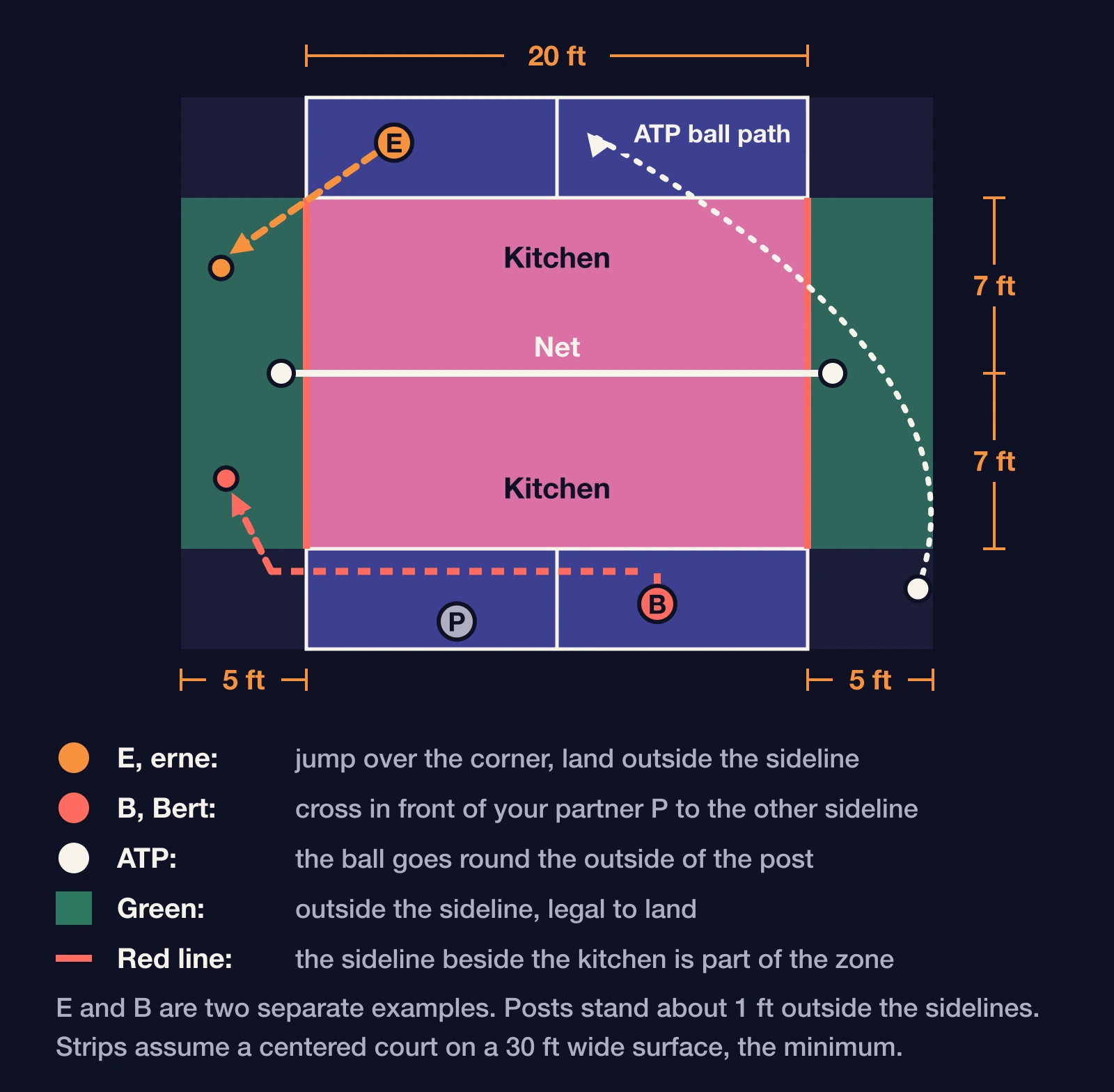
Any volley hit from outside the court beside the kitchen counts. You can jump over the kitchen corner from behind the kitchen line and land outside the sideline. Or you can run round the corner outside the sideline and hit from there. Pickleball.com describes it this way and credits the name to a player called Erne Perry.
Why is it legal?
The kitchen rule bans where you are when you volley, not where the ball goes. Three rules make the erne work.
- All volleys must start outside the non-volley zone. You may touch the zone at any other time (11.A).
- The zone is a flat 7 by 20 foot area. It does not reach up into the air, so a player in the air over it is not touching it (3.A.4.c).
- In doubles, players may stand anywhere, on or off the court, while the ball is live. The limit is that you stay on your own end of the net (5.B.4).
The basic kitchen rule is on the kitchen page, and when you can step in has the rest.
Where may you land after an erne?
Land with both feet fully outside the zone and its lines. The table gives each case and the rule behind it.
| Where your foot or body ends up | Legal after an erne volley? | Rule |
|---|---|---|
| On the playing surface outside the sideline, beside the kitchen | Yes | 11.A, 3.A.4.c |
| On the sideline segment that runs along the kitchen | No, treat it as the zone | 3.A.4.c |
| Inside the kitchen or on the kitchen line | No | 11.A.1, 3.A.4.c |
| Back into the kitchen after you land, because your momentum carries you | No, even after the ball is dead | 11.A.2 |
| Taking off from inside the kitchen, then volleying before both feet are down outside | No | 11.A.3 |
| Touching the net or a net post | No | 13.G.1 |
| Crossing the net plane before you hit the ball, or hitting it before it has crossed to your side | No | 13.I.1.a, 13.F.1 |
| Touching the opponent's end of the court | No | 13.H.1 |
The sideline row is our reading. Rule 3.A.4.c says all lines that bound the zone are part of it, and the zone is the area between the two sidelines. The line beside the kitchen bounds it, so land past that line.
The act of volleying lasts until your follow-through stops (2026 rulebook, Definitions). Landing in the kitchen during that follow-through is a fault, even if the ball is already dead.
Opponents may call a kitchen fault on you, and a disagreement between teams means a replay (9.B.3, 9.B.3.b). The faults table lists the rest.
What is an ATP?
ATP stands for "around the post", and it describes the ball's path, not your feet. Rule 13.C says a ball may be returned around the outside of the net post. Rule 13.D bans hitting it between the net and the post, and 13.E bans hitting it under the net. Pickleball.com says ATPs happen when you're pulled wide past the sideline, usually well off the court. If you volley it from outside the sideline, it is also an erne. See the net rules.
What is a Bert?
A Bert is an erne hit on your partner's side of the court. You cross in front of your partner, between your partner and the net, and take the ball at the other sideline. Pickleball.com and PPA Tour describe it that way. The rules are the same as for an erne: Rule 5.B.4 lets you stand anywhere on your end.
A worked example
You and your partner are at the kitchen line on a doubles court. A dink drifts wide toward your right sideline, about 3 feet from the net. You step right, off the court, and volley it from 2 feet outside the sideline.
The posts are 22 feet apart (3.B.2) and the court is 20 feet wide (3.A.1), so each post stands about a foot outside the sideline if the net is centered. Keep your hip and paddle clear of the post (13.G.1) and land at least a foot beyond the line.
Room depends on the venue. The smallest playing surface the rulebook allows is 30 feet wide (3.A.3), which leaves 5 feet each side of a centered court. The recommended 34 feet leaves 7.
FAQ
Is it erne or ernie?
Both spellings appear. The rulebook uses neither. Pickleball.com, which credits Erne Perry, spells it erne.
Can you hit an erne in singles?
Rule 11.A applies to all play, so a singles player can volley from outside the sideline under the same landing limits. There is no partner, so there is no Bert.
Check your landing feet
Stand beside the kitchen, one step outside the sideline, and shadow-hit five volleys while a friend watches only your landing feet. Do they ever touch the line? The referee in the free Pickleball Game calls kitchen faults by the same rule, momentum included. Poaching and partner positions are on the doubles strategy page.
Sources
- 2026 USA Pickleball Official Rulebook: Rules 3.A.1, 3.A.3, 3.A.4.c, 3.B.2, 5.B.4, 9.B.3, 11.A to 11.A.3, 13.C to 13.I, and the Definitions of the act of volleying and momentum.
- Pickleball.com, What is the erne shot: what an erne is (jumping or running around the kitchen corner) and the name's origin.
- Pickleball.com, What is a Bert shot: a Bert crosses in front of the partner.
- Pickleball.com, What is an ATP shot: an ATP is hit when pulled wide, usually well off the court.
- PPA Tour, What is an erne: a Bert is an erne where you jump in front of your partner.