What Is Stacking in Pickleball? Rules and Examples
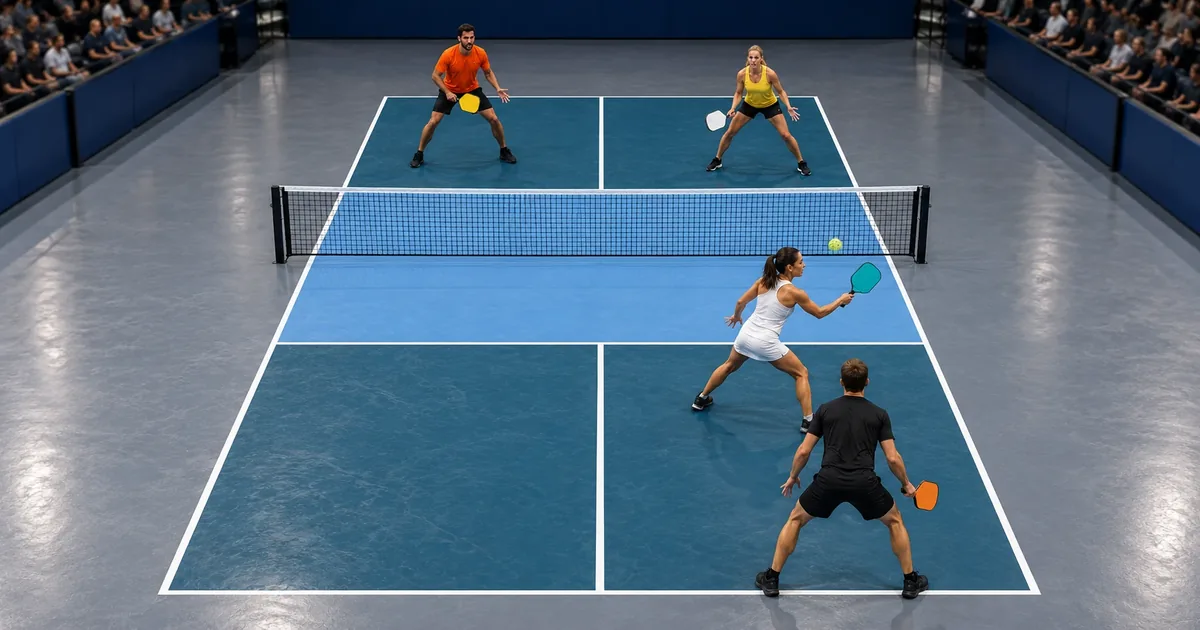
Stacking in pickleball means both partners start a point on the same side of the court, then move to their preferred sides once the ball is hit. It is legal because only the server and the receiver must stand in set places (Rules 5.B.3 and 5.B.4). Their partners can stand anywhere on their own end of the net. The rules page has the rest of doubles.
Why is stacking legal?
Because only two players on the court have a required spot. Rule 5.B.3 says the correct positions of the server and the receiver are set by their team's score: the right side at zero or an even score, the left side at an odd score. Rule 5.B.4 then says that, except while serving and receiving, there is no restriction on where players stand, on or off the court, as long as they stay on their own end of the net while the ball is live (Rule 13.I allows crossing the net plane only after a hit).
So the rulebook sets no position for the partner of the server or receiver. That is what lets a team start together. Why a team would do it is a question of tactics, and it is a habit, not a rule. The ten strategy principles put the tactics in the order a point is played. For who serves and when partners swap, see the doubles rules.
A stack, frame by frame
One example, with the score call 5-2-1. Red serves, so Red's score of 5 comes first, Blue has 2, and Red's server is number 1 (Rule 6.B.2). The players are A and B on Red, and C and D on Blue.
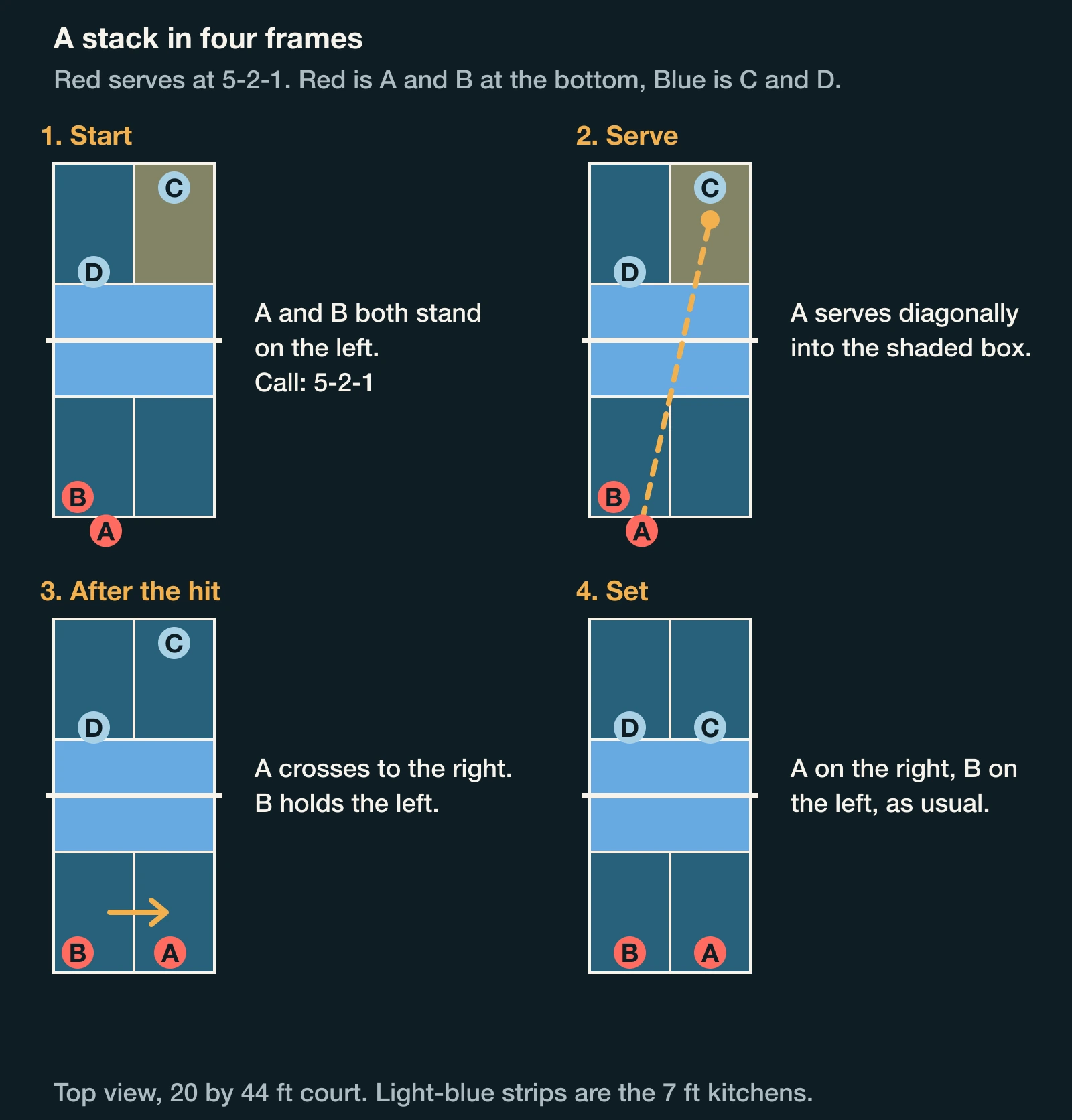
Red's score is odd, so the server, A, must serve from the left serving area (Rule 5.B.3). A normally plays the right side, so the team stacks. B, who plays the left side in rallies, is already on the left, and A starts there too.
- Before the serve: A and B both stand on the left. Blue's receiver C stands in the diagonal service court (Rule 7.E). D stands near the kitchen line, wherever they like (Rule 5.B.4).
- A serves, with at least one foot grounded in the left serving area and no foot on the court (Rule 7.A).
- After the serve is hit, A moves across to the right. B stays on the left.
- Set positions: A on the right, B on the left.
When does a team need to stack?
Only when the server's area isn't the side you want them on. The table is for a team where A plays the right side in rallies and B plays the left. Each row comes from Rule 5.B.3.
| Who serves | Team score | Serving area (5.B.3) | Stack needed? |
|---|---|---|---|
| A | even | right | No |
| A | odd | left | Yes. A starts on the left beside B, then crosses right |
| B | even | right | Yes. B starts on the right beside A, then crosses left |
| B | odd | left | No |
The serving area flips with the score, so which row applies changes from serve to serve. Receiving works the same way in reverse. The receiver stands in the court the serve is aimed at, and the receiver's partner stands where they like. Who becomes first server after a side out is covered in Rule 5.B.2, and the doubles rules walk through it.
What can go wrong?
Three traps, each with a rule number.
- The wrong player returns the serve. When the server and receiver were in the right places at the score call, a player who returns the serve and isn't the correct receiver commits a fault, even if the rally finishes. It must be called before the next serve (Rule 5.C.1.c).
- Someone is in the wrong place at the score call. Any player may stop the rally to say so. A correct claim means a replay (Rule 5.C.1.a). A wrong claim is a fault on the player who stopped it (Rule 5.C.1.b). An error noticed only after the rally leaves the result standing (Rule 5.C.2).
- The serve hits a partner who is standing close. A serve that hits the server's partner is a fault on the server (Rule 7.E.4). A serve that hits the receiver's partner before it lands is a fault on the receiver (Rule 7.E.5).
Is paddle stacking the same thing?
No. At some venues, "paddle stacking" means lining paddles up in a rack or on the ground to hold your turn for the next game. USA Pickleball's player site describes the practice in its open-play etiquette guide. It's a custom of the venue, not a rule of the game. Both uses of the word get mixed up, so check which one a person means.
Walk the four frames with a partner on a taped or chalked court. Say the score call out loud before each serve (Rule 6.B.2) and check that the server's feet are in the right area (Rule 7.A). When both of you can do it without stopping to think, the stack is ready for a game. The scoring guide explains the three-number call, the serving rules cover the feet, and the glossary has stacking and 39 other terms. In Pickleball Game's doubles mode the referee sets the server and receiver positions for you, and you can play it free.