What Is a Reset in Pickleball? When to Use It
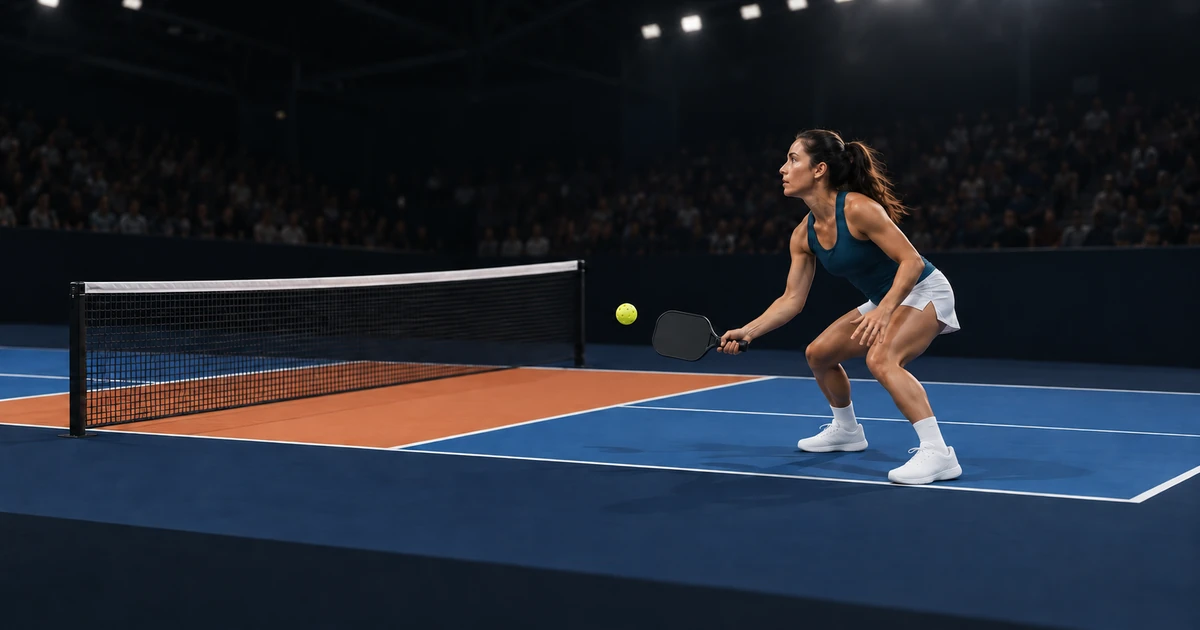
A reset in pickleball is a soft shot that takes the pace off a ball coming at you and lands it in the opponents' kitchen. You use it when the ball is too low to attack, usually while you're still moving up from the back of the court. It buys you the time to reach the kitchen line.
USA Pickleball's page on the reset describes it as a soft, controlled shot that redirects a hard offensive ball into the opponent's kitchen instead of counterattacking with power.
When do you use a reset?
Use it when the ball is coming down at you below net height and you aren't at the kitchen line yet. USA Pickleball's rule of thumb is that if the ball is traveling down toward you, you reset it, because it's nearly impossible to attack well from below the net.
Where you stand matters too. From the baseline to the kitchen line is 15 feet: half the 44-foot court is 22 feet, minus the 7-foot kitchen. A reset has to give you time to walk that stretch.
"Reset" is a coaching word. The 2026 rulebook has no entry for it, or for "dink". The usual rules apply, as for any other shot.
Reset, dink or attack: how do you choose?
USA Pickleball's one-line version: defend when the ball is below the net, attack when it's above. Here is the same idea in three cases. It's coaching advice, not a rule.
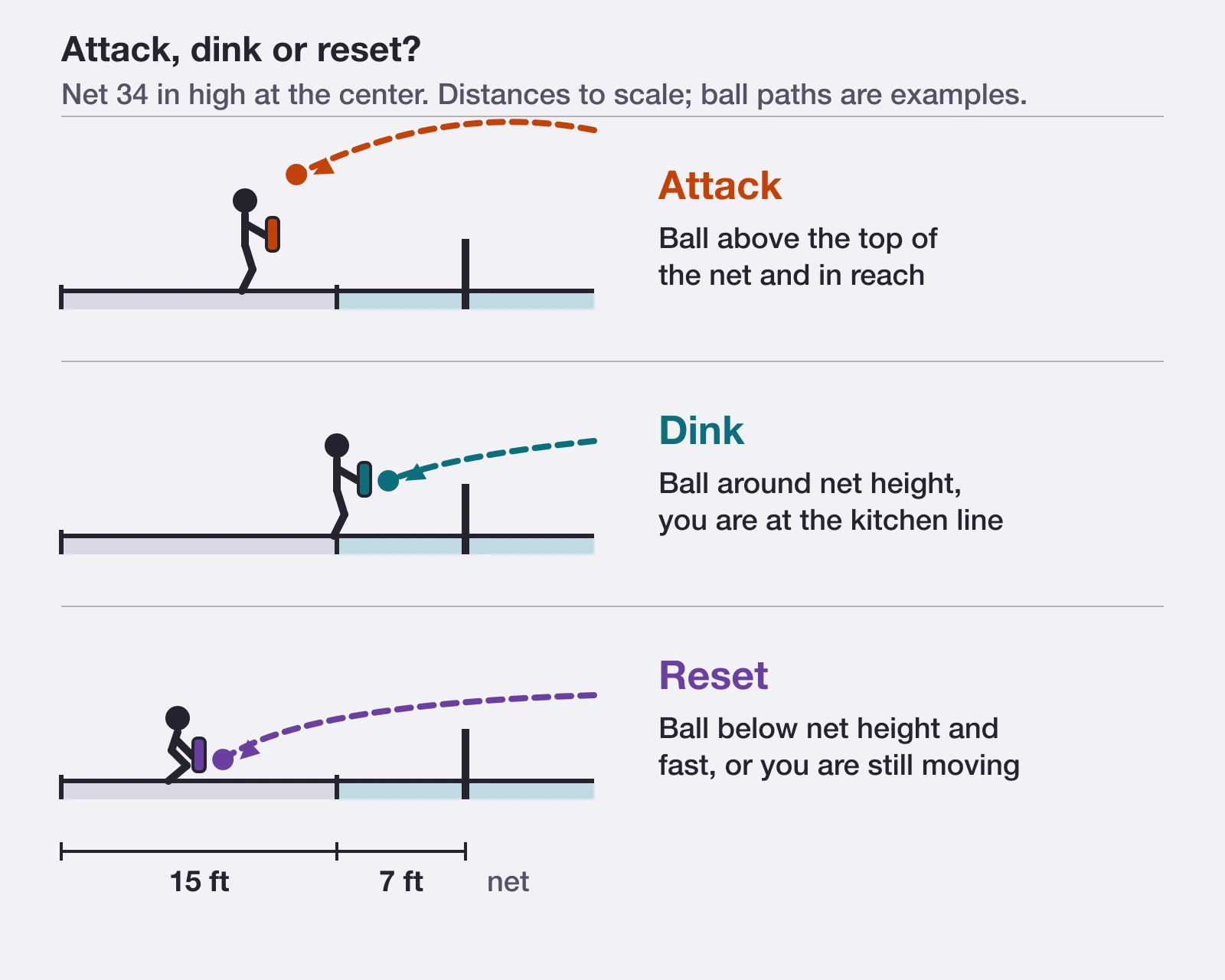
- The ball is above the top of the net and in reach: attack it.
- The ball is around net height and you're at the kitchen line: dink. The dink article compares the soft shots.
- The ball is below net height and coming fast, or you're still moving: reset.
The net is 36 inches at the sidelines and 34 inches in the center (Rules 3.B.6 and 3.B.7). The center is the lowest point to clear.
How do you hit a reset?
USA Pickleball gives four fundamentals.
- Stop your feet before contact. A ball hit on the run tends to pop up.
- Keep the paddle out in front, so you can track the ball and react to a fast drive.
- Use zero backswing. Push the ball with a short motion in front of your body. Any backswing sends it too high.
- Loosen your grip so the paddle soaks up the pace. A tight grip makes the ball bounce off hard.
Aim for the kitchen, which is 7 feet deep and 20 feet wide (Rule 3.A.4.c). A ball that bounces there is hard to attack, because the other side has to let it come to them.
Do the kitchen rules change a reset?
Only if you hit the reset out of the air. All volleys must start outside the kitchen (Rule 11.A). A volley reset taken near the line follows the same rules as any volley: your momentum counts, and a foot touching the zone or its line is a fault (Rules 11.A.1 and 11.A.2). The volley article and the kitchen rules cover this.
A three-step drill ladder
The pass marks below are our suggestion, not from a study.
- Stand at the kitchen line. A partner feeds 12 soft balls at your feet. Reset each one into the kitchen. Pass: 9 of 12 land in the kitchen.
- Start 10 feet behind the kitchen line. The partner feeds a firm ball at your feet. Reset it, then take two steps up and stop before the next ball. Pass: 8 of 10 land in the kitchen, and your feet are still when you hit.
- Same, but the feeder mixes fast and slow balls without telling you. Reset only the fast ones and dink the slow ones. Pass: 7 of 10 right.
Alone, use the wall drills with a tape line at 34 inches. Pass: 15 balls in a row between the tape and 4 feet high. For the dinking half of step 3, the seven dinking drills give you court distances and a pass mark for each.
Three mistakes show up again and again: a big wrist swing that sends the ball up, trying to reset a ball that's above the net when you could attack it, and hitting from a standing start when you had time to walk up and dink.
Run step 1 for five minutes at your next session. In a game against the computer you can also watch where a hard return drops. The rules page has the rest of the court.