What Is a Dink in Pickleball? How to Hit One
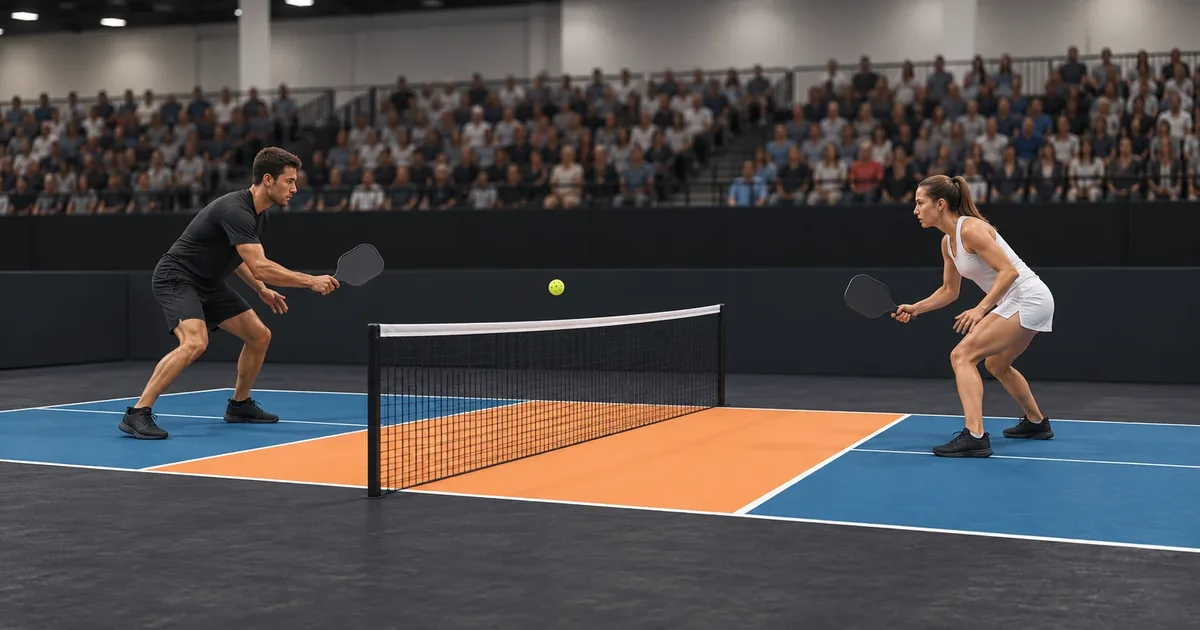
A dink in pickleball is a soft shot that arcs just over the net and lands in the opponent's kitchen, the 7-foot zone beside the net. Players hit it from at or near their own kitchen line, usually after a bounce, to keep the ball too low for the other side to attack.
The rules page covers the whole game. This page covers one shot: what counts as a dink, how it differs from a drop and a drive, and how to hit one.
What counts as a dink?
USA Pickleball's glossary defines a dink as a soft shot hit on a bounce from the non-volley zone, meant to arc over the net and land in the opposing non-volley zone. It can go straight across or crosscourt. Another USA Pickleball piece on dinking says the dink is hit from the kitchen line.
Casual talk is looser. Some players also call a soft shot hit out of the air from behind the line a dink. By the glossary that's a soft volley, which it describes as a blocking motion. The two shots look alike but the bounce separates them.
The 2026 rulebook never uses the word "dink". The dink is a shot name from play. The rule behind it is the kitchen rule.
Why do players dink?
Because the kitchen takes the volley away. All volleys must start outside the non-volley zone (Rule 11.A in the 2026 USA Pickleball rulebook). A ball that lands low and short in the kitchen has to be played after it bounces, so the other side can't smash it out of the air. The kitchen article has the full rule, and doubles strategy shows where both partners stand.
USA Pickleball says the point of a dink isn't to win the rally. It's to neutralize the other side and make them hit the first bad ball. When a ball floats up, you attack it.
One warning from the same page: if an opponent is still deep at the baseline, don't dink unless you're sure they can't reach it. A dink only pulls them up to the net.
Dink, drop or drive?
Three shots cross the net at very different speeds. The difference is where you hit from and where the ball lands.
| Shot | Hit from | Lands | Pace and purpose |
|---|---|---|---|
| Dink | At or near your kitchen line, after a bounce | The opponent's kitchen | Soft. Keeps the rally low. |
| Drop | Deep in your court, after a bounce | The opponent's kitchen, close to the net | Soft. Gives you time to move up to the line. |
| Drive | Anywhere, usually from the back | Deep in the opponent's court | Hard and flat. Tries to force a mistake. |
The dink and drop rows follow the USA Pickleball glossary. The glossary has no entry for "drive", so that row is our plain description of a hard, flat shot. The drop is a different shot with its own technique, which the third shot drop guide covers. A fast ball at your feet calls for a fourth soft shot, the reset.
Where does a dink travel?
Not far. The two kitchen lines are 14 feet apart, because each kitchen is 7 feet deep (Rule 3.A.4.c). The net is 34 inches high in the center and 36 at the sidelines (Rules 3.B.7 and 3.B.6). The baseline is 22 feet from the net.
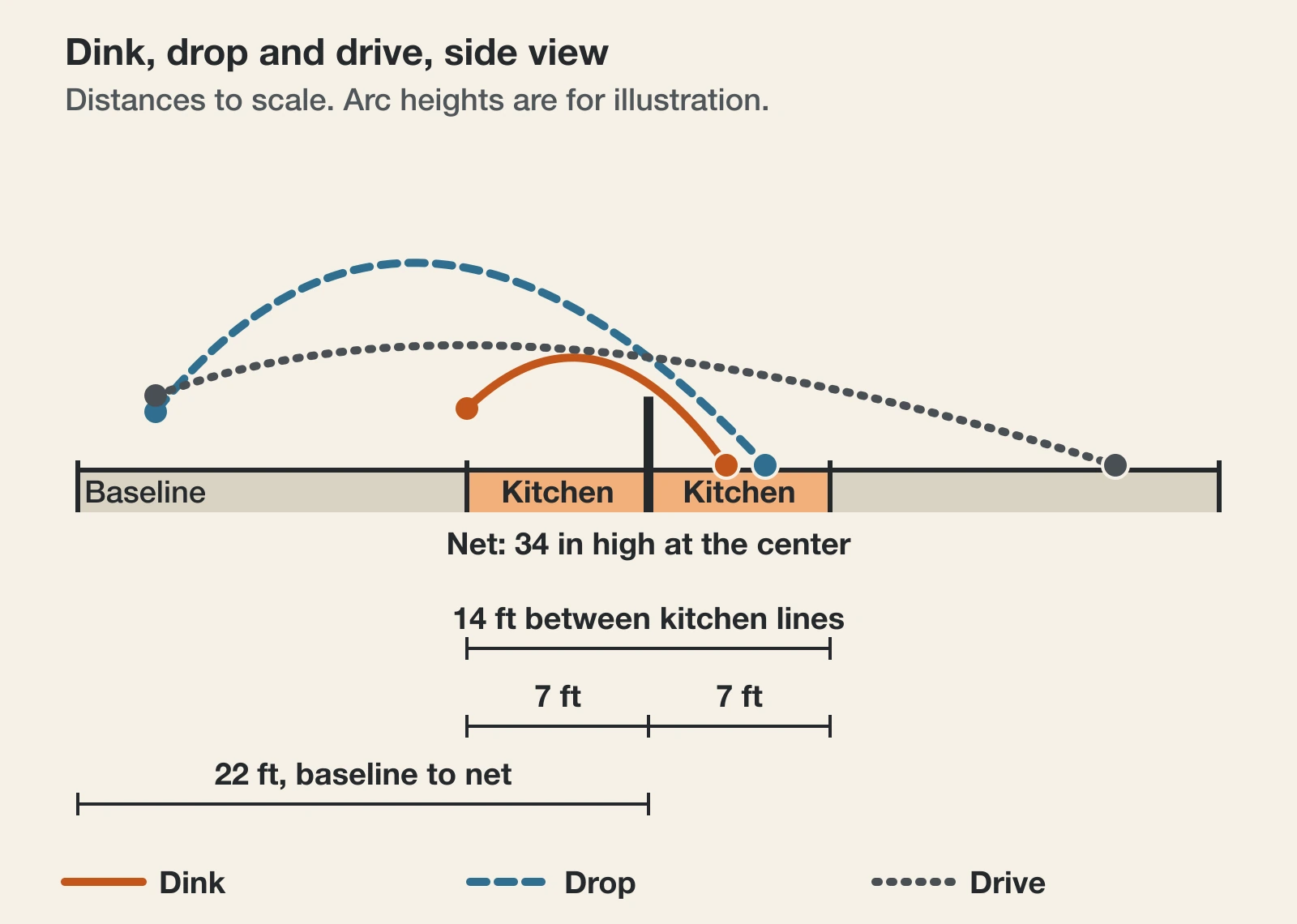
The diagram draws the distances to scale. Heights and arc shapes are for illustration.
Two rules decide whether a dink is good. A ball that lands in the opponent's kitchen or on its line is in, because the lines that bound the kitchen belong to it (Rules 8.B and 3.A.4.c). A ball that fails to cross the net and lands on your side is a fault on you (Rule 10.C.2).
The glossary adds that a crosscourt dink is easier, because the net is lower in the center. A dink that lands close to the net is harder to return, because the receiver needs a steeper angle to get over it.
How to hit a dink
USA Pickleball's glossary and dinking tips give these cues.
- Meet the ball in front of your body.
- Tilt the paddle face slightly open.
- Lift or push the ball gently. The motion comes from the shoulder, with no wrist break.
- Use little or no backswing.
- Hold the paddle loosely. USA Pickleball suggests a 2 on a scale where 1 is almost dropping it and 10 is as tight as you can squeeze. Where to put your hand on the handle is in the paddle grip guide.
- Change the target. USA Pickleball says advanced players rarely dink to the same spot more than two or three times in a row.
Three mistakes at the kitchen line
- Volleying a soft ball with a toe in the kitchen. It can look like a dink. It's a volley, and it's a fault (Rule 11.A.1).
- Swinging too big. USA Pickleball says "less is more" and asks for a small, compact swing. The lighter you hit, the more dinks land in the kitchen and the less the other side can attack.
- Hitting from too far back. A dink is a kitchen-line shot. From the baseline, the shot you want is a drop or a drive.
One rally, from serve to dink
Say a doubles rally starts. The serve bounces before the receiver hits it, and the return bounces before the serving side hits it (Rule 10.A). The third shot is a drop that lands in the opponent's kitchen. Now both teams walk up to their kitchen lines.
From here every ball is a dink. Each player lets the ball bounce, then pushes it softly back across 14 feet of court. Nobody attacks, because every ball lands in the kitchen and stays low. The first ball that floats above the net gets volleyed, from outside the zone.
A one-minute check
Stand a step behind your kitchen line, with a partner doing the same across the net. Hit 10 crosscourt dinks in a row. Count the ones that clear the net, land in the kitchen and don't pop up. Seven out of ten is a good first pass mark. That number is our suggestion, not an official standard. For a scored dink test and a plan to train it, see the four self-tests and four-week plan.
Pickleball Game lists dink, drive and lob among its shots, so you can also try the shot in a free game against the computer. The terms glossary explains other words you'll hear at the kitchen line.
Common questions
Can you dink from inside the kitchen?
Yes, once the ball has bounced. The ban is on volleying from the zone, not on standing in it (Rule 11.A). If you step in to hit a bounced ball, you can't volley the next one until both feet are back outside (Rule 11.A.3). The kitchen article lists what counts.
Can you dink the return of serve?
Yes. The receiver must let the serve bounce first (Rule 10.A), then may hit it softly. A return that lands anywhere on the server's end, kitchen included, is in (Rule 8.B). The serve itself can't land in the kitchen. That's a fault (Rule 7.E.2).