Pickleball Skill Levels: What 2.0 to 5.0 Mean

Pickleball skill levels run from 1.0 to 5.5 on USA Pickleball's scale, which describes what a player can do. DUPR is a different number, from 2.000 to 8.000, worked out from match results. The two measure different things, so a 3.5 on one is not guaranteed to match a 3.5 on the other.
We read both sources on 2026-10-04. If a page has changed since, the page wins. The rules page covers the game itself.
What do the levels mean?
USA Pickleball describes five groups of levels on its skill level page. It says the first official nationwide scale dates to 2005 and that a level rests on knowledge and skill, unlike a rating or ranking, which rests on match results. Its one-page Player Skill Level Matrix (PDF created June 2025) adds detail. The table puts the two together in our words.
| Level | USA Pickleball's group | In plain words |
|---|---|---|
| 1.0 | The Rookies | New, with little or no experience. Leans on instructions and the rules |
| 2.0 and 2.5 | The Kitchen Cruisers | Can do the basics with guidance, but isn't steady yet. The matrix calls 2.5 "Beginner": keeps a short rally going with an equal player and can keep score |
| 3.0 and 3.5 | The Dinkers | Solid strokes and basic strategy, but execution is still a challenge. The matrix calls 3.0 "Advanced Beginner" (a basic dink rally, still learning where to stand) and 3.5 "Intermediate" (heads for the kitchen line, developing the drop shot, limited control of dink height and depth) |
| 4.0 and 4.5 | The Smashers | A strong grasp of the soft and hard game, sees the whole court. The matrix calls 4.0 "Advanced Intermediate" (varied serves and returns, aware of the partner) and 4.5 "Advanced" (good footwork, a serve with power and depth, effective third shots) |
| 5.0 and 5.5 | The Aces | Skilled in every part of the game and hits advanced shots under pressure. The matrix calls 5.0 "Expert" (has mastered the dink and drop shots) and 5.5+ "Expert Pro" (a top-level player whose results show it) |
The page and the matrix use different names. The matrix also starts at 2.5, so it has no row for 1.0 or 2.0.
One row answers a question like "What does a 3.0 look like?"
How is a DUPR rating different?
DUPR is a rating worked out from match results, not from a description of skills. Its how it works page gives a scale of 2.000 to 8.000. All new players start as NR, not rated. A certified DUPR coach can assign a starting rating, or a player can upload gameplay video to an AI rating partner. Ratings are separate for singles, gender doubles and mixed doubles.
It updates after every match, using four factors:
- how you did against the expected result, which the DUPR blog calls the biggest factor
- the type of match, because verified club, league and tournament matches count for more than self-posted games
- how recent the match was
- how many matches you have played
A DUPR blog post dated 2026-08-07 adds that a win alone may not raise a rating. Its example: a 4.5 who narrowly beats a 3.0 underperformed, so the rating can drop. DUPR also shows a Reliability Score from 1 to 100 percent. A higher score means the rating is more likely to reflect your current skill.
Why a 3.5 here is not a 3.5 there
Three reasons.
First, USA Pickleball's levels describe skills, and its page says they aren't ratings. DUPR's number comes from results. Second, DUPR's range starts at 2.000 and does not use the five group names. Third, we found no conversion table on either page, so don't assume one exists.
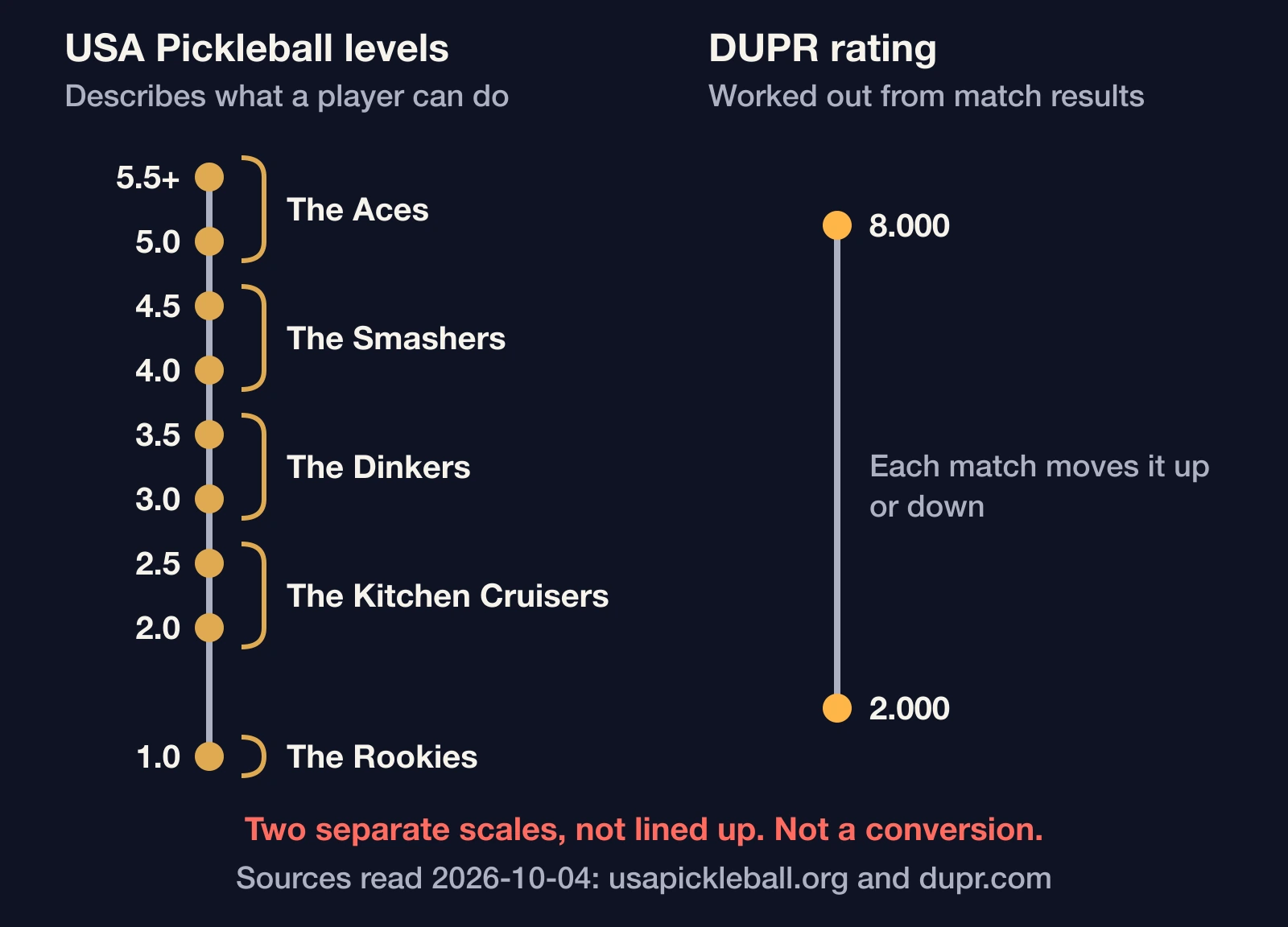
The drawing in words: on the left, USA Pickleball's levels from 1.0 to 5.5+, grouped into the five names above. On the right, DUPR's range from 2.000 to 8.000. The two scales aren't lined up, because they are not a conversion.
Clubs set their own bands too. Coppell, Texas, publishes open play rules with sessions for 2.0 to 2.9, 3.0 to 3.75 and 3.75 and up. That is one city's policy, so read your venue's.
The rulebook mentions ratings in a few places. In a doubles event based on skill rating, the higher-rated partner decides the team's level (Rule 15.A.3.b). A match that is forfeited or withdrawn from in a round robin still counts toward a player's rating (Rule 15.B.4.a). The rulebook's introduction adds that a sanctioned tournament lets players earn a rating. For how open play is run, see pickleball etiquette and open play.
How do you find your level?
Start with USA Pickleball's own self-assessment. Its page says the 12 questions take 3 to 5 minutes. We don't copy it and we don't offer a quiz of our own. A self-assessment is a starting guess, nothing more.
Here is how the two might sit together. A player scores 3.0 on the questionnaire and joins a club session labeled 3.0 to 3.75. Later they play rated matches, and their DUPR moves with the results. The two numbers needn't match. This is an illustration, not a real player.
Take the questionnaire, then read the matrix row one level above your answer to see what to practice next. The self-tests and four-week plan are practice checks with our own pass marks, and they don't give you a level. For the words in the matrix, see the pickleball glossary. Starting from zero? Try the first-week plan or how to play pickleball.
Sources
- 2026 USA Pickleball Official Rulebook: Rules 15.A.3.b and 15.B.4.a, and the rulebook's introduction (ratings from sanctioned tournaments).
- USA Pickleball, Skill Levels: the five groups and the self-assessment.
- USA Pickleball Player Skill Level Matrix: what each level looks like.
- DUPR, how it works: the 2.000 to 8.000 scale and how new players start.
- DUPR, how your DUPR rating is calculated: the four factors and the Reliability Score.
- City of Coppell, Texas, Pickleball open play rules: one city's rating bands for open play.