Pickleball Drills for Beginners: 12 to Do Today
Pickleball drills work best when they match what you have. These 12 are sorted by gear (nothing, a wall, one partner or a small group), and each one gives reps and a pass mark so you know when to move on. With a partner and 20 minutes, jump to the session plan near the end. The rules page covers the game itself.
The pass marks are our own starting targets, not a standard. Hit one twice in a row, then raise it. The distances come from the court: it's 20 feet wide, the kitchen is 7 feet deep, and the baseline is 22 feet from the net (Rules 3.A.1, 3.A.4.c).
Drills for one person, no wall
These three take two or three minutes each. For a full solo plan, see playing pickleball by yourself.
- Drill 1, paddle-face bounces. Bounce the ball up off the paddle face at waist height. Pass mark: 25 in a row. It trains touch.
- Drill 2, drop and target. Drop the ball, let it bounce once, and hit it at a towel about 15 feet away. 10 balls. Pass mark: 5 land within 3 feet of the towel.
- Drill 3, line-check shadow volleys. Stand a foot behind a line and shadow 20 forehand and 20 backhand volleys without touching it. Pass mark: 40 swings with both feet behind the line. This is the habit behind the kitchen rules.
Drills with a wall
You need a flat wall and a line taped at net height. The setup and the six-drill ladder are on the wall drills page. Three of them:
- Drill 4, wall forehand rally. Pass mark: 20 in a row.
- Drill 5, wall dinks. Soft arcs from 7 feet back. Pass mark: 15 in a row.
- Drill 6, wall volleys. Every ball out of the air, short swings. Pass mark: 15 in a row.
Drills with one partner
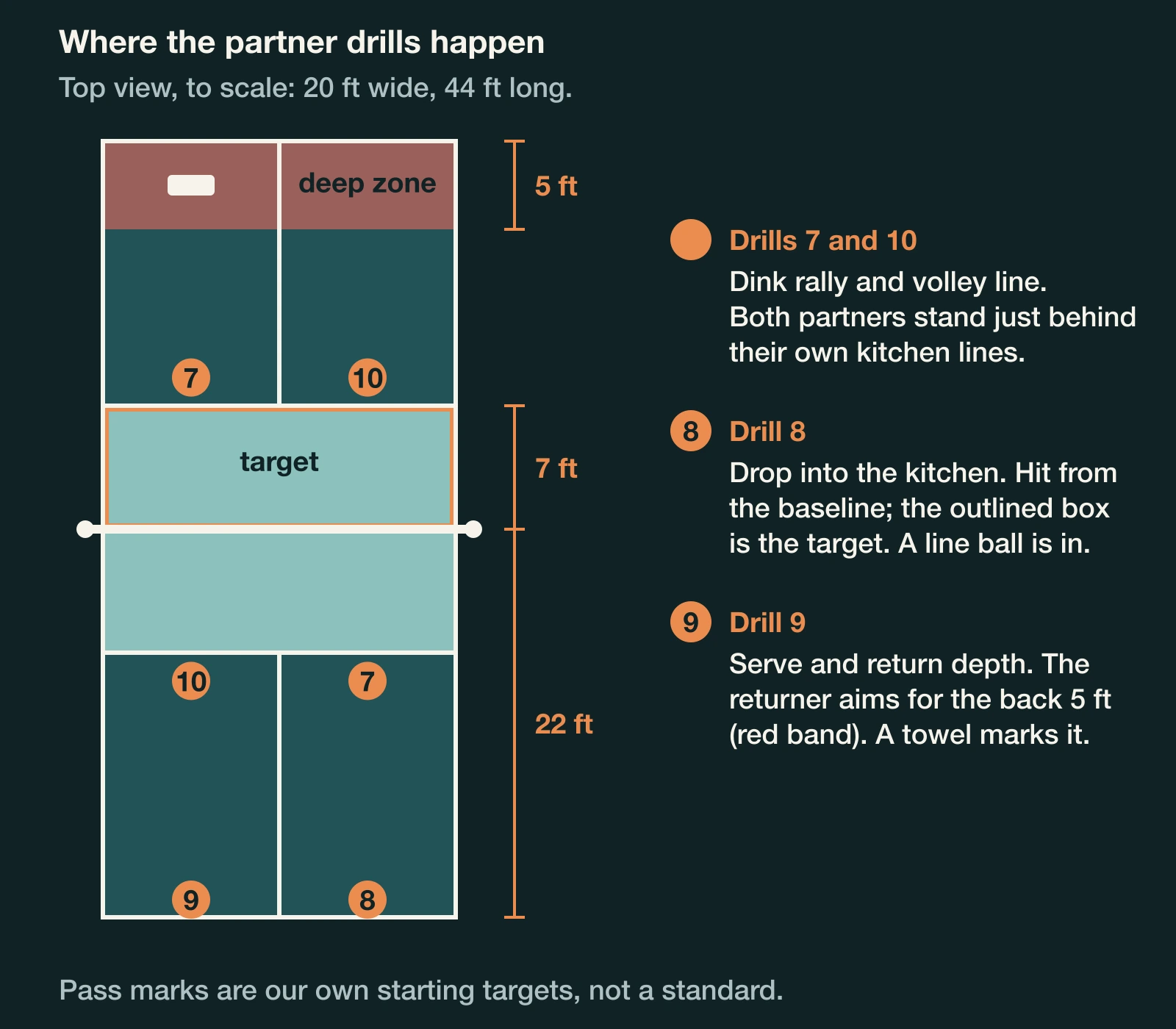
- Drill 7, cooperative dink rally. Both stand just behind your own kitchen lines and dink back and forth, aiming for the other's kitchen. Count aloud. Five tries, best run counts. Pass mark: a run of 20. It trains soft touch. For six more dink drills with court distances and a pass mark each, see pickleball dinking drills.
- Drill 8, drop into the kitchen. You stand at the baseline. Your partner stands at their kitchen line and feeds you a soft ball. You hit a drop that lands in their kitchen. A ball on the kitchen line is in (Rule 3.A.4.c). 10 balls. Pass mark: 6 in the kitchen.
- Drill 9, serve and return depth. One of you serves from behind the baseline and the other lets it bounce, then returns it deep. The server calls the score first and serves within 10 seconds, as in a game (Rule 6.D). 10 serves, then swap. Pass mark: 5 returns land in the back 5 feet, marked with a towel. The serving rules explain the foot and swing rules.
- Drill 10, volley exchange at the line. Both stand just behind your own kitchen lines and volley back and forth without letting the ball bounce and without touching the line (Rule 11.A.1). Pass mark: 10 in a row, then 15.
The picture shows where drills 7 to 10 happen. The kitchen is the target for drill 8, and the back 5 feet is the deep zone for drill 9.
Drills with a small group
- Drill 11, three-person no-speed-up game. One player on one side, two on the other. Play points, but nobody may speed the ball up. Time how long you keep the rally going. Pass mark: beat your longest run. Anna Bright describes three-person drills on pickleball.com, including one with no speed-ups, and suggests timing rallies. Start slow and keep the ball low.
- Drill 12, 7-11. One player starts at the kitchen line and the other at the baseline, who opens the point with a third shot drop. The baseline player needs 7 points to win, and the kitchen player needs 11. DUPR describes the drill and says nothing about who serves, so we don't either. Pass mark: win as the baseline player in three games out of five. Save it for when the earlier drills feel steady.
A 20-minute session with a partner
Four drills, 20 minutes, one pass mark each. Start with the six-minute warm-up so your first dinks aren't cold.
| Minutes | Drill | Pass mark |
|---|---|---|
| 0 to 4 | 7. Cooperative dink rally (start slow) | a run of 20 |
| 4 to 9 | 8. Drop into the kitchen | 6 of 10 in the kitchen |
| 9 to 15 | 9. Serve and return depth (swap at minute 12) | 5 of 10 deep, each of you |
| 15 to 20 | 10. Volley exchange at the line | 10 in a row |
If the first pass mark feels easy, raise it by 5. If you can't reach it after three sessions, drop it by 5. The target is a streak you can almost hold. For what to work on over your first week, see pickleball for beginners.
Mistakes that waste a session
- Counting a streak when the feed was easy. Make your partner feed it at game pace.
- Treating a pass mark as a grade. It's a number to beat next time.
- Standing in the kitchen on the volley drill. A foot on the line is a fault (Rule 11.A.1). The ready position and footwork guide covers how to stop and set your feet near the line.
- Skipping the serve before a rally. The 10-second rule is part of the habit (Rule 6.D).
- Drilling only what you're already good at.
Here is drill 8 in numbers. You hit 10 drops. Six land in the kitchen, three land short of the net, and one lands past the kitchen line. That's 6 of 10, so you've hit the pass mark once. Do it again next session. Two in a row means it's time to ask for 7 of 10.
Pick the one drill that matches what you have right now and do it today. Write down the number and try to beat it next time. With no partner around, you can also practise points and scoring in the free browser game.