Pickleball Dinking Drills: 7 Drills With Targets
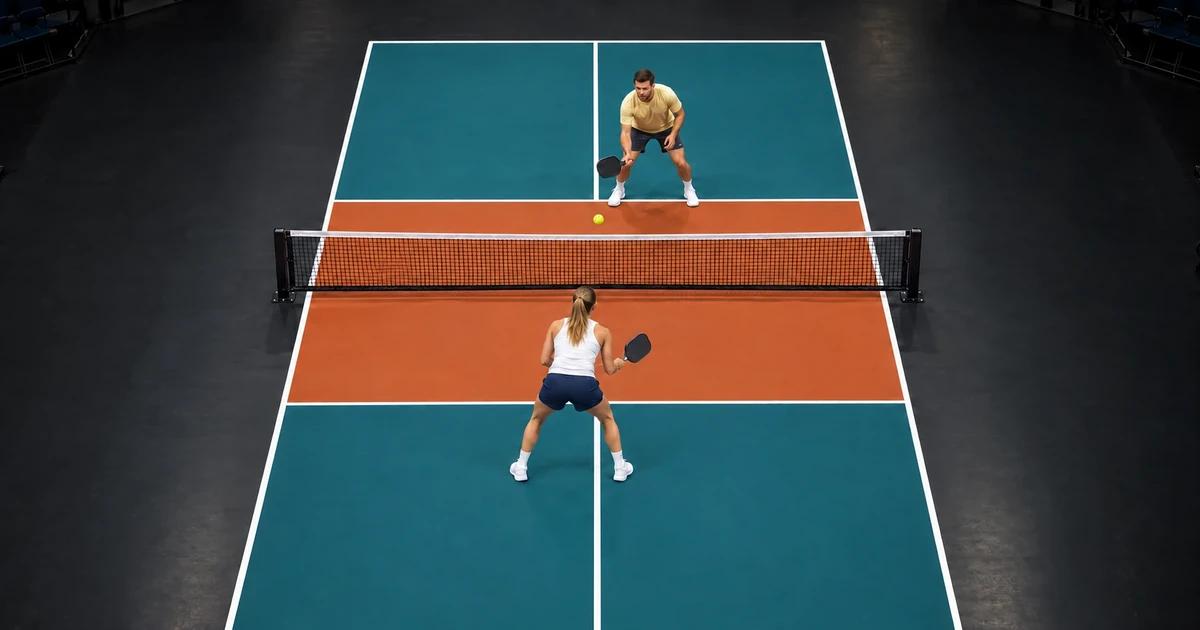
These pickleball dinking drills all use one idea: a rally of soft shots that land in the other side's kitchen, counted until someone misses. Stand at the kitchen line, 14 feet from a partner straight ahead or 17 feet across the diagonal. Seven drills follow, each with a pass mark.
A dink is a soft shot hit just over the net into the opponent's kitchen (what a dink is). The rules page has the rest of the game. The pass marks here are our suggestion, not from a study.
How far apart are you, and where must the ball land?
Stand just behind the kitchen line and the numbers are fixed. The kitchen is 7 feet deep and 20 feet wide (Rule 3.A.4.c), so two players at the back edge are 14.0 feet apart straight ahead.
For the diagonal, put each player in the middle of their half of the court width. That's 10 feet across, and the distance is the square root of 10 squared plus 14 squared, or 17.2 feet. All the figures are about, because court lines are measured to their outside edge (3.A.2).
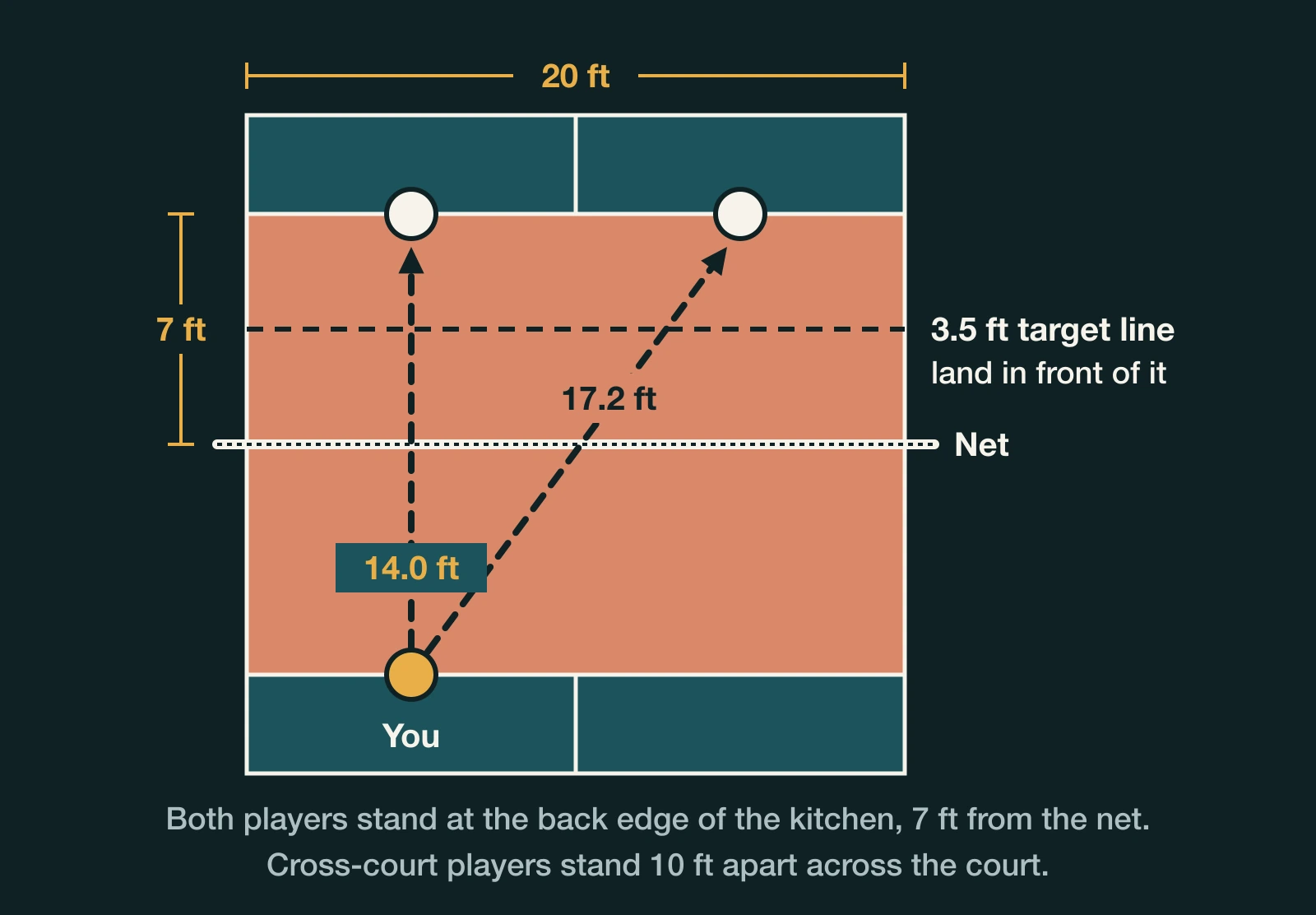
A dink that lands 3.5 feet from the net travels 10.5 feet straight and 14.5 feet cross-court. So the cross-court ball covers about 4 feet more to the same spot. A ball that lands in the kitchen, or on its line, is in play, because the lines belong to the zone (3.A.4.c).
You may stand in the kitchen between volleys, and you may hit a ball that has bounced from inside it (11.A). Stay behind the line if you will volley. See the kitchen rules.
Seven drills with pass marks
| # | Drill | Setup | Pass mark (ours) | Idea from |
|---|---|---|---|---|
| 1 | Straight rally | Both at the kitchen line, straight across, 14 ft apart | 10 dinks in a row, then 20 | Common practice |
| 2 | Cross-court rally | Diagonal, 17 ft apart | 10 in a row, then 20 | Cross-court dinks, from the USA Pickleball dink page |
| 3 | Short target | Tape a line 3.5 ft from the net across the kitchen. Land every dink in front of it | 8 of 10 | Ours (half the kitchen depth) |
| 4 | Depth switch | Alternate a short dink (in front of the tape) and a deeper one (behind it) on each side | 10 in a row, alternating | Ours |
| 5 | Figure 8 | One player always hits cross-court and the other always hits straight, which traces a figure 8 | 20 dinks in a row without breaking the pattern | PlayPickleball |
| 6 | Battleships | Cones at each player's inside and outside foot positions. Hit cross-court at the other player's cones | Play to 7, or hit a cone 6 times in 12 dinks | PlayPickleball |
| 7 | Step-in dink | A partner feeds a ball that lands short in your kitchen. Step in after the bounce, dink back, step out behind the line | 8 of 10 with both feet back behind the line before the next feed | Ours |
The figure 8 and Battleships ideas come from PlayPickleball's two-person dinking drills page (2024-03-13). In Battleships a point goes to the player who wins the rally or hits a cone, and play runs to seven. We changed the solo pass mark.
Don't move to the next drill until you pass the one above twice in a row. That's our ladder rule, and it works as a check on yourself.
Keep the ball low. USA Pickleball's dink page says the keys to an effective dink are patience and precision, with crosscourt dinks and angled placements. Keep a light hold too, around 3 to 4 out of 10 on Pickleheads' scale (how to hold the paddle).
Step-in drill 7 is legal because you may touch the kitchen at any time except while volleying (11.A). After touching it, both feet must be completely outside before you volley (11.A.3).
How do you fix the common misses?
- The ball is too high. It sits up for the other side to attack. Aim lower: USA Pickleball says to keep the ball low and controlled.
- The ball lands too deep. It lands behind the 3.5 ft tape. Drill 3 shows you this one.
- The ball goes in the net. Lift your target a little. This is a suggestion, not a rule.
A fast ball coming at you is a different problem. The reset shot page covers it.
Here's a worked example of a session log, illustrative only. Drill 3, right side: 6 of 10 land in front of the tape. That isn't a pass, so repeat it. At 8 of 10, move on to drill 4.
What do players get wrong?
- Volleying from inside the kitchen while rallying (11.A.1).
- Stepping in and volleying before both feet are back outside (11.A.3).
- Dinking only straight ahead. The cross-court ball travels about 3 feet farther between players (14.0 against 17.2 feet), so it needs more control.
- Using 21.2 feet as a shot length. That's the kitchen's corner-to-corner diagonal, and no rally uses it.
Pick drill 1 or 2, set a timer for 10 minutes and write down your best streak. For the full drill menu, see pickleball drills, and for something you can do alone, wall drills. Playing a point in the free Pickleball Game won't train a dink, but the referee calls the same kitchen faults.
Sources
- 2026 USA Pickleball Official Rulebook: Rules 3.A.2 (measuring to the outside of lines), 3.A.4.c (the kitchen, 7 feet deep, lines included), 11.A, 11.A.1 and 11.A.3 (volleying and the kitchen).
- USA Pickleball dink page: patience and precision, crosscourt dinks and angled placements, keep the ball low.
- PlayPickleball, two-person dink drills (13 March 2024): the figure 8 and Battleships drills. PlayPickleball is run with paddle maker Selkirk Sport.
- Pickleheads, how to hold a pickleball paddle (27 April 2023): a grip pressure of 3 to 4 out of 10.