Pickleball Footwork and Ready Position: A Simple Guide
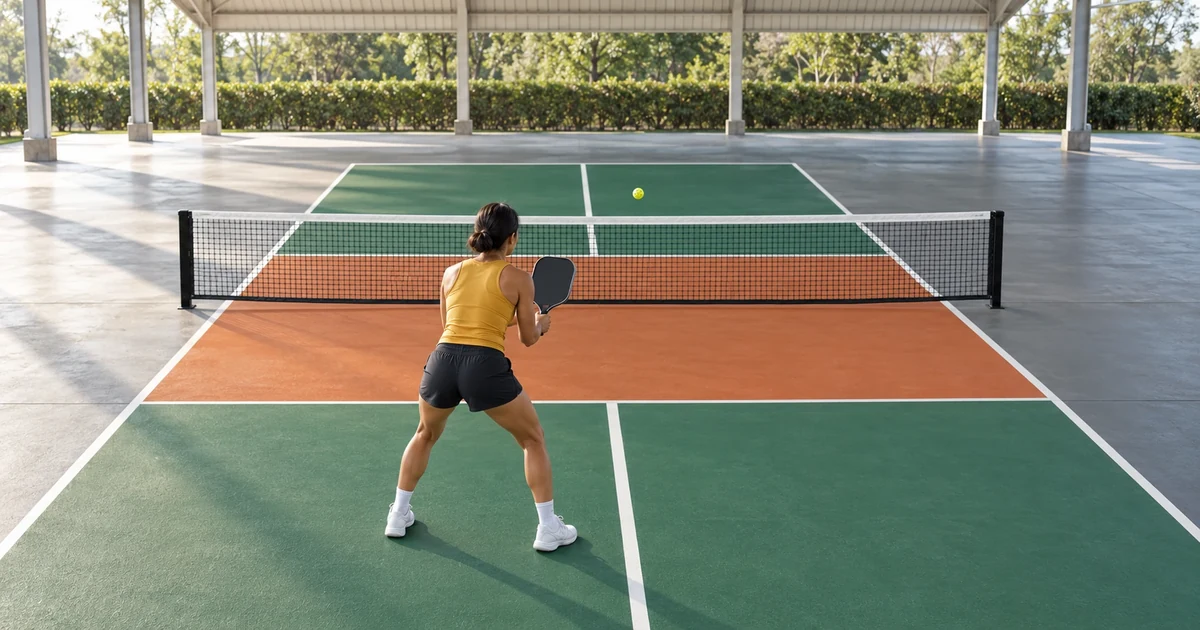
Good pickleball footwork starts from a balanced ready position: knees bent, weight on the balls of your feet, paddle up in front. Add a small hop as your opponent hits the ball, the split step, and shuffle to the ball. Between two players at the kitchen line, a 45 mph ball takes about a fifth of a second.
This page is about how to stand and move. For where to stand, see where to stand, and for the plan behind it, pickleball strategy. Everything here is coaching, not rules. No rule sets where you stand after the serve and return (5.B.4).
What is the ready position?
A balanced stance you can move out of in any direction. Bend at the knees, not the waist, as pickleball.com's footwork article puts it. USA Pickleball's split-step page asks for a wide, balanced base with your weight on your toes. Our description of the rest: paddle up in front of you, so it's ready on both sides.
What is the split step?
A small hop timed to your opponent's hit. USA Pickleball says to start the hop just before your opponent hits, be in the air as the paddle meets the ball, and land as the ball leaves the paddle. Then push off toward the ball.
How should you move to the ball?
In small, quick steps, shuffling sideways. Our rule of thumb: move your feet to the ball instead of reaching for it. The pickleball.com article describes a drill in which you may not take a step longer than a shoe length, to force small adjustments. It also says to shuffle along the kitchen line instead of turning your hips away from the net.
Sources differ on crossing your feet. USA Pickleball's kitchen line footwork page calls a crossover step on the backhand side an advanced move, and a drop step (a small step back at 45 degrees with your hitting foot) a way to make room without giving up the line. Shuffle first.
How much time do you get at each spot?
Less and less as you move forward. This table is computed for two players who stand at the same mark, with a 45 mph ball and no drag.
| Both players stand | From the net | Distance between you | Time for a 45 mph ball |
|---|---|---|---|
| 1 ft behind the baseline | 23 ft | 46 ft | about 0.70 s |
| In the transition band | 16 ft | 32 ft | about 0.49 s |
| 2 ft behind the kitchen line | 9 ft | 18 ft | about 0.27 s |
| On the kitchen lines | 7 ft | 14 ft | about 0.21 s |
45 mph is 20.1 meters a second and 14 feet is 4.27 meters, so 4.27 / 20.1 = 0.21 seconds. At 18 feet it's 0.27. Scientific American (Mark Fischetti, 1 October 2024) gives the same figure, according to engineer Phil Hipol: about 0.2 second at 14 feet and 45 mph, which the article calls pushing the limit of conscious human reaction time. A real ball slows in flight (see Pickleball Science's page on drag), so it takes a little longer than the table says.
That's why you set your stance before the ball is hit, and why the split step lands as the ball leaves the paddle.
A two-part drill with chalk
This drill is ours. No court? Use tape on a driveway and a tape measure.
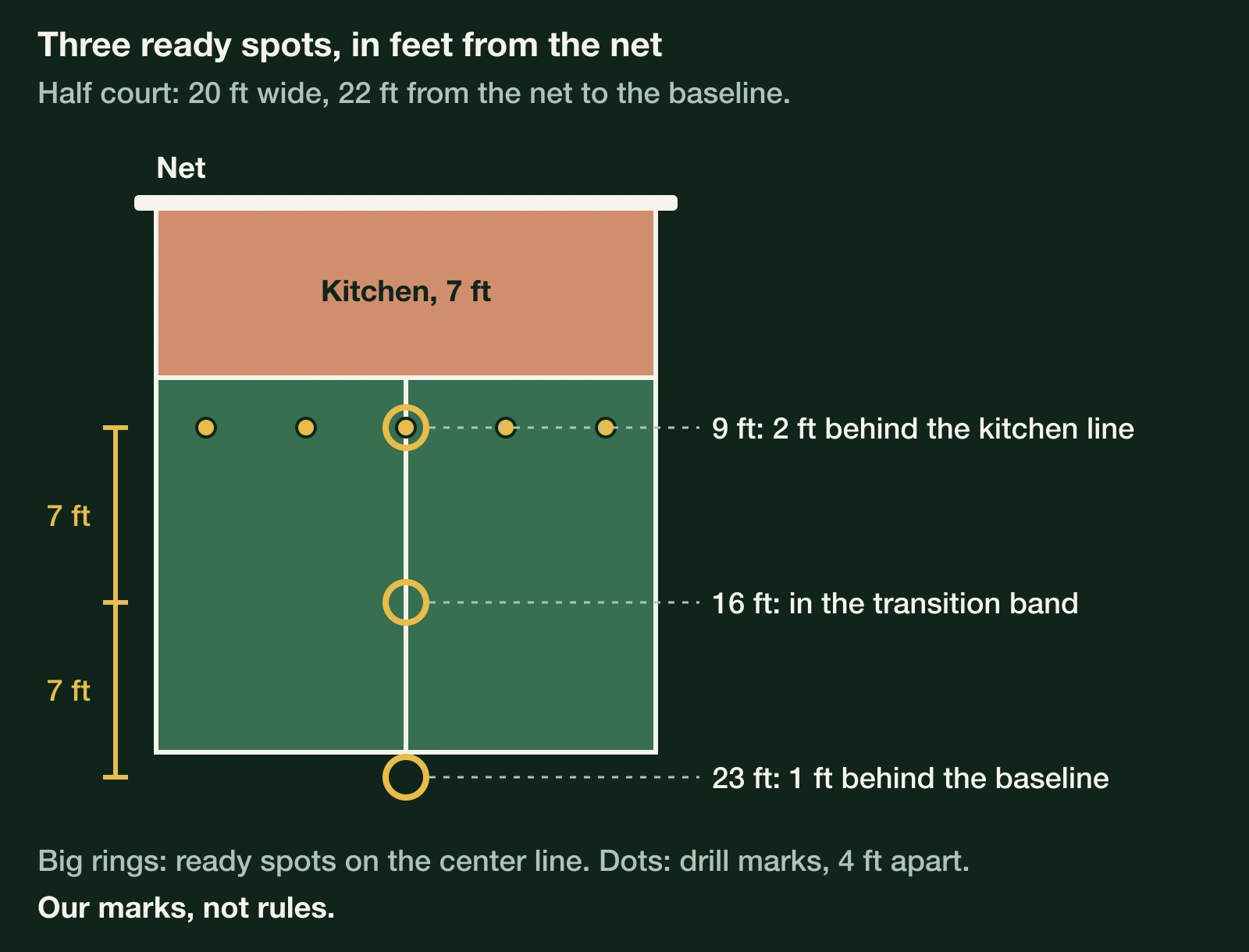
Part A, forward to the line. Mark three spots on the center line of your end, 23, 16 and 9 feet from the net (7 feet apart). Start on the 23 foot mark. On each clap, move to the next mark, split-step and hold the ready position for a count of two. Five trips.
Part B, along the line. Mark five spots 4 feet apart along the 9 foot line, at 2, 6, 10, 14 and 18 feet from one sideline. The middle one is your 9 foot mark from Part A. Start at the first mark. On each clap, split-step, shuffle to the next mark and split-step again. One lap there and back is eight shuffles.
Pass mark (ours): five laps of Part B and five trips of Part A with no crossed feet, knees bent and the paddle up at every stop. Stop if something hurts.
What must your feet respect at the kitchen?
Three rules from Section 11 of the 2026 USA Pickleball rulebook. The rules page has the rest.
- You may enter the kitchen to hit a ball that has bounced. You may not volley while you or anything you touch is in it or on its line (11.A, 11.A.1).
- Momentum that carries you in after a volley is a fault, even if the ball is dead (11.A.2). The act of volleying ends when you regain your balance or stop moving toward the kitchen.
- After touching the kitchen, both feet must be completely outside it before you volley (11.A.3).
The kitchen page has every case.
Chalk the three marks and do five trips before your next game. For more practice, try the drills, wall drills or doubles strategy. The free game moves your player with the keyboard, so use it to watch where the computer stands during a rally, not to practice footwork.
Sources
- 2026 USA Pickleball Official Rulebook: Rules 5.B.4, 11.A to 11.A.3, and the Definitions of the act of volleying and momentum.
- USA Pickleball, How to Master the Split Step for Faster Reactions: wide balanced base, timing of the hop.
- USA Pickleball, Advanced Pickleball Footwork: Crossover and Drop Steps at the Kitchen Line: crossover step on the backhand side, drop step at 45 degrees.
- Pickleball.com, a closer look at pickleball footwork with Michael Loyd: bend at the knees, the shoe-length drill, shuffling along the line.
- Scientific American, Pickleball Physics Explained, from Balls and Paddles to Shots (1 October 2024): 0.2 second at 14 feet and 45 mph.
- Pickleball Science, pickleball aerodynamic drag: a real ball slows in flight.