Pickleball Wall Drills: 6 You Can Do Alone
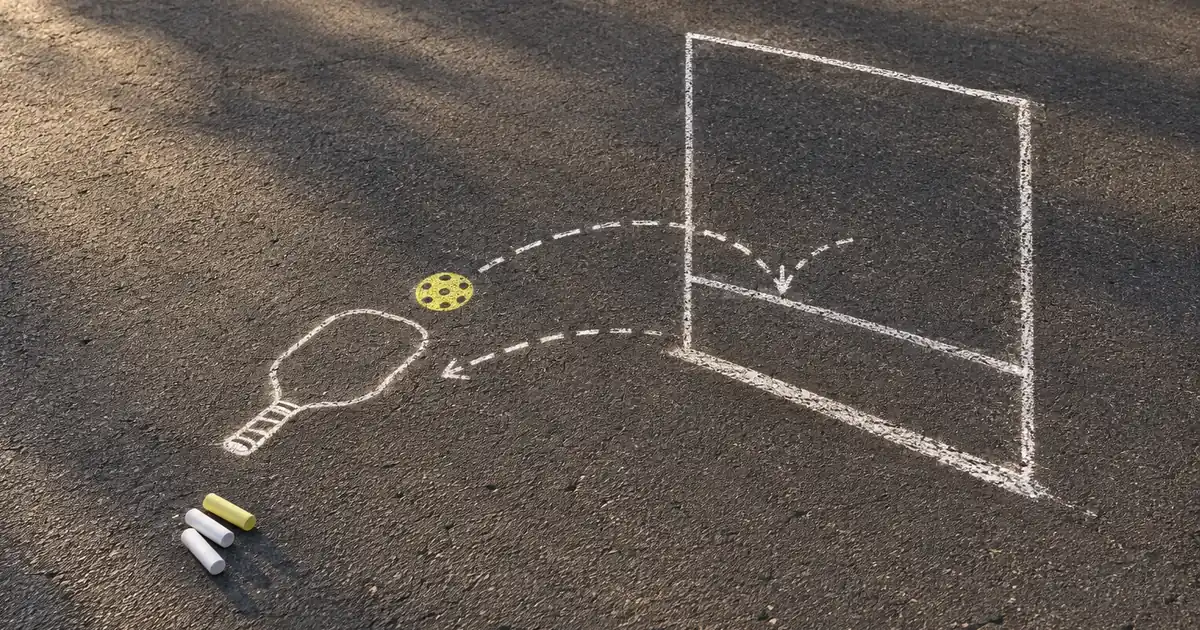
Pickleball wall drills give you free reps with no partner. Tape a line 34 inches up the wall, mark the floor 7 feet back, and hit above the line. Work through the six drills in order and move on when you hit each pass mark twice in a row. The rules page covers the game itself.
How do you set up a practice wall?
You need a flat wall, a line at net height and two marks on the floor.
- Pick a flat, hard wall with room to swing and nothing breakable near it.
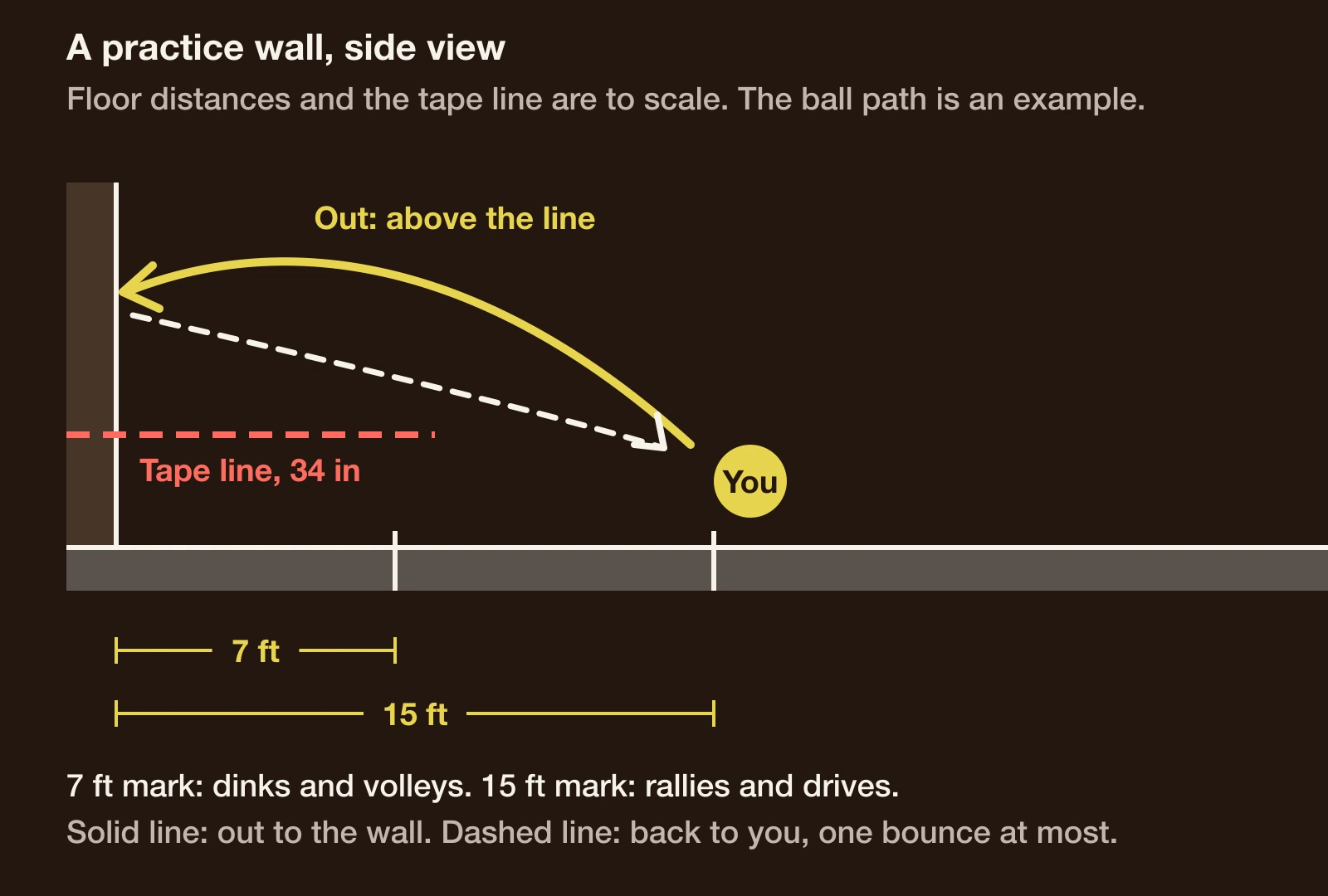
- Tape a line 34 inches (2 feet 10 inches) above the floor. That is the height of the net at the center (Rule 3.B.7). A ball that hits above the line is a ball that would have cleared the net.
- Mark the floor 7 feet from the wall for dinks and volleys. That's the depth of the kitchen (Rule 3.A.4.c).
- Mark the floor 15 feet from the wall for rallies and drives. That's our own choice. It equals the distance from the kitchen line to the baseline, and the court dimensions show why.
- Count only balls that hit above the line and that you return before the second bounce (Rule 10.B).
Stand just behind the mark, not on it. Use a ball you don't mind scuffing.
Where can you find a wall?
Look for a blank, hard, flat wall, and ask first. Check whether your local tennis courts have a practice wall. A garage wall, a door or a school wall can work too. A window, a car or a shared fence can't.
A pickleball is loud on a hard wall. Ask the neighbours and pick your hours.
The six-drill ladder
Start at the top and move down when you hit the pass mark twice in a row.
| Drill | Stand | What you do | Pass mark |
|---|---|---|---|
| 1. Forehand rally | 15 ft | Hit forehands above the line. Let the ball bounce once, or hit it out of the air if it comes back high. | 20 in a row |
| 2. Backhand rally | 15 ft | The same, backhand only. | 20 in a row |
| 3. Forehand and backhand | 15 ft | Alternate forehand and backhand as the ball returns. | 20 in a row |
| 4. Wall dinks | 7 ft | Soft arcs just above the line. Let it bounce once, then dink again. | 15 in a row |
| 5. Wall volleys | 7 ft, just behind the mark | Hit every ball out of the air with short, compact swings, above the line. | 15 in a row |
| 6. Drive then reset | 15 ft | One firm drive, then one soft block above the line, and repeat. | 10 pairs without a miss |
The pass marks are our own starting targets. Raise them when you clear them twice. No pass mark is a rule, and a wall returns the ball at your pace, not an opponent's. The drills page lists drills 1, 4 and 5 in one line each, next to the partner and group drills. A wall rally is also one of the four tests in how to get better at pickleball, which turns the results into a four-week plan.
Here is drill 4 from the 7-foot mark. You hit 12 dinks above the line in a row and miss the 13th. That's a streak of 12. Your pass mark is 15, so you stay on drill 4 and try again.
What a wall can't teach
It can't move you, it can't pick a corner against you, and there's no score or kitchen to watch. The footwork and ready position guide covers how to stand and move, with a chalk-line drill you can do on a court or driveway. For a full solo session, see playing pickleball by yourself. To practise points and scoring, the free browser game plays full matches against the computer.
Common questions
Do wall drills help pickleball?
A wall trains contact and repetition. We found no study measuring how much it helps, so treat it as practice, not proof.
Can you practice pickleball against drywall?
It's a wall, so yes, but a ball marks paint, can dent thin drywall and is loud. Ask the owner first. A masonry or concrete wall is the better choice.
Tape the line tonight and do drill 1 for five minutes tomorrow. Write down your best streak. When you're ready to work on your serve, take a bucket of balls to a court, since a wall can't judge where a serve lands. For a week-by-week start, see pickleball for beginners.