How Long Is a Pickleball Game? Points and Time
How long a pickleball game lasts depends on the score, not a clock. A game goes to 11 and must be won by 2, and most sites put that at about 15 to 25 minutes. The only measured figure we found is for pros: 36 minutes for a whole match. The rules page has the full rules.
How many points is a game?
Usually 11, and you must lead by at least 2 (Section 1 of the 2026 USA Pickleball rulebook). Tournaments also play to 15 or 21, or best 2 of 3 or 3 of 5 games to 11 (Rule 15.C.1). How scoring works is on the scoring page.
| Format | Points to win | Players change ends | Rule |
|---|---|---|---|
| Standard game | 11 | At 6 (tournament rule only) | Section 1, 21.B.1 |
| One game to 15 | 15 | At 8 | 15.C.1.c, 21.B.2 |
| One game to 21 | 21 | At 11 | 15.C.1.c, 21.B.3 |
| Best 2 of 3 or 3 of 5, games to 11 | 11 per game | Between games; a tie-breaker game also at 6 | 15.C.1.a, 15.C.1.b, 21.B.1, 21.F.2 |
| Rally scoring game (optional, provisional) | 11, 15 or 21 | At 6, 8 or 11 | 15.C.2.a, 21.B |
| Bad-weather game (director's call) | 7 | At 4 | 15.C.2.d |
At 10-10 play goes on until someone leads by 2, with no cap, so 12-10 and 13-11 are normal. A game can't end 11-10. Win by two applies to the tournament formats too (Rule 15.C), except team play.
Changing ends and time-outs are in the tournament part of the book, which says its rules apply to tournament play only. The standard rules have no end change, so a friendly game need not stop at 6. After an end change the same server continues (Rule 21.B.4).
Why it takes the time it takes
Time is rallies multiplied by the time each rally takes, and the score fixes the rally count. In side-out scoring, every rally ends in either a point for the server or a side out. So in singles, rallies equal points plus side outs.
Here is one singles game to 11 that ends 11-9. Player A serves first. We counted it with a script.
| Serving turn | Server | Points won that turn | Score after (A-B) |
|---|---|---|---|
| 1 | A | 0 | 0-0 |
| 2 | B | 0 | 0-0 |
| 3 | A | 1 | 1-0 |
| 4 | B | 0 | 1-0 |
| 5 | A | 0 | 1-0 |
| 6 | B | 2 | 1-2 |
| 7 | A | 0 | 1-2 |
| 8 | B | 2 | 1-4 |
| 9 | A | 0 | 1-4 |
| 10 | B | 0 | 1-4 |
| 11 | A | 6 | 7-4 |
| 12 | B | 4 | 7-8 |
| 13 | A | 1 | 8-8 |
| 14 | B | 0 | 8-8 |
| 15 | A | 0 | 8-8 |
| 16 | B | 1 | 8-9 |
| 17 | A | 3 | 11-9 |
That's 20 points and 16 side outs, so 36 rallies. A turn that wins 0 points is one lost rally and a side out.
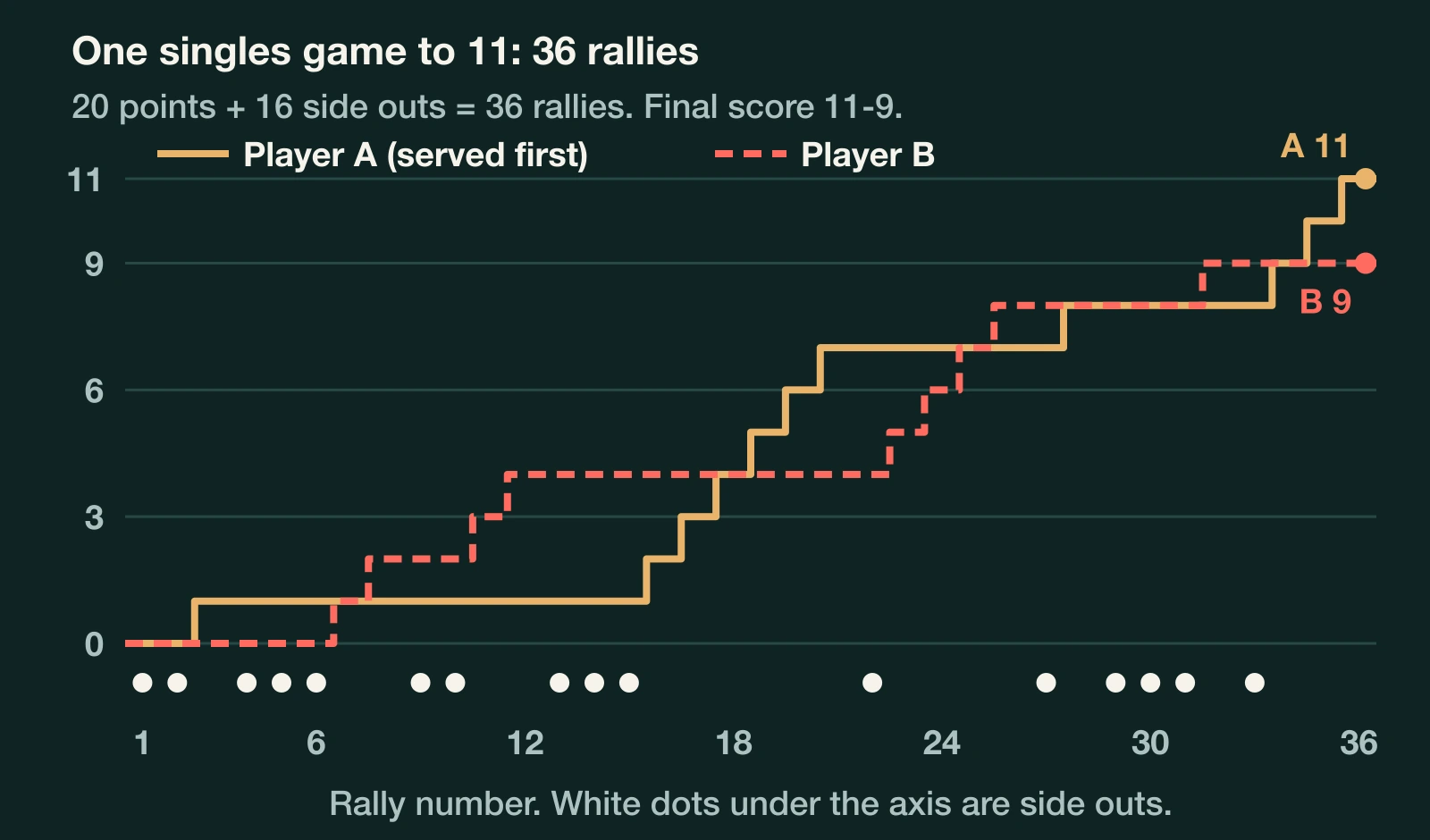
With rally scoring the same 11-9 score is exactly 20 rallies, because every rally is a point (Rule 14.A.2). Now multiply by the time per rally, including the pause before the next serve.
| Time per rally | 36 rallies (side-out scoring) | 20 rallies (rally scoring) |
|---|---|---|
| 30 seconds | 18 minutes | 10 minutes |
| 40 seconds | 24 minutes | 13 minutes |
| 50 seconds | 30 minutes | 17 minutes |
| 60 seconds | 36 minutes | 20 minutes |
That's arithmetic, not a measurement, and the seconds are examples. The 15 to 25 minutes most sites quote fits 36 rallies at about 25 to 42 seconds each. Your game will be different, so time your next one and divide by the rallies. How the other format works is on the rally scoring page.
What the pros show
A 2025 study timed 8 professional men's doubles matches from two PPA Tour events (Lozano and colleagues, International Journal of Performance Analysis in Sport). Matches averaged 36 minutes, and the ball was in play for 14 of them, 39 percent. Rest took 1.6 times as long as play. Most points lasted 3 to 9 seconds. That's pro doubles, not a recreational norm.
How long can the breaks be?
Time-outs are 1 minute each, and the end change is at most 1 minute. This is the most the rulebook allows, not what players take (Rules 21.A, 21.B.5, 21.F.1, 21.G).
| Break | Longest allowed |
|---|---|
| Time-outs in a game to 11 or 15 (2 per side) | 4 minutes |
| Time-outs in a game to 21 (3 per side) | 6 minutes |
| End change inside a game | 1 minute |
| Between games | 2 minutes |
| Between matches | 10 minutes |
A single game to 11 with every break used adds at most 5 minutes. A best-of-three that goes three games adds at most 17: 4 minutes of time-outs in each of the three games, 1 for the end change in the third, and 2 between each pair of games.
Common questions
Is pickleball a 2 or 4 person game?
Either. Singles has two players and doubles has four (Section 1). The singles rules and doubles rules differ in serving and scoring.
Who serves first?
A fair method picks who chooses first, such as a coin toss (Rule 17.C.4, written for tournaments). The first serving team in doubles starts at 0-0-2.
Time your next game with a phone. Note the minutes, count the rallies from the score (points plus side outs) and divide. That's your own seconds per rally. The free browser game shows the score call on screen, so you can count rallies there too.