Pickleball Topspin: How to Hit It and Is It Legal?
Pickleball topspin is legal on every shot, serve included. You hit it by swinging low to high and brushing up the back of the ball. On a serve you may spin the ball at paddle contact, but you may not add spin with your hand or paddle while releasing it (Rule 7.B.2).
The rules page covers the rest of the game. This page covers the spin: what the serve rule allows, what topspin does, how to hit it and a wall drill.
Is a topspin serve legal?
Yes, if the spin comes from the paddle hitting the ball. Rule 7.B.2 of the 2026 USA Pickleball rulebook says some natural rotation is expected when you release the ball. You can't manipulate the ball with your body or the paddle to add spin before you hit it. The one exception is that the ball may roll off the face of the paddle by gravity. Spin may be applied on contact. Older guides may cite the 2025 number for this rule, and the plain-English list of 2026 rule changes matches the old and new numbers.
If the receiver decides you added spin on the release, they can call for a replay, but only before returning the serve (Rule 7.B.2.a).
On a volley serve, the paddle must move in a clear upward arc at contact, the paddle head must clearly not be above the wrist, and the ball must clearly be no higher than the waist (Rules 7.C.1 to 7.C.3). An upward brush goes the same way as that arc. A drop serve has its own rule (7.D). The serving rules cover the rest, and how to serve walks through the motion.
What does topspin do to the ball?
It pulls the ball down, so you can hit it a little higher over the net and still land it in. USA Pickleball says topspin makes the ball dip and jump forward off the bounce.
One physics study backs the dip. In a Tennis Warehouse University study of pickleball aerodynamics, Crawford Lindsey found topspin produced a stronger downward force than backspin produced upward force at the same spin. It's one study from one source, and none of its numbers carry over to your game.
A flat shot gives more speed for the same swing and less margin over the net. Which one is better depends on the shot. That's advice, not a rule.
How do you hit topspin?
These steps follow USA Pickleball's topspin dink guide.
- Get the paddle under the ball. You won't get topspin if you start on top of it.
- Swing low to high, brushing up the back of the ball like a windshield wiper.
- Make contact in front of you.
- Finish over the top of the ball.
USA Pickleball adds that you should only hit topspin dinks when you're balanced at the kitchen line with the ball out in front of you, not when you're off balance or on the run.
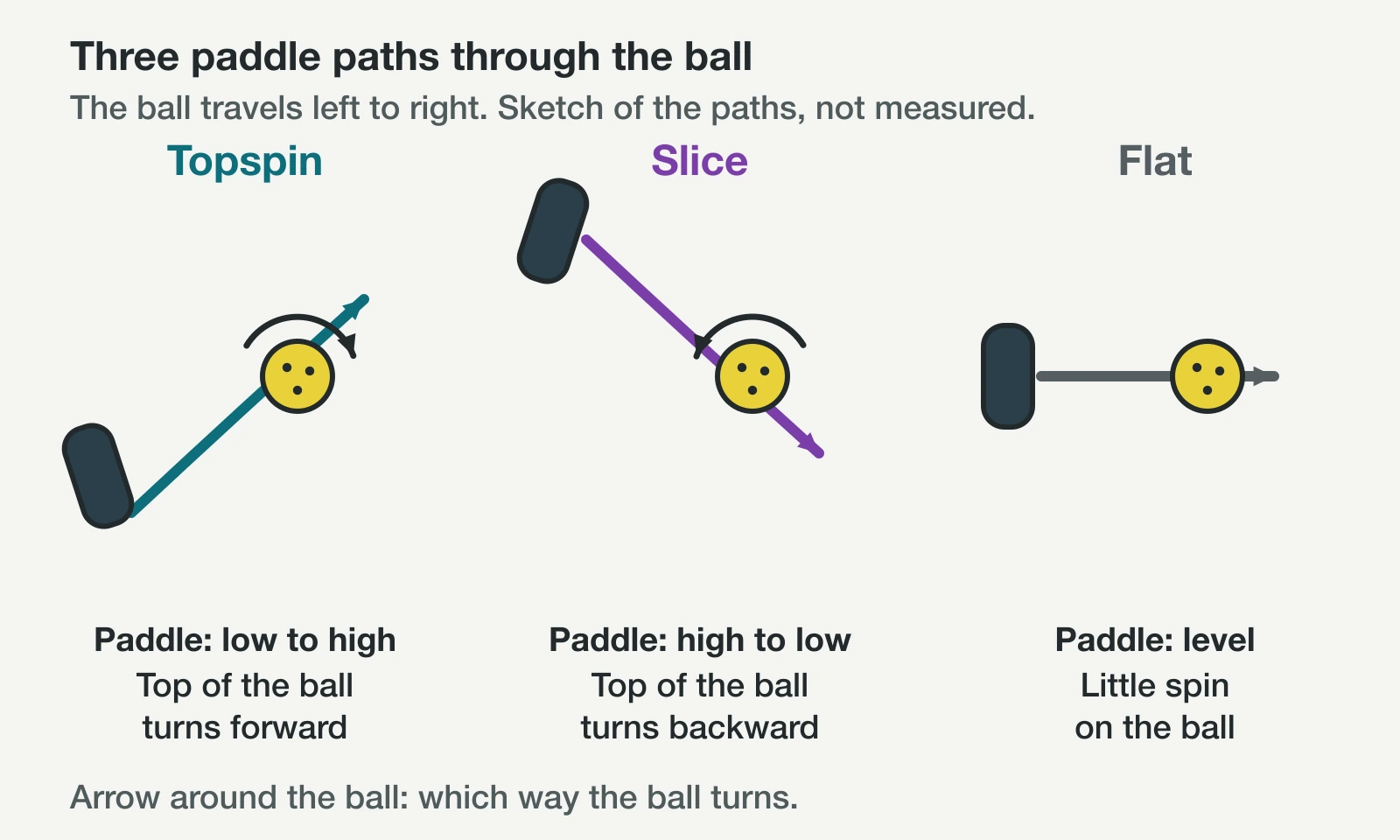
A slice goes the other way: the paddle travels high to low under the ball and puts backspin on it. A flat shot is level through the ball. The drawing is a sketch of the paths, not a measurement.
Does a rough paddle add spin?
Rough texture isn't legal. Rule 3.D.5 bans rough texturing, sandpaper characteristics, anti-skid or spin paint and anything else that adds excessive spin to the hitting surface.
A second Tennis Warehouse University study of pickleball spin found that when a ball hits at a steep enough angle, all paddles produce the same spin whatever their surface roughness. Most shots in play, it said, hit at that kind of angle.
USA Pickleball also tests spin directly. Beginning 1 October 2026, paddles submitted for certification must measure 2,100 rpm or less in its spin rate test.
A wall drill to learn the brush
This drill is our own, not from a study. You need a wall, a ball and a pen.
- Draw a stripe around the middle of the ball.
- Stand about 8 feet from the wall. The wall drills page has a full setup.
- Hit the ball to the wall with a soft, low-to-high swing.
- Watch the stripe. On topspin the top of the ball turns forward as it travels away from you.
- Pass mark, also ours: 8 of 10 balls where the stripe turns forward and the ball comes back without rising above your head.
- Repeat with a level swing, then a high-to-low swing, and watch the stripe turn differently.
Three mistakes show up often. Spinning the ball with your hand or paddle as you release a serve isn't allowed, and the receiver can call a replay. Swinging so hard your finish goes high sends the ball sailing. And trying topspin on a ball you aren't set for pops it up.
Run the drill for five minutes and count to the pass mark. For a topspin dink, see the dink article. You can also practice your serve in a free game against the computer.