Pickleball Etiquette and Open Play: How to Join a Game
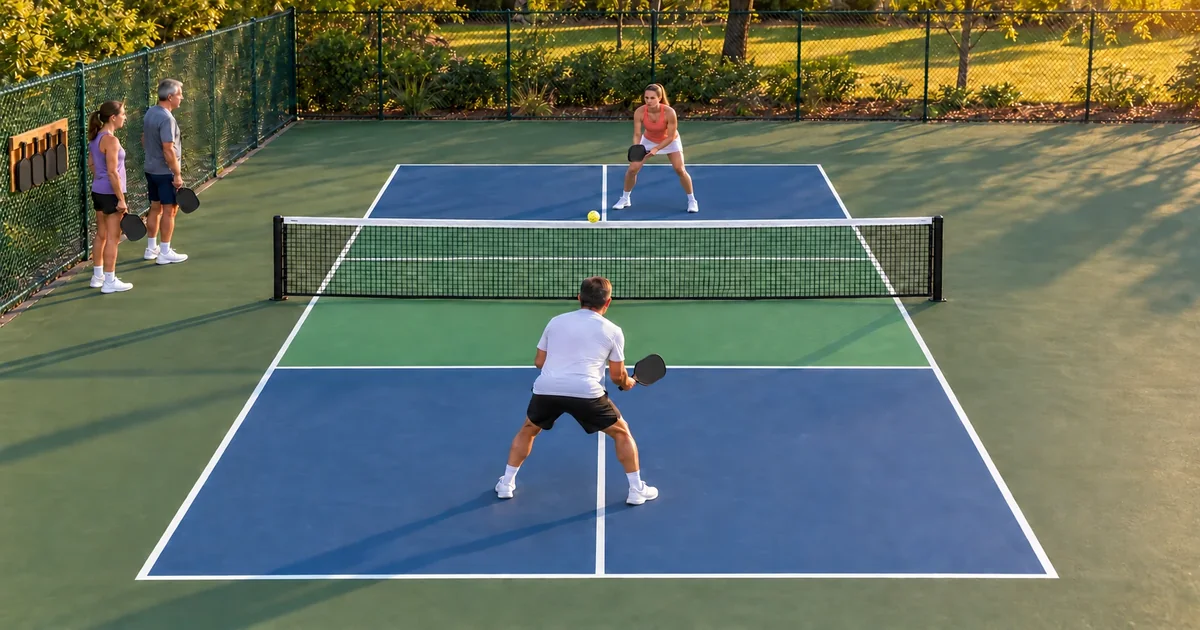
Pickleball etiquette at open play comes down to a few habits: join the paddle queue, be ready when your turn comes, make honest line calls and warn others about stray balls. The rulebook asks for courtesy and fair play. The queue and the rotation are local custom, so ask the courts you use.
The rules page covers the rules themselves. This page tags every habit with where it comes from. Rule is a numbered rule in the 2026 USA Pickleball rulebook. Principle is from the rulebook's Underlying Principles. Guide is USA Pickleball's Sportsmanship Guide. Custom is a local habit that you should check.
How does open play work?
Open play is a drop-in session. You show up, put your paddle in the queue and play with whoever is next.
It is custom, not rule. The 2026 rulebook says nothing about queues, paddle racks or rotation. USA Pickleball's guide says to rotate on and off courts fairly and courteously, "in accordance with local practice."
How much that practice varies is easy to see:
- PlayPickleball's open play page (July 2024) says to look for a paddle holder and add your paddle in line. At some courts winners stay on, and at others four new players come on every game.
- Pickleheads' guide to organizing open play (July 2023) names two common formats: open rotation, "4 on, 4 off", and challenge courts, where the winner stays on.
- The city of Coppell, Texas, publishes its own open play rules. After each game the winners put their paddles in a "Victors" rack and the losers in a "Challengers" rack. That is one city's policy, not a national rule.
So read any posted sign, or ask the person running the courts, before you put your paddle down.
What happens to the queue?
Take eight players, A to H, and one court. A and B play C and D. The queue is E, F, G, H, with E first. Here are two common ways it can go. Both are examples of custom.
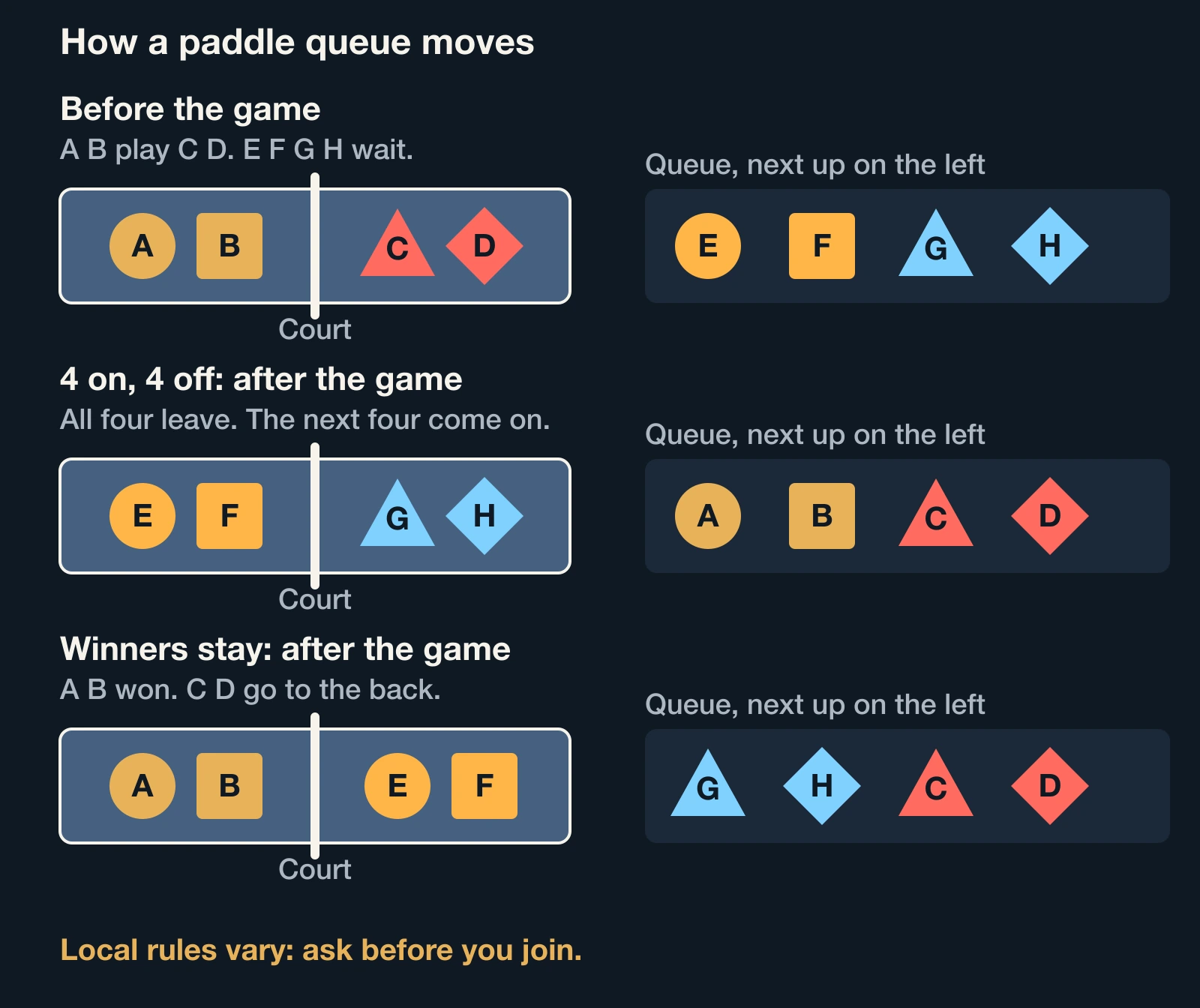
In words:
- 4 on, 4 off. The game ends and all four players leave. E and F play G and H. A, B, C and D join the back of the queue. Everyone sits out every second game.
- Winners stay. A and B win and stay. E and F come on. C and D go to the back, so the queue is G, H, C, D. If E and F win the next game, they stay, G and H come on, and A and B go to the back. The queue is then C, D, A, B.
Some courts limit how long winners can stay. Pickleheads suggests, as an example, that a team that wins three games in a row gives up the court. It also describes a version where winners play one more game but split up to take partners from the queue.
If you arrive with three friends and want to play together, PlayPickleball says you can stack your four paddles together in the line.
Which habits are rules, and which are manners?
| Habit | What it says | Where it comes from |
|---|---|---|
| Call close balls in your opponents' favor | A ball is out only if you clearly see space between it and the line. Doubt means in. See line call rules | Rule 8.D, 8.E |
| Call your own faults | Call a fault on yourself or your partner as soon as it happens | Rule 9.B.2, Guide |
| Show you're not ready with a signal | Paddle above your head, your free hand above your head, or your back turned to the net, before the score call starts | Rule 6.A.1 |
| Don't distract the hitter | The rulebook lists loud noises, stomping and waving the paddle around | Rule 10.F, Definitions |
| Deal with stray balls | A ball from another court that hinders you stops the rally and it is replayed. If your own ball heads for another court, shout "ball" | Rule 9.C, Hinder definition, Guide |
| Wear something that isn't ball-colored | Avoid clothing that closely matches the ball | Principle |
| Don't argue calls | Question a call only respectfully. Officiated play uses an appeal to a referee | Principle, Guide |
| Don't jump the queue | Don't rearrange paddles to move someone up, don't call a lower score or start a second game to stay on, and be ready when your turn comes | Guide |
| Greet people | Introduce yourself to players you don't know and meet the other team at the net after each game | Guide |
| Go easy on weaker players | Avoid hitting excessively to a weaker player. Give advice only when asked | Guide |
| Cross courts carefully | Wait until play stops, then cross quickly in a single group | Guide |
| Ask about local rules and warm-up time | Queue rules differ. Coppell asks for no more than 90 seconds of warm-up when courts are full | Custom |
Two rulebook points surprise people. It treats a stray ball as a hinder, and a called hinder means a replay (Rule 9.C.2), not a point for either side. And it leaves most faults to the player who committed them. A player may mention a fault after the rally, but the final decision belongs to the player who allegedly committed it (Rule 9.B.4). Non-volley zone faults and service foot faults are the exceptions: you may call those on an opponent (Rule 9.B.3).
The faults page lists them.
What are round robin and king of the court?
In the rulebook, a round robin is a tournament format. All singles players or doubles teams play each other, and the winner has the most matches won (Rule 15.B.4). Teams stay fixed.
Social groups often use the name for something else: rotating partners. Pickleheads describes a "switch doubles" round robin, where players rotate partners through a set number of rounds so each plays the same number of games. It also describes a "teams" round robin, where partners stay together.
Here is a switch-doubles schedule we worked out and checked ourselves. It has eight players, A to H, two courts and seven rounds. Every player partners every other player exactly once and plays each opponent exactly twice. Everyone plays all seven rounds.
| Round | Court 1 | Court 2 |
|---|---|---|
| 1 | A B vs C D | E F vs G H |
| 2 | A E vs B F | C G vs D H |
| 3 | A G vs B H | C E vs D F |
| 4 | A C vs E G | B D vs F H |
| 5 | A F vs C H | B E vs D G |
| 6 | A H vs D E | B G vs C F |
| 7 | A D vs F G | B C vs E H |
King of the court has no single definition. One club's published version uses several courts and 12-minute games. Winners move one court toward the top and split from their partner. Losers move the other way and split too. Winners on the top court stay and split, and losers on the bottom court stay. Ask what a group means before you join.
Two meanings of "stacking"
Paddle stacking means lining up paddles for the next game, as above. Stacking on a doubles court is a way of choosing who starts on which side. It is a separate idea with its own page: what is stacking in pickleball.
Your first visit
Do these five things:
- Watch two games and see how players rotate.
- Find the rack, or ask who runs the queue, and ask what the local rules are.
- Put your paddle in.
- Say your name to your partner and to the other side.
- Call the score out loud before each serve. The scoring guide has the calls, and the doubles rules show who serves.
New to the game? The first-week plan gets you ready for a first session, and how to play pickleball covers the basics.
You can also play a free game in your browser first. You face the computer at Low, Medium or Hard, singles or doubles, with keyboard and mouse, and the referee calls faults under the 2026 rules. It won't teach queues or manners, but you can practice the serve order and the score call before you walk onto a court.
Sources
- 2026 USA Pickleball Official Rulebook: Rules 6.A.1, 8.D, 8.E, 9.B.2 to 9.B.4, 9.C.2, 10.F, 15.B.4, and the Underlying Principles in Section 1.
- USA Pickleball Sportsmanship Guide: conduct habits for open play.
- PlayPickleball, pickleball court etiquette for public open play: how paddle queues work. PlayPickleball is run with paddle maker Selkirk Sport.
- Pickleheads, how to organize pickleball open play: switch-doubles and teams round robins.
- City of Coppell, Texas, Pickleball open play rules: a local example of queue and warm-up rules.
- Community Pickleball Club, King/Queen of the Court: one club's version of the format.