How to Choose a Pickleball Paddle: 5 Questions to Ask
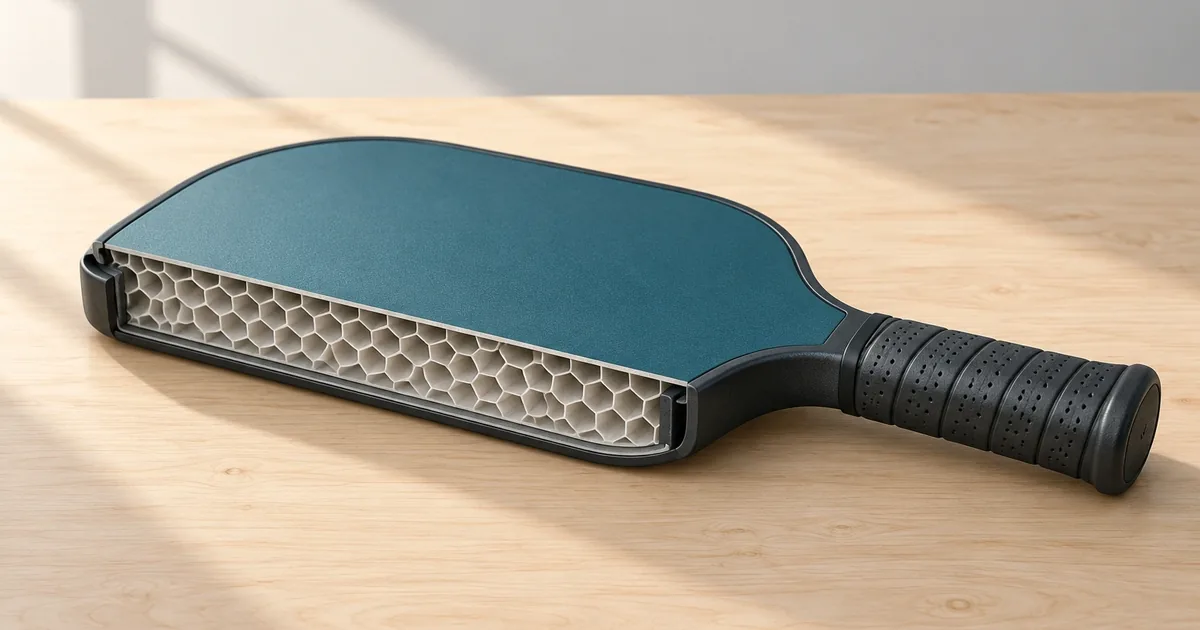
To choose a pickleball paddle, check the rules first: every legal paddle meets two size limits (17 inches long at most, 24 inches for length plus width), and weight and thickness are free. Then decide on feel: weight, thickness, shape and grip size. Try before you buy. The table below turns five questions into things you can test.
This page has no brands or prices on purpose. It won't pick a product for you, and it can't tell you which paddle is "best". It tells you what to check. The paddle rules are in Section 3.D of the 2026 USA Pickleball rulebook, and the rules page covers the rest.
What is the first thing to check?
That the paddle is legal. A paddle may be at most 17 inches long, and its length plus width, counting the edge guard and butt cap, may be at most 24 inches (Rule 3.D.2). If you plan to play in sanctioned tournaments, it also has to be on USA Pickleball's approved list (Rule 18.A). The paddle size and legal limits page covers how to measure one and what "approved" means.
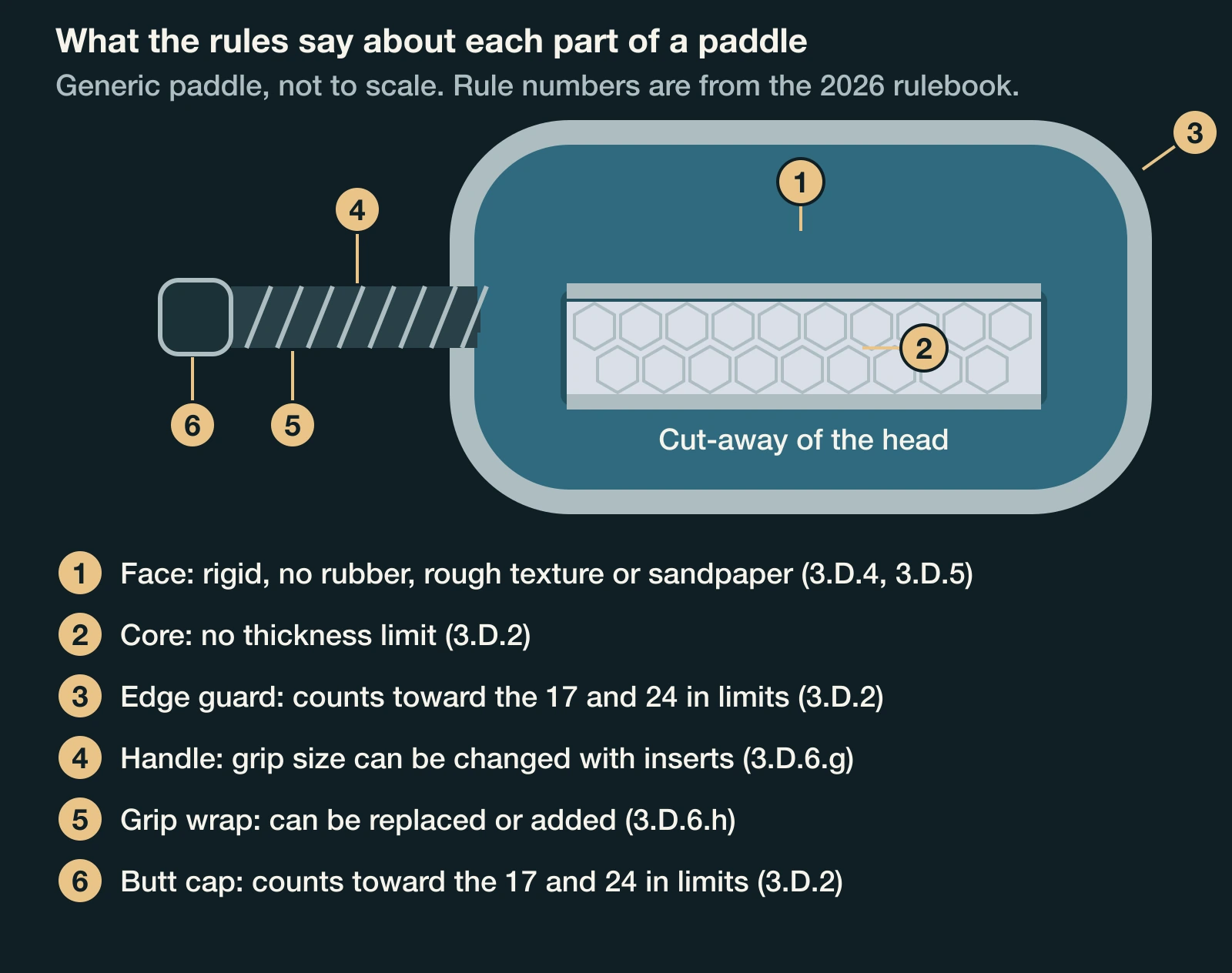
The drawing shows what the rulebook says about each part: the face (Rules 3.D.4, 3.D.5), the core (no thickness limit, Rule 3.D.2), the edge guard and butt cap (counted in the 17 and 24 inch limits, Rule 3.D.2), and the handle and grip wrap (adjustable, Rules 3.D.6.g, 3.D.6.h).
The five questions
Each row gives what the rules say and a test you can run before you pay.
| Question | What the rules say | A test before you buy |
|---|---|---|
| 1. Is it legal and listed? | Size limits (3.D.2). Approved list for sanctioned play (18.A). | Measure it. Search the model name on the approved list before you pay. |
| 2. How heavy? | No weight limit (3.D.3). | Read the paddle weight page, then swing two different weights for a few minutes each. |
| 3. How thick is the core? | No thickness limit (3.D.2). | Rally 10 minutes with a thicker paddle and 10 with a thinner one. Note which gave you fewer mishits. |
| 4. What shape and face? | Shape is free inside 17 and 24 inches (3.D.2). The face must be rigid and non-compressible (3.D.4), with no rubber, rough texture or sandpaper (3.D.5). | Try a standard outline and a longer one. Compare your reach and where the ball feels solid. |
| 5. What grip size? | Grip size can be changed with inserts (3.D.6.g) and grip wrap (3.D.6.h). | Hold it in your normal grip. If you squeeze hard to keep it steady, the handle may be too narrow. |
A longer outline leaves less room under the 24 inch total. A paddle that is 17 inches long can be at most 7 inches wide.
Should you pick a 14 mm or a 16 mm paddle?
Either. The rulebook has no thickness limit (Rule 3.D.2), so both are legal. It says nothing about which is better, and this page cites no test, so it makes no claim. Test both back to back, as in question 3.
One neutral fact about power. Every approved paddle has to pass the same surface roughness and power limits in the Equipment Standards Manual (Sections 2.E.2 and 2.E.6.f, revision 3.0, January 2025). We draw no conclusion from that about which paddle suits you.
Does shape or material matter?
The rules set only the limits above. Shape is free within the two size tests. The face must be rigid and non-compressible, and it can't have the surface features listed in Rule 3.D.5. Beyond that, anything a listing says about a face material or shape is the seller's description. Check it by trying the paddle.
What grip size should you pick?
One you can hold without squeezing hard. Harvard Health's article on pickleball elbow (1 September 2023) says the handle shouldn't be so narrow that you squeeze it too tightly. The rules let you thicken a grip with inserts and wrap (Rules 3.D.6.g, 3.D.6.h), so a handle that is a little small can be adjusted.
This page is general information, not medical advice. Harvard Health's article says that if pain doesn't go away, you should see an orthopedic surgeon.
A 20-minute test before you buy
This is our plan, not a standard. Ask to borrow or demo two paddles, and run each through the same four blocks:
- 5 minutes of dinks.
- 5 minutes of drives.
- 5 minutes of volleys.
- 5 minutes of serves.
Note arm comfort, mishits and control. The pass mark is a comparison. At the end you should be able to say which paddle you'd keep, and why. A warm-up first is a good idea.
A worked example, with made-up numbers: a listing says "16 mm core, 16.5 by 7.5 inch outline, 4 inch grip". Run it through the table. It is legal, because 16.5 + 7.5 = 24.0 and the length is under 17. Thickness and shape are choices. The grip depends on your hand.
What to skip
- Price as a proxy for quality. The rules say nothing about price, and we cite no test that ties price to play.
- Marketing words as measurements. "Control" and "power" are descriptions. Weight, thickness and grip are numbers you can check.
- Changing paddles every month. That's our view. Without a change in your game, you can't tell what a new paddle did.
Mistakes to avoid
- Choosing before you check that the model is legal.
- Forgetting that a longer outline pushes the total toward 24 inches.
- Picking a grip that is too narrow.
- Skipping the test.
To start, pick the one question in the table you can't answer yet and test that one first. New to the game? Pickleball for beginners and how to play pickleball cover the basics. Once you have a paddle in hand, you can play a game free in your browser.
Sources
- 2026 USA Pickleball Official Rulebook: Rules 3.D.2 (size), 3.D.3 (weight), 3.D.4 and 3.D.5 (face), 3.D.6.g and 3.D.6.h (grip changes), 18.A (approved paddles in sanctioned play).
- USA Pickleball Equipment Standards Manual (revision 3.0, January 2025): Sections 2.E.2 and 2.E.6.f, the surface roughness and power limits.
- USA Pickleball approved paddle list: the list a paddle must be on for sanctioned play.
- Harvard Health, How to avoid this common pickleball injury (1 September 2023): the handle shouldn't be so narrow that you squeeze it too tightly; see an orthopedic surgeon if pain doesn't go away.